




























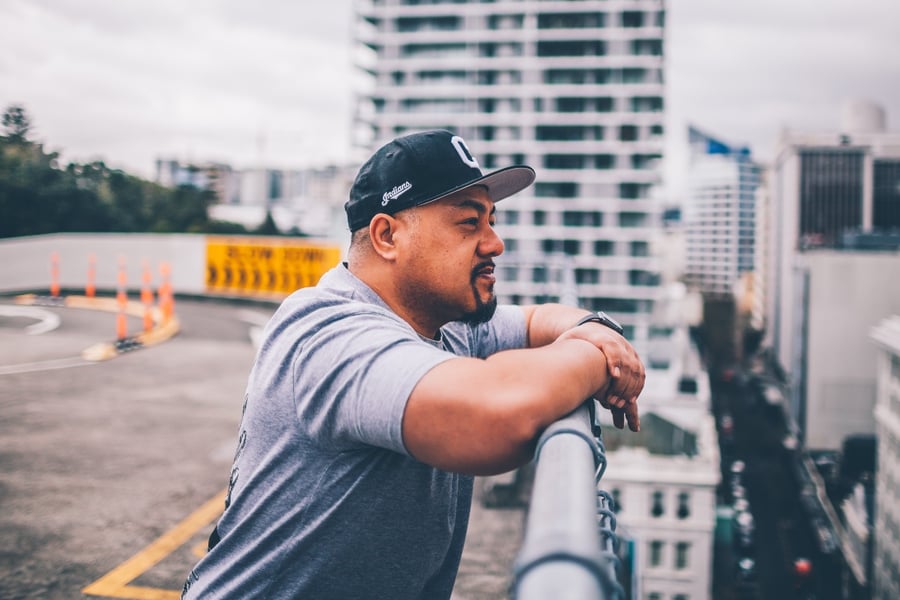
Despite what you might think, Ché Fu never saw himself as a leader. However, in the wake of the success of his debut solo album 2b S.Pacific in 1998, the celebrated Māori Niuean singer-songwriter, producer, and DJ realised he would have to become one if he wanted to fully realise the music that lived inside his head. The process that followed was hard work, but it paid off.
When he released his second album, Navigator, in 2001, Ché completely reset the benchmarks of success for local hip-hop, R&B, and reggae with a set of songs that caught the spirit of the times.
From the silky-smooth neo-soul of “Misty Frequencies” to the singalong electro-reggae shuffle of “Fade Away” and the post-Neptunes bop of “Random”, the album became a defining summer soundtrack from Tāmaki Makaurau Auckland to Ōtepoti Dunedin.
Two and a half decades later, Navigator’s guiding stars — identity and resilience, unity and hope — remain as relevant as ever. And as the moons have come and gone, and the accolades and influence have piled up, he has been indelibly etched into our musical history books as one of Aotearoa’s most influential voices.
Today, Ché can feel like a myth, but he walks amongst us as well. In his heart, he’s still the five-year-old boy who watched Bob Marley perform from the side of the stage in Western Springs Stadium. Nevertheless, he’s grown into a man with countless stories to tell. Who else in New Zealand music can recall Chris Knox helping him set up a microphone as a teenager and recording a guest verse for a Wu-Tang Clan remix?
This October, Ché Fu is celebrating 25 years of Navigator with a 10-date national theatre tour. ‘An Evening with Che Fu & The Kratez’ will see the legendary artist perform Navigator, alongside a career-spanning selection of favourites, joined by his unbeatable live band The Kratez and three special guests, Aaradhna, Betty-Anne, and King Kapisi.
Last week, Rolling Stone AU/NZ spoke with him by video call. Over a wide-ranging conversation, Ché reflected on the road to Navigator, his landmark album’s ongoing impact, and everything that has happened in between.
Love Music?
Get your daily dose of everything happening in Australian/New Zealand music and globally.

Rolling Stone AU/NZ: First off, congratulations on your recent second induction into the New Zealand Music Hall of Fame. It spoke volumes when you opened your performance at the awards by greeting the crowd in several different languages from the South Pacific.
Ché Fu: Yeah, that’s standard operations for me. I’ve always felt like that growing up in the place that I did. The primary school I went to had Samoans, Tongans, Cook Islanders, all of us. You know what I mean. My primary school had the first bilingual unit in the country. It always felt natural for me to greet people that way.
When people walk about the ocean, they often look at it in two ways. You can say the waters divide or connect us. I think it’s safe to say you’re in the second camp.
I wrote a song called “Remember 2 Forget” on my third album. One of the bars reminds me of what you’re talking about. It goes like this, “Difference in language, from one place to another, is a record of how long we’ve been apart.”
You’ve just announced a tour to celebrate the 25th anniversary of your second album, Navigator. Set the scene and take us back. What was happening in your life in the years between your solo debut, 2b S.Pacific, and Navigator? I guess it was the calm before the storm?
You’re very right in saying that. It was a lot of strategising. I made a concerted effort to build the skills to get the second record done. I learned a lot from doing the first record with my good homie [Andy Morton aka] Submariner. After that experience, I really wanted to do the next record myself. I wanted to produce and possibly mix it myself. To do that, I needed to learn the languages of production and audio engineering, so I understood how these things work in the studio. That’s a lot of what was on my mind during the interim.
It’s the pursuit of a 1:1 ratio of expression between what’s in your heart and mind, and how that gets conveyed to the world, right?
Absolutely. The ego, you know what I mean? As much as 2b S.Pacific was cool, I kept having these nagging feelings. I wish I could have done this, or that. Working in collaboration with someone is a give-and-take type of thing. Once I’d done that, I wanted to do a record by myself. That meant I had to learn a lot of things.
I was really fortunate. I had a friend who had a 24-track Pro Tools LE recording system set up in his garage. This was early on in 1999-2000. Home studios were still in their infancy. Nobody was rocking 24 tracks in their garage yet. He had one of the first systems like that rigged up here. His name is Brian Taite, aka Brother Zeb from the 12 Tribes of Israel. I learned how to rock Pro Tools in his garage. Later on, he became my guitarist for a bit.
It was really one of those ones where the village came together, wasn’t it?
A super OG also guided us by the name of Dick Reade, a super-master film, television, and music soundman who worked with Blerta. For those who don’t know, Blerta was a group of musicians, actors, scriptwriters and movie makers [led by the late Bruno Lawrence]. Back in the ‘70s, they travelled all over the country making music and art. They were making content before we even knew what content was. They had a crazy old time.
Someone else who came out of Blerta was the late Geoff Murphy, who directed, co-wrote and produced several classic New Zealand new wave films like Goodbye Pork Pie, Utu, and The Quiet Earth in the early ‘80s.
Geoff Murphy taught me a lot about directing. He was very helpful when I was trying to direct my own music videos. Dick Reade is from that same world. He worked as a sound engineer on a lot of Geoff’s films. One of the coolest things Dick ever did, in my opinion, was working on Mad Max. He got to be a part of one of the highest-grossing B-movies known to man.
By the time Navigator came around, you were making hip-hop, R&B, and reggae, but the pool of cultural influences you drew from ran far wider and deeper than some might expect.
That was part and parcel with the era. You had to get out into the world and be amongst it because that information wasn’t really at your fingertips yet. I had to physically dig, be present amongst the art-making process, and play shows while trying to make it happen. A lot of the time we were working in the dark, but now and then we’d be lucky enough to come across people like Geoff Murphy or Bruno Lawrence and have one-on-one interactions. It was like discovering the Rosetta Stone, if you know what I mean? After that, you could unlock what you needed to unlock. Dick Reade was a huge part of that.
It’s a whole world away from having easy access to YouTube tutorials and the like.
It was very punk and DIY. You had to do it yourself. No one wanted to let us do this hip-hop stuff in their recording studios. They’d roll their eyes when I started touching the bass dial. I learned a lot from the homies. When I finally got into a real studio, I was really confident I could produce what I needed.
Tell us what it was like when you got into Revolver Studios to record the album?
One of the cool things that happened was working with the engineer and producer Neil Baldock. When we were laying the drums, I showed him this article from a graffiti magazine. It was about a series of compilation albums that the DJ Breakbeat Lou compiled called Ultimate Breaks and Beats.
In the article, they talked to the engineer who recorded a lot of the funk, soul and rock 7”s that ended up on those compilations. Turntablists used to use them when they were juggling beats. Neil took the article home. The next day, he started applying some of the techniques when we were recording the drums for ‘Misty Frequencies’. It was so awesome to have that freedom.
It feels like so much about Navigator was a culmination of everything you’d learned through Supergroove, making music with DLT and Submariner, and that band you guys played in down at Cause Celebre, Token Village. I’d love to know what else was happening in your life and the world around you that influenced that album?
For Navigator, I had a basic concept: Moana Pasifika, Tangata Whenua, and the future. I was thinking about how we might be perceived in 10,000 years, hence the cover art. I wanted technology, but I wanted trees as well. I watched a lot of sci-fi as a kid. I remember there was a Star Wars Christmas special. They went to Chewbacca’s house. They’re in Chewbacca’s crib. It’s inside a tree, and there’s space technology mixed with nature. That made an impression on me.
I also wanted to take what I’d been doing making beats with an MPC [sampler], DJing, scratching, and rapping — and keep on mixing that all up with playing in a band. Navigator was the 2001 version of 2b S.Pacific. I just love turntablism. I watch it the same way that other people watch sports. But then I also love the art of selectors, DJs who can pick the right song to play, like the brother Manuel Bundy. If I come to your house and you have turntables, I’m going to want to scratch and juggle some records with you.
You basically look at turntablism like a martial art, don’t you?
Yes, and I love the jazz side of it. I love that you’re not supposed to touch records like that, but we do. It taps into a punk buzz, hacking technology and using it in new ways.
Aside from the singalong singles we all know, a deeper cut favourite is “The Mish (2)”, which I think of as a precursor to the sort of songs Home Brew recorded on the Last Week EP.
My man Ermehn, who passed away a few years ago, always used to ask me when we were going to do a song like that together. “The Mish (2)” was a fun time. Ermehn was the original gangster rapper from Aotearoa. He spoke about the lifestyle in a way that was authentic, but he was also really funny, bro. He was hilarious. He had a profound connection to his Samoan heritage. Whenever I kicked it with Ermhen and Kas aka Tha Feelstyle, we had so much fun.
Kas needs to get more flowers as well. I never spoke about it much, but he was hugely influential on me. Kas taught me about abstract rhymes. I remember he had a rhyme book with lines written in it like “hibiscus milk falling from the tree of eternity.” He blew my mind.
We’re in a different era now. You’ve adapted, but there are parts of the past that you haven’t let go of either. How do you change while remaining the same?
I’m a dad. I need to change and learn. In my heart, I’ll always be Peter Pan. I’m always going to be that kid. I also have to change because the artist in me compels me to do so. It’s like breathing. At some point in the day, I’m probably going to make a beat. I just need that pulse. My son comes to my studio after work and makes beats as well. I get to sit there and give him little bits of advice. It’s the best.
How cool is this? You discovered hip-hop when you were a kid, and now decades on, it continues to manifest as all these little rituals in your life. It doesn’t even have to be about grandiose statements anymore.
That’s what it is. As I get older, having these little habits and mechanisms has helped me stay in the game. When I was a young man, we used to joke about how funny it would be in the future when cafes played hip-hop. We’ve lived to see that come to pass. Me, King Kapisi, Dam Native, Teremoana, Upper Hutt Posse — when we started, they used to have slogans on the radio like “No rap, no crap”. The establishment didn’t want to let us do it until it became internationally undeniable. We pushed through that.
Twenty-five years on from Navigator, who have been some of the more interesting people who’ve revealed themselves to be fans over the decades?
I got this letter from [the late Māori rights activist and politician] Tariana Turia. The reason why I say that is it freaked me out how well she knew my tunes. She broke them down to me. As a songwriter, it’s really beautiful and interesting when people tell me about the impact my music has had on them. To know my tunes go beyond just having a jiggle means a lot. It’s the best feeling.
View this post on Instagram
There’s a tension I’ve observed here. I get that sense that people often want you to be a leader or a role model, but you’d prefer if everyone led themselves.
100%, I’ve always been a reluctant leader. I care about a range of perspectives. When I write my songs, I’ve always found it hard to write about a dude without writing about a woman as well. Whenever I tried to write a love song, it was always really difficult. I used to play with it. Lyrically, it wouldn’t actually be that, but sonically, it would harmonise with what a love song sounds like, in that way. I always try to include two sides. Writing something that is authentic and has purpose is hard. I also need to learn about myself sometimes to write. My children are neurodiverse, so I’ve been learning about that. I’ve also been learning that I’m neurodiverse as well.
Do you think it’s fair to say that from Supergroove to Navigator, you were out there performing a service for the world, but afterwards, you were able to spend more time in service to yourself and your family?
I grew up in rock bands. I read a lot of autobiographies when I was young. A lot of the rock band autobiographies had the same sentiment in the last third. It was always some version of “I wish I spent more time with the kids.” “I wish I could have worked out touring better, had them come with me,” and that type of stuff. I always thought, “If I ever have a go at this music, I’m gonna keep that in mind.”
I’ve been really lucky to have a job where I can do that. You know what I mean? I’ve been able to spend time with my kids. I know my kids. I know that because my job isn’t so 9-to-5, I was able to be there during the crazy times they’ve had growing up. I’ve been able to share that with them and be there for them.

