




























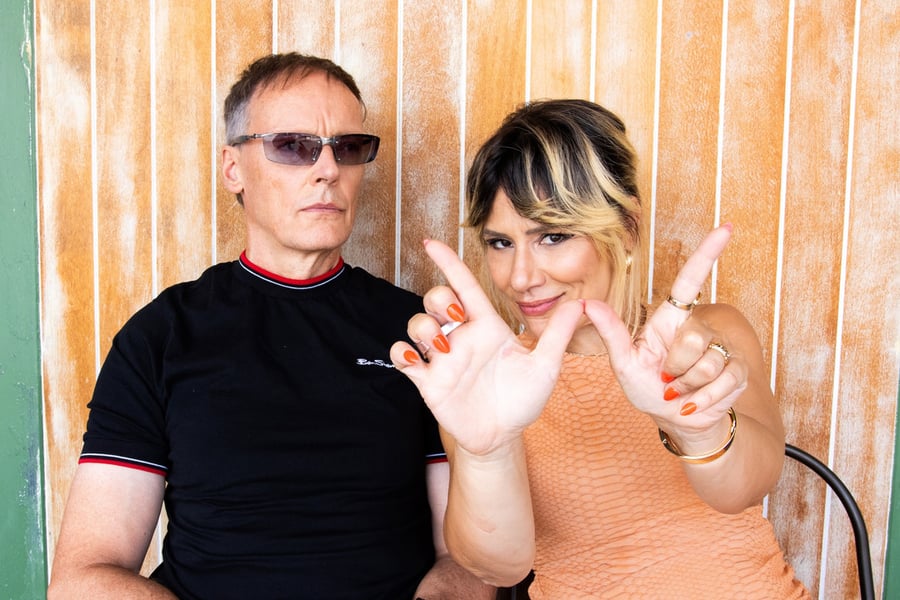
For a project built around one of Australia’s most enduring pop records, Bachelor Girl’s Waiting for the Day: Artist Sessions is remarkably uninterested in preserving the past.
The new album revisits all 15 tracks from Tania Doko and James Roche’s ARIA-winning 1998 debut, pairing the duo with 15 iconic artists including Jessica Mauboy, Delta Goodrem, Guy Sebastian, Darren Hayes, Courtney Act, Ella Hooper, Tommy Emmanuel and Suze DeMarchi. But nostalgia, Doko insists, was only ever the doorway. The point was to walk through it and start pulling the songs apart.
“People want to feel something familiar, comfy, the warm hug experience,” she tells Rolling Stone AU/NZ. “They want to go back to that time. But rather than just go back and replicate pretty closely what it was, we just thought we’d completely screw it all up and turn them all on their head and have fun in the playground. What would we do with this now?”
Originally conceived around the album’s 25th anniversary, Artist Sessions took over two years to coordinate and complete independently. Aligning 15 artists, their teams, recordings, mixes and release plans turned a neat anniversary idea into something far more ambitious than it initially seemed.
Eventually, Doko and Roche stopped worrying about the calendar.
“It’s nice to do anniversaries and milestone records, but what’s even better is to make sure that you’re really into it and you’re proud of it,” Doko says. “There was no point rushing it because milestones come and they go, but it turns out that the record thankfully became a bit like a good wine. People got mushier about it as the years went on.”
Love Music?
Get your daily dose of everything happening in Australian/New Zealand music and globally.

Thankfully, Doko says, throughout trials and tribulations — “mostly mine,” she adds — Bachelor Girl was able to capture people’s imaginations.
“Maybe because we always spoke of the human condition,” she says. “Even if it was a love song, it was still, ‘What can we say from a psychological point of view to get down under people’s defences?’”
That question became the connective tissue of the redux. Rather than treating the guest vocalists as decorative additions, Bachelor Girl invited each artist to inhabit the songs.
“We mostly let them have free rein,” Doko explains. “‘Be you inside of a Bachelor Girl song,’ which is already kind of odd, if you think about it. I think they’ve nailed their own personalities inside these songs. They are being them, but being true to the song. And that’s just testimony to their artistry.”
The first sessions, with Mauboy and Goodrem, immediately raised the stakes. Hearing two singers who had grown up with Bachelor Girl return Doko’s own vocal phrasing to her was both confronting and affirming as a creative.
“The pipes on these girls, I had to really step up,” she says. “It taught me to bring my A game. But what it also taught me was that they were singing back my licks — new and improved versions. That was very humbling. I had no idea that they were influenced vocally by the record as much as they were. I think that was the prize of it. It’s the ultimate validation.”
Behind the joy, however, is something Doko values even more. In an industry increasingly organised around numbers and metrics, the artists said yes because the songs meant something to them.
“We’re working very, very hard in the music business, and it’s very fragmented and it’s very crazy now,” she says. “But what we have in common is we are still here. We are still here for some crazy reason. We still love music. We still love making music.”
None of the collaborators, Doko says, approached the project by asking what it could do for their profile or their data.
“They just wanted to do it. It wasn’t about, ‘What can I get out of this?’ It was just, ‘We love that record,’” she says. “And that gave me a lot of inspiration because we can be very cynical in the music industry.”
Then comes the line that seems to hold the entire project together: “There’s no chart for heart.”
View this post on Instagram
Doko understands the practical machinery surrounding a release — the pre-saves, pre-orders, chart positions, touring opportunities — but she is determined not to let it hollow out the thing itself.
“I am committed to that not robbing the experience,” she says. “It sounds super cheeseball, but it is very true to me because actually that’s why I stopped being an artist and I went to Sweden for a long time and wrote songs for other people. The creative beast needs love, needs nurturing.”
The clearest meeting point between craft and feeling may be the new “Permission to Shine”, reimagined as a gospel- and soul-tinged duet with Guy Sebastian. Doko says Sebastian’s technical ability was never in doubt. “Guy can sing the phone book and Yellow Pages, White Pages, all the books,” she says. The harder task was deciding what not to use.
“It was just a case of, ‘Well, what are we going to leave out? Where do I sing? Because you sound so awesome,’” she says. “He knows when to lean in and when to understate it.”
Sebastian also helped prevent experimentation from becoming an end in itself. While Bachelor Girl considered pushing the song into a faster, more overtly contemporary shape, he argued for retaining the emotional centre audiences had carried for more than two decades.
“He actually brought us back to the essence of the song,” Doko says. “We were like, ‘Let’s muck around with it and make it 100 BPM,’ and he’s like, ‘Yeah, but let’s not lose the spirit of what it is for people.’ That was the challenge for us from the whole project. It’s one thing to change up the songs, but let’s not just change for change’s sake. You don’t want to destroy what the songs were for people.”
“Permission to Shine” has also changed meaning for Doko. Its message once met a young artist learning to take up space. Now, it meets a 52-year-old woman who knows confidence does not permanently erase insecurity.
“I think I can be in my power and I can be confident, but I can be insecure,” she says. “I don’t walk around with a knowing all the time about what I’m doing. What I’ve learned to embrace is it’s a wave. This insecure feeling probably will pass and you’ll be okay in the morning. You’ve just got to ride it.”
In the past, she says, a setback could trap her in self-criticism for weeks. The difference now is not that the feeling has disappeared, but that she no longer mistakes it for the truth.
“In this process of making this record, there’s been obstacles, there’s been hiccups, there’s been delays, but I didn’t make it mean the end of the world,” she says. “Let it go, because don’t make that no mean that you are failing. It’s just a no.”
View this post on Instagram
Revisiting the album also forced Doko to confront the physical distance between the singer she was and the singer she is. Her younger voice had “a lot more ping,” but years of performing have left injuries and scar tissue. She refuses to romanticise that damage, but she will not treat it as disqualification either.
“A footballer has a knee reconstruction. We don’t go, ‘Oh, well, he’s rubbish and he should resign,’” she says. “I can’t do everything I used to do, but I bring all the battle scars and bring all the stories. I’m a mum now and a wife and a daughter of an ageing parent, and I try to have a bit more empathy.”
Age has also sharpened her understanding of boundaries.
“What I wasn’t that good at back in the day was boundaries,” she admits. “You do the yes to everybody and no to yourself, all that. And that’s, as a woman, you learn that with age. I suck at it sometimes still.”
The final track strips away the album’s impressive guest list. On “Waiting for the Day”, the project returns to Doko and Roche alone, with piano, voice and strings. After inviting so many artists into Bachelor Girl’s past, they close by returning to the partnership that created it.
“I just trusted my instinct,” Doko says. “I said to James, ‘I think that’s just you and I. Maybe the super fans want to hear you and I the way we do it live.’ We end on the sobering note of the title track. We go back to the beginning of just James and I.”
For all its scale, Artist Sessions ultimately rests on a disarmingly simple act: asking. Asking artists they admired to enter these songs. Asking old work to reveal something new. Asking whether a pop record can hold nostalgia without becoming trapped by it.
“Ask the impossible and you never know — people might say yes,” Doko says. “Collaboration is not so hard if you just lean into your community.”
Bachelor Girl’s Waiting for the Day: Artist Sessions is out now.

