





























Decades after Keith Urban left Queensland for Nashville, there’s a new crop of Australians laying claim to Music City.
What began as a handful of success stories — Urban’s Grammy-winning career; Tommy Emmanuel’s mentor–protégé relationship with Chet Atkins; Morgan Evans’ platinum-selling American hit “Kiss Somebody” — has turned into a transpacific pipeline. Australia is Nashville’s second-largest overseas market, sending more tourists and temporary residents to town than any other country besides the U.K. Every year, the city’s population continues to swell with Aussies who show up with O-1 visas and acoustic guitars, eager to plant their flag in a city where songs still matter.
Jedd Hughes moved to town in 2002. He’d grown up on the outskirts of the Australian outback, in an area where civilization thinned out and raw, rugged landscapes began to dominate. It was the sort of terrain that Marty Robbins might’ve sung about — a western world of dry land and railroad tracks — but what drew Hughes to America wasn’t a similarity in scenery. It was the promise of opportunity.
“It’s hard to make a full-time living as a musician in Australia,” says the Nashville transplant, who’s spent years playing for artists like Emmylou Harris and Rodney Crowell while juggling a solo career. “There’s not as much opportunity to tour. You have to cover long distances between cities, and you can only play the big markets once or twice a year.”
Emma Swift agrees. A former DJ for the Australian Broadcasting Corporation, she left her Sydney-based radio job in 2013 to pursue an indie-folk career in Tennessee. She still gigs often, both as a solo act and with her husband, the U.K. songwriter Robyn Hitchcock, and sees Nashville as a well-placed hub for road warriors. “There’s 28 million people in Australia,” she says. “You can go out and play 100 shows a year in America, but that’s not nearly as feasible in Australia. Think about the proximity to Europe, too. It’s a seven-hour flight from Nashville to London, but if you fly from Sydney, it’s 24 hours.”
Logistics aside, Swift relishes the chance to be “an obsessive music fan” in Nashville, a city that hosts literally hundreds of shows every week. “I was at Brown’s Diner on Tuesday night, watching Lilly Winwood play,” she says. “I was at the American Legion on Thursday, watching Neelys Band. And on Saturday, I went to the Brooklyn Bowl to see Gillian Welch and Dave Rawlings. There’s a part of me that knows I could exist as a professional musician in Australia, but I stay in Nashville because there’s nowhere else like it. The music scene is very accessible as a fan.”
She isn’t the only Australian racking up a tally of airline miles. Already an established solo artist in her native Melbourne, Katie Bates spent the bulk of 2025 on tour as a sidewoman, playing a blur of international shows — including U.K. gigs with Americana mainstay Sam Outlaw and a Scandinavian run with fellow Australian act the Pleasures — before heading to Nashville to record her newest single, “Tunnel Vision.” Despite the globetrotting, she still views Nashville as the go-to destination for roots-based musicians looking to put in the hours.
Love Music?
Get your daily dose of everything happening in Australian/New Zealand music and globally.

“Melbourne is our version of Music City,” Bates says. “Like Nashville, you can see live music every night of the week. If you’re targeting the Americana and country scenes, though, you’re dealing with a smaller audience and a smaller scale. There’s not as much work to be found, and opportunity for artist growth is limited. Why wouldn’t you go to Nashville instead?”
Bex Chilcott, who performs under the name Ruby Boots, did go to Nashville, trading the remoteness of Perth — the world’s most isolated metropolis, located more than 13,000 miles away from the nearest city — for the open arms of a community that made room for everyone. “I was looking for a place where I could fit in,” Chilcott says. “I had a record deal in Australia, but I couldn’t find a deep-seated scene for alternative country. That scene was healthier in America, with acts like the Deslondes, Nikki Lane, and Emily Nenni. I wanted to go find the people who operated in between.”
That’s what drew Jeremy Dylan to Tennessee, too. Raised in Sydney, he’s spent years bringing some of Nashville’s biggest names — including Taylor Swift, Luke Combs, and Kacey Musgraves — to Queensland to play CMC Rocks QLD, the largest country music festival in the southern hemisphere. Moving to Nashville during the 2010s gave him the chance to support the industry’s underdogs. “A middle-class art existence is actually achievable here,” Dylan says. “Nashville supports people who operate in more niche sub-genres, like esoteric folk music or variations of America. You can make that kind of music here. It’s very hard to find the equivalent of someone like Steve Poltz or John Craigie in Australia.”
When Sydney native Phil Barton came to town, he wasn’t looking to build a home on the fringes. Instead, he headed straight for the boiler room of country music’s mainstream machine — Music Row, where many of the genre’s hits are written — and kickstarted his career by writing Lee Brice’s Number One single “A Woman Like You.” “I landed my first publishing deal and couldn’t believe that something I’d been doing at home in Australia — writing songs — could be an actual job in America,” he says. “Nashville felt like this magical place where I could write and have an actual salary.”
When his publishing company celebrated the chart-topping success of “A Woman Like You” with a party, Barton was happy to see dozens of Australians in the crowd. “It was the same for Morgan Evans’ Number One party,” he says. “It was the same for Lindsay Rimes’ first Number One. There’s a cool base of Australians here, and we’re all behind each other so much.”
That sort of mutually supportive environment doesn’t necessarily thrive in Australia, where “tall poppy syndrome” — a cultural mentality that discourages open ambition in favor of humility, rooted in the egalitarian idea that that the tallest poppies in a field get cut down first — is the unspoken law of the land. “Tall poppy syndrome is part of our national identity,” says Jordie Lane, who grew up in the Melbourne suburb of Thornbury. “You’re told to be happy with what you’ve got, take what you’re given, and don’t ask for more. We see it as a noble way to be, and we use humor to put each other down, because laughter is good medicine. Over time, though, it lowers your confidence. It penalizes you for having big dreams. And in order to be a musician, you need those big dreams — maybe even some delusion — to keep going.”
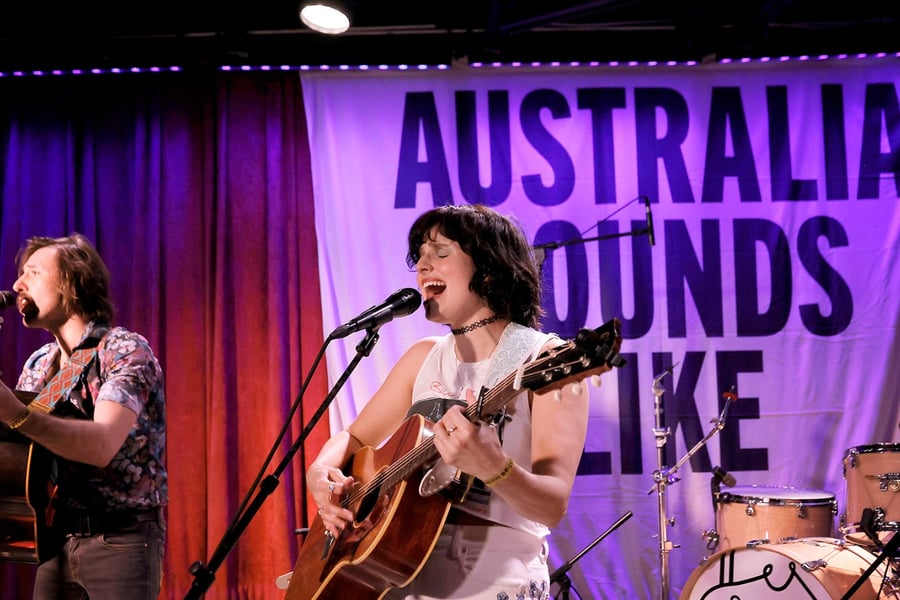
Australians like Swift and Josh Rennie-Hynes have swapped songs at “Breading Bread,” Lane’s concert residency at the Urban Cowboy hotel in East Nashville. Even more have played the Aussie BBQ, a showcase that’s become a staple of AmericanaFest’s annual schedule. Listening to those accents swirling around the same venue, it’s hard not to assume that a camaraderie born from distance — from the shared understanding of what it’s like to leave not only a culture, but a continent — has bound these musicians together. Lane acknowledges that his fellow transplants are connected by their heritage, but he’s quick to point out that it doesn’t define them.
“We leave our homes to go see the world and integrate into other cultures,” he says. “I don’t want to focus on being part of the Australian scene in Nashville. That’s not the goal. I just want to be part of Nashville.”
“As Australians who’ve moved to Nashville, there’s something we all understand about each other,” adds Imogen Clark, an ARIA-nominated solo artist who moonlights as a member of Jim Lauderdale’s touring band. “But I didn’t come to Nashville to only do Australian things. I moved to Nashville to be part of this thing here.’”
As the sound of Nashville continues to expand, it’ll be those willing to do something a little different, like move halfway across the world, who steer the ship. Obtaining an O-1 visa isn’t easy. It requires time, money, and usually an immigration attorney, and all that effort tends to weed out complacent musicians who’d be just as happy staying home. For Aussie artists who do make it to Nashville, there’s a crystallization of purpose — a reminder that there’s no such thing as coasting when you’ve bet this much on your music.
“We live in a city of immigrants,” Dylan says. “So many people in Nashville aren’t from here, so it’s a place we’ve all chosen for ourselves. People live in Nashville because they have some kind of creative dream to pursue, or some kind of way they want to live their lives. This city is a place where that can happen, and that’s as true for Australians as it is for anybody else.”
From Rolling Stone US

