





























Ethan Montanẽr / @ethmon
All-Ages Shows Are Big in Dunedin. But the Scene Still Needs Help
All-ages gigs are thriving in Dunedin and Port Chalmers. Rolling Stone AU/NZ spoke to people involved in the scene to find out more.

This feature is part of a new Scene Report on Dunedin. Check out the series here.
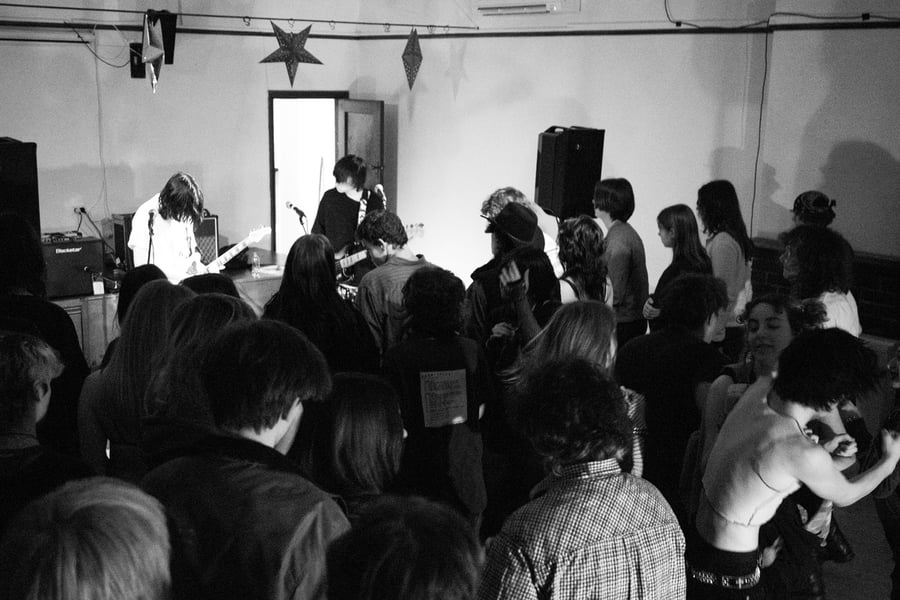
Despite rain buffeting the tarmac on the long and winding journey from Dunedin, about 15 kilometres away, a decent-sized crowd turned up to see another promising Dunedin band take its first steps.
People watched quietly and respectfully — save for two elder statesmen who gamely tried to get a mosh pit going — during the sets, and politely huddled outside between them. Some smoked rollies, most just chatted about music. An inquisitive cat kept returning to the front lawn, revelling in the attention.
And throughout this wholesome scene, there was not a drink to be seen. No cheap beer, no poorly-poured whiskey & coke, nothing.
All-ages shows are thriving in Ōtepoti, just as they’ve been flagging in other places, with worrisome issues in the country’s biggest city being well-documented in recent years.
Affectionately nicknamed “the little hall that could,” Pioneer Hall is one of two main focal points for all-ages shows in the Dunedin region.
“There’s not really much else for the kids to do except for hang around and go to gigs and stuff,” Stefan, a member of noise-punk trio U-NO JUNO, tells me.
Love Music?
Get your daily dose of everything happening in Australian/New Zealand music and globally.

“I do think that the strongest thing that we have is all-ages spaces. [There’s] barely any spaces around New Zealand that you can go in underage… if you’re young and you see a band, you want to do it yourself.”
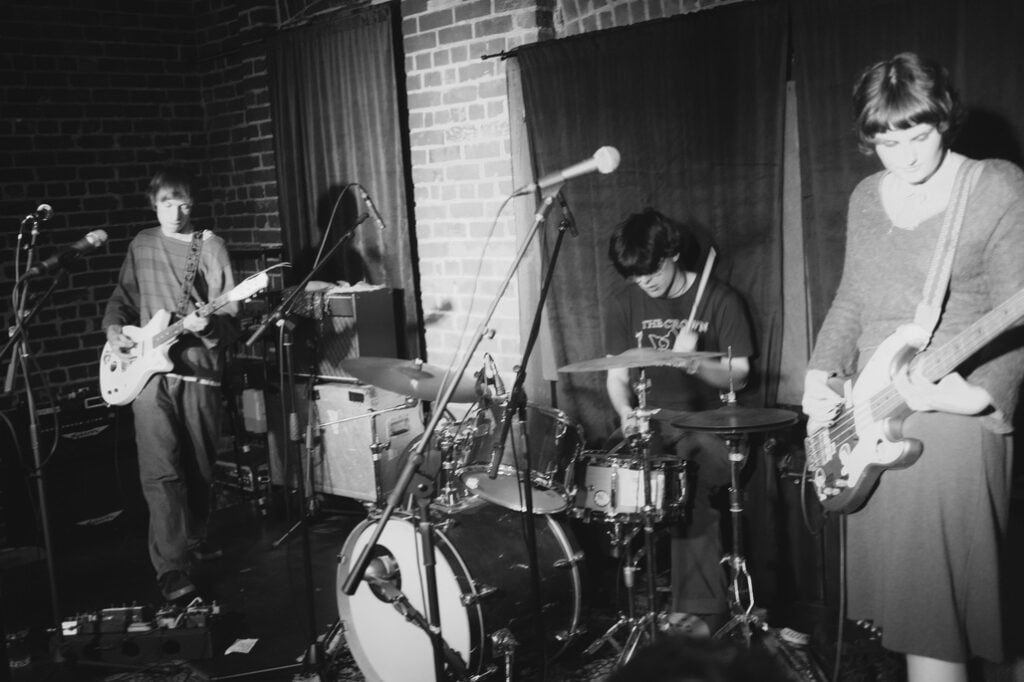
Image: U-NO JUNO Credit: Ethan Montanẽr / @ethmon
The other centre for all-ages shows is Yours, a worker-owned café and venue that’s become a community hub.
“Hey, look, I believe the children are our future, man!” Ani says, with only a splash of irony. They’re one of the people behind Yours, which is run by volunteers who care deeply about providing a nurturing and inclusive space for Dunedin’s artistic community. “[S]ome of us are studying, some of us have other jobs,” Ani says. “It’s a lot of work.”
Two weekends ago, Yours hosted Femme Fest 2, a returning music festival that “celebrates queerness and gender diversity in the Aotearoa music scene.” It was, crucially, another all-ages event, and it certainly won’t be the last.
Local musicians queue up to sing the praises of Yours.
“[B]efore that there wasn’t really an all-ages venue in the centre city,” Keira Wallace, a talented solo artist and member of Motheaten, tells me. “So that’s been really big for getting high schoolers to come to gigs and also being such an inclusive space for people. I think that makes a huge difference.”
“It doesn’t have a venue fee, it’s just koha, and that’s been really good because younger bands can play shows who can’t play it,” says Kim from The Pink Opaque. “They can play in Yours and don’t have to empty their pockets out. I think that’s really cool.”
A number of people have been instrumental in making Dunedin’s current all-ages scene so strong, but perhaps none more so than Craig Monk and Natasha Griffiths.
They lead Amped Music Project, a free music mentorship programme for musicians of high school age. Produced by Dunedin Fringe Arts Trust, Amped provides workshops with both industry professionals and renowned artists, as well as education on promotion and recording. Amped is also, unsurprisingly, dedicated to putting on as many all-ages shows as possible — practice makes perfect for any fledgling band.
Approaching its seventh year, Amped has supported almost all of the exciting new wave of Dunedin bands, including Vagina Dry (yes, that’s their real name), U-NO JUNO, Sogg, and Sivle Talk.
View this post on Instagram
In conversation, Natasha’s excitement about the project and Dunedin music is infectious.
“[W]e teach these young people how to put on their own gigs. And when they’re ready, they do that,” she says. “There have been over 20 acts of high school age put on shows, nice full halls of young people loving it, it’s no drinking, it’s about the music.”
Amped encourages these young musicians to take care of themselves, to the point that “now you have 16-year-old bands saying, ‘Okay, we’re not going to start until we all go get your earplugs,'” she notes.
Natasha has been in this game for a long time — think of a band from Dunedin over the last two decades, and chances are that she’s helped support their career in some way, certainly in the early stages. She’s emotional talking about this current crop of “16 to 23 year olds” in the city. “I believe that this scene is saving lives, the mental health aspect of it is so powerful.”
She’s also noticed significant change in recent years. “[M]ore touring bands are coming and doing all-ages gigs and inviting the young bands to play as well as doing their R18 shows, which is just amazing… our job is to protect it and it actually feels [like] a real privilege to do that.”
Kim agrees. “It’s just my speculation, from what I’ve heard, but it’s [all-ages shows] really starting to become more sort of the focus when booking shows.” Looking ahead, they hope to see more venues “friendly to putting on all-ages shows,” places “willing to compromise over certain bookings.”
Ani admits to feeling a little “bent out” after a big year for the venue, but they’re hopeful about the future.
[T]he music is important for the space… they [musicians] don’t get a whole lot of opportunities to be themselves and express themselves. That’s what’s important for me and that’s what I hope we can keep doing. Other types of art as well — we’ve got a stage, maybe we can put some theatre on it or do exhibitions of their art.
“Some of these kids don’t have jobs — it’s tough even as adults who are bringing in income from their shows, it’s not a profitable business to be in. They’re really doing it because they want to.
“So that’s a huge part of it for us is to take away that financial barrier, which brings in so many faces… it didn’t start as a queer space, but because of the politics that guide the space, the queers show up… we’ve been able to build a drag scene out of it, which has been pretty huge. They’re getting booked out of bars and venues now, but that wouldn’t have happened if we weren’t able to provide them [with] a cheap venue that’s safe and is going to take care [of them].”
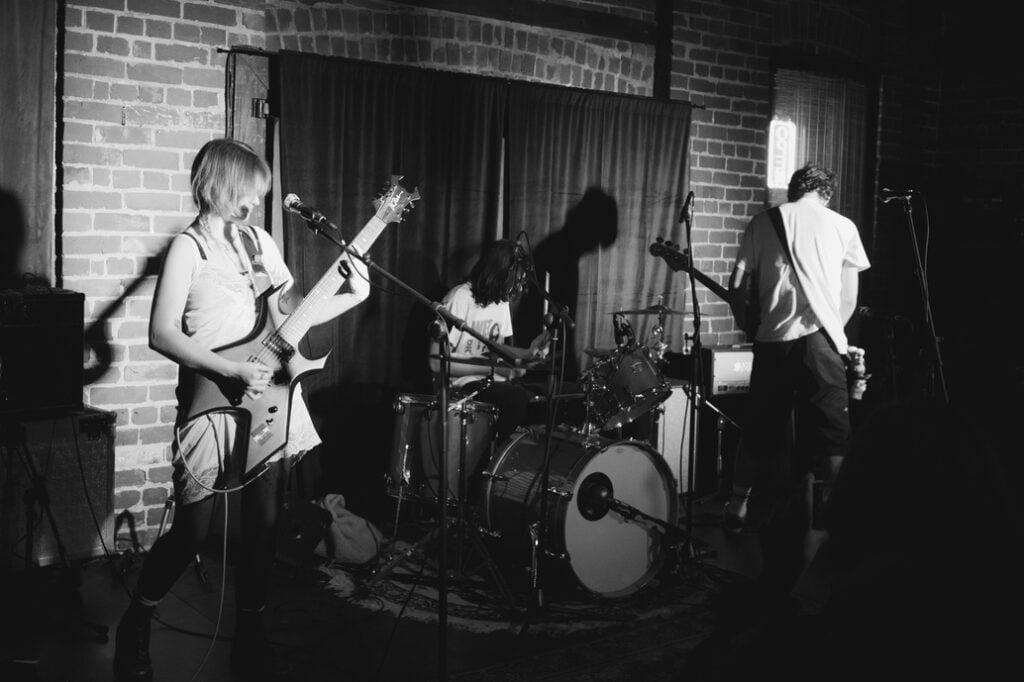
Image: Vagina Dry Credit: Ethan Montañer / @ethmon
Over at Pioneer Hall, support is needed.
Jonathan Holloway has spent the past two years providing stage sound for young musicians who lack installed PAs, hiring it out “at the lowest rate possible,” but it’s been a self-funded initiative.
That’s why he’s started a Boosted campaign to “get next level sound for all-ages gigs in Ōtepoti.”
“We have had a great series of all ages gigs in 2025, and 2026 can be even better,” Jonathan writes on the campaign page. “Everything we need is in place, but what would bring us to the next level is more powerful speakers. Rather than push things to their limit, we want to be able to effortlessly deliver the best sound possible in the rooms we use; the sound the musicians and audience deserve. The young bands / artists are ready to go next level, this will keep up with them.”
With 27 days still left, Jonathan’s campaign has raised almost 50% of its target total of $3,900.
As Jonathan’s campaign states, the equipment needs to be improved in order to “keep up with musicians.”
“As the acts get better, and the audiences get larger, it needs to be great,” he writes.
He’s not wrong. “The music is powerful,” Natasha says about the bands currently making music in the city.
“Maybe because there is such this incredible support system, it’s allowing the bands to be who they are and just be themselves and kind of be that genuine Dunedin band that we’ve seen in the past.”

