



























Mike Sabath isn’t interested in cutting corners. The 28-year-old has been in music for a long time, both as an artist as well as a producer-songwriter with an extensive list of collaborators throughout his career. He primarily works with British singers Raye and Jade, but he’s also manned the boards for Niall Horan, Shawn Mendes, Zara Larsson, Sabrina Carpenter, and more over the past decade. AI tools aren’t part of that process. “I don’t use AI in my rooms, and I haven’t worked with people that do yet, to be honest,” Sabath tells Rolling Stone. However, it’s top of mind outside of the studio, where he’s frequently having conversations with artists and industry executives about the urgency around the growing technology.
Sabath gets chills when he thinks of artists like Raye, with whom he’s worked since her 2023 debut My 21st Century Blues, and Rosalía, who he’s long admired. He qualifies both as masters of their craft — and hopes people consider artists like them when conversation turns to AI and what it’s threatening to replace. “The art of mastery in general has continued to be diluted over the years, and technology is a huge part of that,” Sabath says.
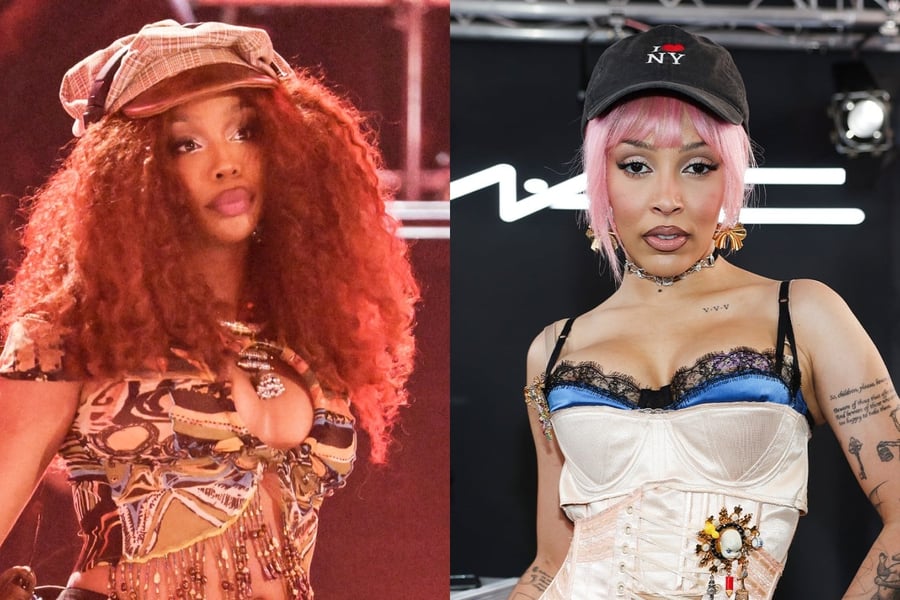
While artists are focusing on sharpening their skills and expanding their reach, their releases are being used to train models that replicate the output of real musicians quicker than performers can safeguard their intellectual property. Discussions like the ones Sabath has been having are now spilling into public forums and across social media as artists like SZA, Doja Cat, Kenny Beats, and more voice their frustration.
“The greatest tool that the big money folks use is instilling the feeling of fear and that we can’t stop it,” Sabath says, noting that there’s a constant push towards normalizing AI. A Rolling Stone report from earlier this year noted all the ways in which AI was entering the workflows of top producers, songwriters, and artists. Earlier this year, Diplo went viral after telling artists who are hesitant to embrace AI: “You need to adapt or just give up and become an Uber driver until everyone has a Waymo.” Sabath isn’t convinced an AI future is as inevitable as it’s being made out to be. “People go, ‘Well, it’s just the wave, let’s just ride it.’ It’s like, well, we made the wave. Humans made the wave,” he says. “You locked in and made Suno real and are continuing to make it better.”
Suno previously owned up to training its model on “tens of millions of recordings” available online. The admission came in a legal filing created in response to a lawsuit from the Recording Industry Association of America (RIAA) — which represents the industry’s “Big Three” record companies, Universal Music Group, Sony Music Entertainment and Warner Music Group — accusing Suno and Udio of training their AI tech on unlicensed works from their artists.
“Training without approval is crazy to me,” Sabath says.
In June, The Atlantic expanded its investigation into the generative-AI industry with the addition of an expansive dataset titled Laion-Disco-12M. The set, compiled by the nonprofit LAION in November 2024, contains a collection of more than 12 million songs retrieved from YouTube. The company paired each link with “metadata to support basic machine learning research in foundation models for generic audio, music information retrieval, and audio dataset analysis.” For a year and a half, this data was available through LAION, but The Atlantic’s engine made it easily searchable.
Love Music?
Get your daily dose of everything happening in Australian/New Zealand music and globally.

There are works from more than 250,000 artists listed in the dataset, including SZA and Kehlani, who both shared screenshots of their search results (238 and 179 songs, respectively) on their Instagram Stories in June. A search for Sabath’s name yields 18 results. There are even more when factoring in his production and songwriting credits. The database doesn’t guarantee the music listed has actively been used for training, but that it’s readily available to AI developers. “If you’re a musician and you support this degenerate shit?” SZA wrote on Instagram. “You’re disgusting and there’s NOTHING YOU COULD EVER SAY TO ME TO MAKE THIS OKAY.”
In April 2024, over 200 artists signed an open letter from the Artist Rights Alliance calling on “AI developers, technology companies, platforms and digital music services to cease the use of artificial intelligence (AI) to infringe upon and devalue the rights of human artists.” Chappell Roan, Doechii, Noah Kahan, Lola Young, Billie Eilish, and more signed. The concern around the use of AI in music has grown exponentially since then.
“When we wrote that letter, AI training to a lot of artists was theoretical,” says Jen Jacobsen, executive director of the Artist Rights Alliance. “Most artists didn’t have much visibility into how their work was being used. Now, with the AI Watchdog database and other avenues, it’s making the issue very real and very personal for artists.”
It’s also testing, if not completely eroding, the trust between artists and their audiences. In June, fans discovered a heap of unreleased songs they believed to be Doja Cat leaks; she later revealed they were all AI. “Really disappointed in everyone thinking that’s me,” she wrote on X. “Fuck AI for real.” Weeks later, debate persists as to whether they even believe her. Some argued the songs are real, but were written off as AI to minimize interest. One fan thanked the person who shared the songs for “making my day better even if they are AI.”
One prevailing argument against AI is that robots and machines can’t possibly replicate emotional human experiences. At least not yet. “The technology is as bad as it’s ever going to be,” says J Erving, founder of the distribution company Human Re Sources, whose client roster includes Raye, Jill Scott, and more. “Think about how much better the songwriting is going to get, how much better the song creation is going to be, as they continue to build on what’s available to people to use currently.”
Erving’s career in the music industry spans more than two decades and even he’s been duped on a few occasions. “There’s one artist in particular that I went back to my team yelling and screaming about, and I’m like, ‘How the hell is this kid not on our radar? This music is amazing,’” he says. It turned out to be AI. “I had no idea that this was AI. The song was really good, his voice was really good — it checked a lot of the boxes that I would want to see from an emerging act.” Despite this, the executive doesn’t plan on getting into the business of distributing music for AI artists.
On the other side of more deceptive releases are real artists, like singer and producer Natanya, whose music is distributed via Human Re Sources. Even with just one album and a few loose singles under her belt, a few of Natanya’s pop and R&B releases are already showing up in AI database searches. This highlights exactly what artists like SZA are worried about. In her Instagram post, she argued “the best and brightest Black minds of writers and producers” are being used to train AI models on platforms like Suno.
In her fight to protect artists in the face of AI through the Artist Rights Alliance, Jacobsen recognized a persistent cycle: “First, an artist has their work stolen and used without their permission, so that’s a number one violation,” she says. “Then their stolen work is used to create some new piece of I don’t know, it’s not art, but it’s a new work that is then competing directly against the person whose work was infringed upon.” This year, an AI-generated hit spent six weeks at Number One on Billboard’s U.S. Afrobeats Songs chart: “Let Me Be” is credited to the performer Second Voice, but originated as a demo from Rwandan artist Elvin Cena. Cena turned to Suno to complete the song, boosting it with upbeat amapiano production and altering the second verse to feature a woman’s voice, he recently told Okayafrica. It appeared on the chart alongside artists like Ayra Starr, Tyla, and Asake.
“To some extent we’re still talking a lot about copyright infringement and who’s stealing our stuff,” Jacobsen says. “But the debate to some extent has shifted or evolved from infringement to participation in the marketplace.” Both sides of the conversation require the parties profiting from this work to allow artists to have a say in how their intellectual property is used. “There needs to be responsibility, and anything involving rules of the marketplace has to start with transparency,” Jacobsen says. “Artists or fans can’t talk about what they want or what they want to change until they know what’s happening in the first place.”
Guardrails for musicians take time to develop, likethe AI policy that TIDAL put into practice in mid-July. On June 29, the streaming platform announced plans to identify and tag music found to be almost completely AI-generated. These labeled releases will be allowed to exist on the platform, but not eligible for monetization. “In my opinion, it’s almost, ‘Why not earlier?’” says Robert Andersen, Tidal Lead and principal designer at TIDAL developer Block.
Spotify and Apple Music have both rolled out features to identify AI-generated content, though they largely rely on transparency from artists and their distributors. “We looked for a partner that would be able to help us basically scan every single track in our catalog and give it a score of how much AI was used in the creation of that track,” Andersen says. “The hardest part is making sure that we are completely accurate about our assumptions.” Andersen thinks it will take some time to fine-tune their technology to reduce the number of potential false positives or false negatives.
AI will continue developing in the meantime. “We’ve heard that a lot of the top pop songs and stuff like that on the charts are at least partially generated,” he says. “There’s this whole confusing spectrum here, which is why we’re taking a stance on 98 to 100 percent is not OK, but 50 percent? 25 percent? It’s really hard to say.” For now, TIDAL is focused on protecting its userbase, which will be able to filter out primarily AI-generated releases similarly to the way explicit content can be blocked. “I go on our Reddit quite a bit, for better or for worse, and people are just raging nonstop about AI slop on TIDAL being recommended to them,” Andersen says. “And artists have spammy impersonations that appear on their profiles and steal those plays.”
Artists whose likeness is being exploited to train programs share a sense of protectiveness around the distinctiveness of their output — whether it’s Doja Cat feeling let down by her fans falling for alleged AI dupes, or Elvin Cena listing “Let Me Be” under a separate artist name as to not dilute his own creative brand by associating too closely with AI. The same rings true for emerging indie artists, Andersen says. “A lot of the indie artists that we talk to that are starting out in their bedrooms and just beginning for the first time, they’re scared of these tools — they think it’s sort of atrocious,” Andersen says. “They’re also open to the idea of automation for things like the tedious parts of their lives. You see a little bit of a willingness to learn and be tech-forward, but mostly just a lot of fear and skepticism.”
Suno is moving into the independent space with Spark, a recently announced incubator program providing independent acts with grants, marketing support, and access to writing camps with other musicians, songwriters, and producers. Participants must be unsigned and completely independent and are required to use Suno’s tools at some point in the creation process, even if only to generate a new idea.
Specific details — like how much Suno will pay out to artists through Spark — have not been publicly disclosed. In the “Good Vibes Only” section of the Suno Spark Program terms and conditions, effective June 21, the company included an anti-disparagement clause that has since been revised. Those selected for the program, it initially read, “will not at any time make any statements or representations, either directly or indirectly, whether orally or in writing, that portrays Suno, Suno personnel, and/or any Suno products or services in a negative light.”
This particular section of the fine print drew criticism across social media. “For lack of a better analogy, there’s a human element to this, where it’s not even about the business side,” Erving says. “If I come to you and I say, ‘Hey, I’m going to give you $2, but in exchange for that, you can’t be honest about me,’ that doesn’t feel right on a human level.” The section has since been updated, effective June 26, with new language that shifts focus away from Suno itself. Now, it holds that at any time during or after participation in the program, selected artists may not “disparage Spark or its participants,” in particular. Suno states this is about “maintaining mutual respect, and does not prevent you from speaking honestly about your experience in the program.”
A spokesman for Suno notes that the company’s music partnerships team built the Spark program to support independent artists, and have received many thousands of applications already. “We fundamentally believe the best music will always be made by humans, no matter what tools they are using to create it,” says Paul Sinclair, Chief Music Officer for Suno. “That’s what we all love about music — the emotion, the imperfections, and the stories that can only come from real lived experiences.”
The company’s music partnerships team “works with thousands of artists who have a wide range of perspectives about AI,” he says. “This includes giving them access to test our products, provide feedback, and learning what will best support them in their creative processes.” A recent report from Luminate also showed that musicians are increasingly open to using generative AI as a tool. Still, Sinclair says, “We also understand why many artists have concerns about AI and we respect that and it’s our job to listen.”
Days before Suno announced Spark, it was on the receiving end of a call out from the producer Kenneth Blume, or Kenny Beats. “You are true losers. Whoever’s running this account, and your boss, and their bosses boss,” he wrote on X. “I can’t imagine going into work daily knowing you are stealing from countless struggling musicians. I can’t imagine being proud to earn a paycheck obliterating the work and dreams of artists. Get fucked, every single one of you.”
Blume’s frustration regarding unethical AI trends aligns with what Sabath describes as “this facade that it’s not people making choices — that it’s a company or a brand making a choice.” In the past year, Sabath came close to working with “a couple of large corporations,” but backed out when he realized their principles weren’t aligned with his own. “I’ve talked to execs who have values but are disregarding them for their job, and that’s a problem,” he says. In that particular instance, there were only two people at the table: “Two people that have the decision-making power in how AI music is gonna be able to be used in this particular area.”
One of the primary goals of the Artist Rights Alliance is to expand the dialogue to include more people who will be directly impacted by AI. Most of the questions Jacobsen rattles off only recently became primary concerns, compared to when the open letter was written in 2024: “Were artists consulted? Do performers share in the revenue of the deal? Is the consent that’s in the deal meaningful? Are artists able to give a meaningful opt-in consent to their work being used?” Even when artists are consulted and informed, they should be mindful of the fine print. “If your whole entire goal in life is to be an artist, contributing to these platforms seems to be eroding the value of artistry,” Andersen says. “When people can just generate 20 songs of their choice, it sort of makes the struggle of an artist or the work of an artist look trivial.”
And these are just the concerns that pertain directly to musicians. SZA has emphasized the dangers of environmental racism, which targets marginalized groups, linked directly to the prevalence of AI. “None of you care ‘cause you’re codependent on a machine,” she argued. Sabath similarly worries we’re actively being trained to lack the patience and ability to take action during hard times. “It’s always been, ‘Alright, new tech, more efficient, potentially more money here — oh, it’s gonna kill these people, but we’re gonna be able to do this a little faster,’” Sabath says. “’It’s actually gonna raise the temperature of the Earth by this much, but it’s all good.’ It’s always that, because there’s a trade off when you’re trying to cut corners. That’s how it works.”
Still, with more artists speaking out, the producer is hopeful more people will push back against a future in which music is entirely reliant on AI. “When you get up close to these corporations, you realize, ‘Oh, there’s actually only a couple of you motherfuckers making choices around here’ — so actually, it’s not that crazy,” Sabath says. “It’s just conversations and decision making that says, ‘We are going to prioritize the humans here and we’re going to prioritize chills.’”
From Rolling Stone US

