




























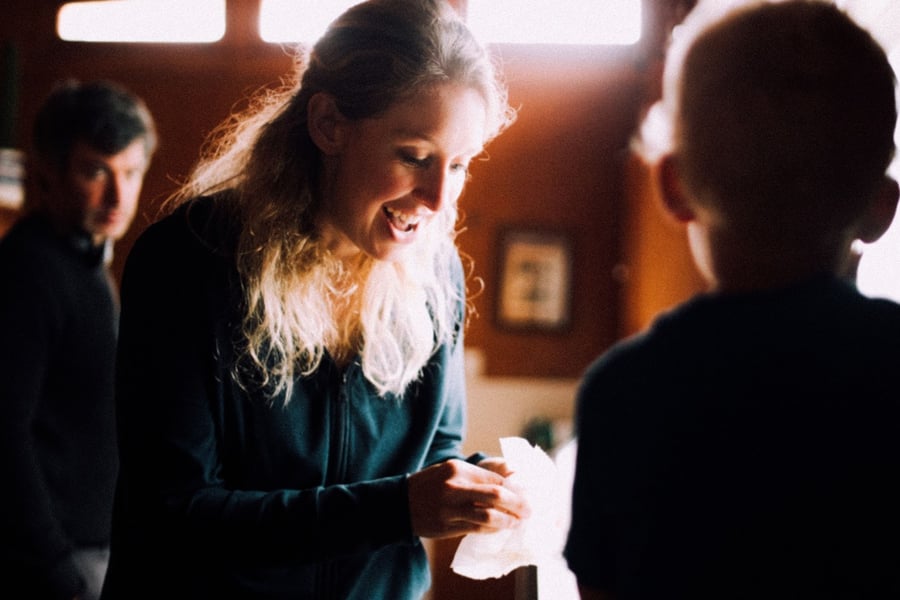
In 2023, Elizabeth Holmes was going to prison. The eccentric founder of the blood-test startup Theranos had become a poster girl for everything that was wrong with Silicon Valley hero worship and the media’s elevation of self-made billionaires and tech disrupters. Accused of defrauding investors over claims that her company had invented a test that would screen for a variety of diseases with a single drop of blood (see: this now iconic photo), Holmes had been found guilty in both the courts of law and public opinion. The True-Crime Industrial Complex had a field day: endless magazine articles, op-ed screeds, multi-episode podcasts, an Alex Gibney documentary, an award-winning limited series on a streaming service. You remember the story and the brouhaha.
Holmes had kept an extremely low profile in the years leading up her 2018 conviction, though she’d married budding entrepreneur Billy Evans in 2017 and become the mother of two children. She’d stopped talking to the press and prepared to serve her time. Then, right before her sentence was about to begin, Holmes and Evans approached A24 about the possibility of doing a documentary about their life leading up to her incarceration. That was odd enough on its own. It soon got odder. Soon after the meeting, the film company took a phone call from a filmmaker who’d heard that the couple had expressed interest in a doc. His curiosity as to why they’d do this was overwhelming. Could he talk to them and potentially pitch himself for the gig? The prospective man behind the camera: Nathan Fielder.
There are stranger, more shocking things that exist in this world than You Can See Everything, the end result of Fielder and co-director Lance Oppenheim’s embedded reporting-slash-wild ride with Holmes and her husband. Or so we’ve been told, at least. It’s hard to imagine anything more twisty, turn-y, and totally gobsmacking that’s been unleashed on audiences in recent memory. Made virtually in secret — even its existence was extremely classified up to the minute an unannounced screening at Telluride took place — this seamless hybrid of high-concept nonfiction, manufactured scenarios, and 100 percent pure, uncut WTF-itude feels completely singular even when compared to both Fielder and Oppenheim’s respective past works. It received its official public unveiling Wednesday night at the New York Film Festival. It may take those who were present decades to process what they’d just seen.
“The reason Liz has been turned into a monster is because no one knows who she is,” Evans says at the outset, as Holmes sits quietly behind him, nursing their newborn. It’s 45 days before she will become an inmate in a federal prison, and she wants to spend as much time with her family as possible. But by letting filmmakers document their everyday life as parents, spouses, and residents of San Diego’s Del Mar beach community, the hope is that Holmes can be humanised instead of vilified. The fact that the couple are attempting to kickstart what Evans dubs “Theranos 2.0” and get investors onboard a new business venture is, one assumes, entirely beside the point. “We’re getting the band back together,” he says, with unfettered venture-capitalist glee. “We’re committed to the cause.” Um, what band? What cause?
They eventually ask Fielder to move into their seaside rental, at which point you expect the Nathan for You creator to engineer some sort of gonzo craziness, or perhaps construct a fake Starbucks in their guest room. Instead, he becomes the voice of reason. Fielder keeps asking questions, some gently prodding and other aggressively forthright. Why pick me for this project? How much remorse do you feel? You do realise that what you did was immoral and illegal, right? Oh, wait, you don’t? You still believe your Theranos “inventions” actually work? The ones that earned you a public pillorying and a prison sentence?
The man behind The Rehearsal has long been a trickster, and his onscreen persona has colonised the place where uncomfortable silences lead to cringe-comic gold, and occasionally pathos. There are an abundance of those moments, to be sure — an attempt to explain Abbott and Costello’s “Who’s on First?” routine and the slipperiness of language is a stunning example of why Fielder’s ability to stretch awkward exchanges past their breaking point approaches the level of genius. Ditto an attempt to watch The Dropout, the Hulu miniseries that won Amanda Seyfried a Golden Globe for portraying Holmes, with the couple. (It does not go well.) But he exhibits sympathy for his subject, and a genuine attempt to understand her mindset. Despite Holmes’ well-documented personality tics and all those armchair-psychologist diagnoses on social media, Fielder seems to bond with her, and vice versa. Seems is the operative word here. You’re never totally sure whether she’s faking it so real, or he’s faking it so realer. The tension behind that uncertainty is the movie’s prime currency.
By the time the family relocates to Texas, where Holmes will call a federal prison home for the next 10 years or so, and the countdown to jail time hits zero, You Can See Everything has gone from being a peek at image rehabilitation into a portrait of pathologies several times over. Holmes seems unable to grasp that she’s done anything wrong, or why she’s so disliked, or even the notion that her business was viewed as a scam. Evans appears overprotective and entitled at best, and opportunistic and controlling at worst. Some 90 minutes in, Holmes enters the penitentiary, and Fielder sits in his car, sunglasses and baseball cap, watching her go. You expect the end credits to roll, but the movie has only hit its halfway point. It’s about to take a major swerve.
Love Music?
Get your daily dose of everything happening in Australian/New Zealand music and globally.

The story picks up two years later, with Holmes still behind bars, Fielder questioning what took place over that month he lived with them, and to what extent her husband might have been exploiting her notoriety for personal gain. Evans, for his part, doesn’t seem that interested in continuing the doc but also doesn’t want to let things go; there’s a struggle going on between the interviewer and interviewee regarding the ownership of this project, especially as the latter’s new business venture is about to launch. Fielder smells a rat. He feels like he needs to investigate what’s really going on.
At which point You Can See Everything explodes and transforms into something else entirely — a weird melding of melodrama, detective story, heist film, historical time capsule, and meta-commentary on the ongoing Grifter, USA zeitgeist of the 2020s. Fielder exercises his talent for re-creations. Things are said on-camera that can’t be unsaid. Your mind is blown, diligently reassembled, then re-blown. The metaphor of a magic trick is trotted out early on, and by the film’s conclusion, you are generally unsure whether you’ve been watching nothing more than a pair of master illusionists saw a lady in half. There’s no “ta-da!”, there’s simply a “what did I just watch?” sense of shock and awe.
Here’s what you do know: Fielder has now cemented his reputation as a master builder of line-blurring works. Oppenheim — a longtime documentarian with a penchant for making weird vérité with a human pulse — is having a hell of a moment, with the one-two-punch release of the To Catch a Predator origin-story drama Primetime and this extraordinary take on celebrity and infamy practically back to back. And the only thing that America seems to love more than a comeback story is a con-artist fairy tale. The film’s title comes from a promise that Holmes makes to Fielder about this endeavour; she’s so serious about total transparency that she texts him the same phrase minutes later. You Can See Everything makes good on the irony behind that pledge. As for viewers, you will likely have no idea what you have just seen, besides that it’s simply, unabashedly, unashamedly brilliant.
From Rolling Stone US

