






























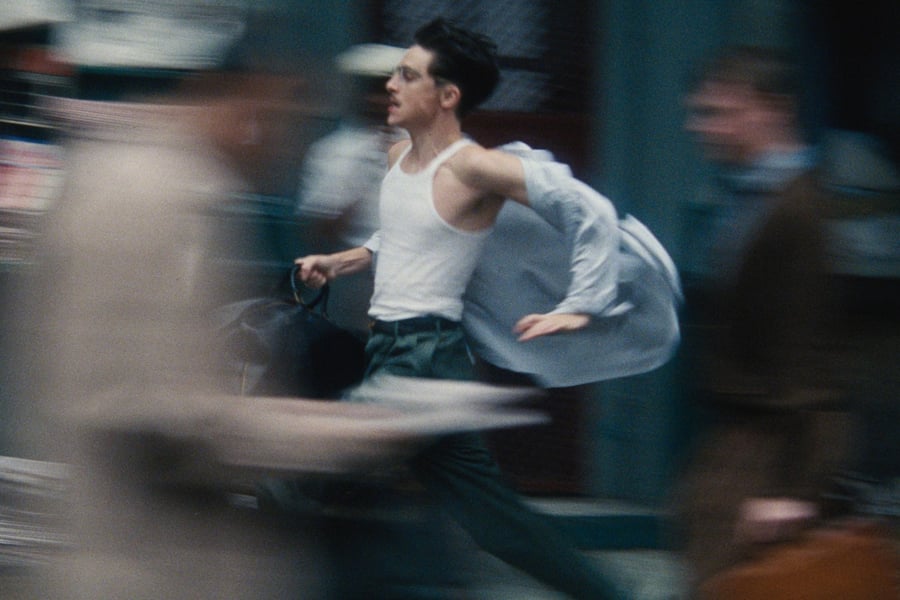
Marty Mauser can’t be stopped. He won’t be stopped. The young man with the Coke-bottle glasses and pockmarked face and ferret-like frame may be one of eight million stories in the naked city known as Manhattan circa 1952. But Mauser refuses to be just another schlemiel working at a shoestore. Luckily, he’s got a plan. It involves being the single greatest table tennis player the world has ever seen. The kid has the willingness to beg, borrow, or steal (mostly the latter) in order to get to London for the sport’s world championship; the confidence to bum-rush his way into the tournament once he’s there; and the talent to go the distance. Mauser has got a genuine shot at the title. He is his No. 1 biggest fan. If only this perpetual fuck-up wasn’t also his own worst enemy.
Imagine Rocky if you substituted ping-pong for prizefighting, Alexander Portnoy for the Italian Stallion, and an egotistical prick for a lovable underdog. You’d have something close to Marty Supreme, Josh Safdie‘s manic character study that doubles as a cracked American success story. Mauser may be loosely — and we do mean loosely — based on five-time world champ Marty Reisman, but he has a lot more in common with the filmmaker’s usual gallery of hustlers, rogues, crooks, and schnooks. Whether solo (see: his 2008 debut The Pleasure of Being Robbed) or in tandem with his brother Benny (Daddy Long Legs, Good Time, Uncut Gems), Safdie specializes in giving sad sacks a sympathetic spotlight while keeping things raw, rough, and paced like a Rube Goldberg machine of chaos. The character he’s dreamed up with co-writer, co-editor, and longtime collaborator Ronald Bronstein may be his most accessible, charismatic loser to date. Mauser recognizes he’s extraordinary; he’s just waiting for everybody else to catch up.
It helps, of course, that Safdie has lots of supreme talent in his corner: cinematographer Darius Khondji (Seven), production designer Jack Fisk (Days of Heaven, There Will Be Blood), costume designer Miyako Bellizzi, composer Daniel “Oneohtrix Point Never” Lopatin. They’re below-the-line legends, the lot of them. The soundtrack is a playlist comprising period-appropriate tunes and Eighties New Wave and post-punk. (Les Paul and Mary Ford, meet Tears for Fears!) Per usual, the writer-director mixes in non-professionals who look like they’ve stepped straight out of a Weegee portfolio with a supporting cast you’d swear was assembled via Mad Libs. Seriously, name another ensemble that boasts Fran Drescher, Tyler, the Creator, Penn Jillette, cult filmmaker Abel Ferrara, NBA hall of famer George Gervin, and Shark Tank‘s Kevin O’Leary?
There’s one person who’s truly channeling Safdie’s grindset obsessions, however, and arguably stands head and slim shoulders above the rest. Timothée Chalamet has played troubadours and sociopaths, chocolatiers and cannibals, messiah figures and broken-hearted boy-wonders. You wouldn’t think a motormouth jerk who’s really the Michael Jordan of ping-pong would be a bespoke role for the star, yet the role fits him like a customized backless jumpsuit. It’s not hard to believe his Mauser could make a fellow shoe salesman liberate the store safe easier with his patter than the pistol in his hand; Marty’s gift of gab is even more aggressive than his serve. The guy’s an aspiring pro athlete but a professional grifter, putting the confidence back into “con artist.”
Of course this nebbish with the rat mustache will talk his way into both the Ritz and the pants of a faded movie star (Gwyneth Paltrow, reminding you how good she was before Goop became her full-time gig), the ultimate seduction by chutzpah. Of course he’ll win over journalists with proto-edgelord pull quotes — “I’m gonna do to Klutsky what Auschwitz couldn’t!” he exclaims, regarding a Hungarian rival; it’s OK though, Mauser says, because he’s also Jewish and “Hitler’s worst nightmare” — and piss off the powers that be. Of course he’ll refuse to kowtow to a fountain-pen magnate (O’Leary), a.k.a. the actress’ husband, then humiliate himself before the tycoon in order to accomplish his goals. Of course he’ll get his married neighbor (I Love LA‘s Odessa A’zion) knocked up, then co-opt her into his schemes. Of course he’ll bilk Long Island rubes out of their dough with a fellow table tennis ace (Tyler) and turn a hotel disaster involving a gangster (Ferrara) and an M.I.A. dog into an extortion plan. You know the fable about the scorpion and the frog? Marty’s the one with the stinger. Everybody else is simply waiting to get stung.
Chalamet doesn’t just lean in to Marty’s less-than-stellar qualities; he turns them into pluses, pitching them as part of the DNA that will allow Mauser to eventually stage something akin to a comeback. You can feel some of the Complete Unknown star’s own reputational baggage being used to good advantage here — not just the inherent confidence that occasionally speed-reads as arrogance, but the striving, the constant need to prove himself, the sort of let-it-blurt attitude that finds the artist formerly known as Lil’ Timmy Tim pining in public to be one of the greats. The irony is that this role bursting with equally naked yearning gets him that much closer to actually demonstrating why he might make that wish come true. It’s the sort of performance that feels like early Pacino or Dustin Hoffman, all twitches and vibrations and seeming like he’s in a constant state of motion even when standing still. And it fuses so well with what we, the viewer, think we know about Chalamet that it begins to blur the boundary in the best possible way.
In other words, Marty Supreme is a testament to the Men Who Would Be King, both the fictional and nonfictional ones. The real regent here, however, is the one actually calling the shots. Josh Safdie would likely cop to identifying with Mauser not wisely but too well; game usually does tend to recognize game. To say that Marty Supreme is autobiographical would be pushing it. But the way the director lends his high-anxiety style of filmmaking to this highly caffeinated Horatio Alger narrative is extremely simpatico. You have to be a hustler to make movies like this in the age of AI and IP, even ones with genuine movie stars in them. It’s in Safdie’s DNA as much as Marty’s. Both end up champions in their own way, and we’re the ones who end up winning.
Love Music?
Get your daily dose of everything happening in Australian/New Zealand music and globally.

From Rolling Stone US

