




























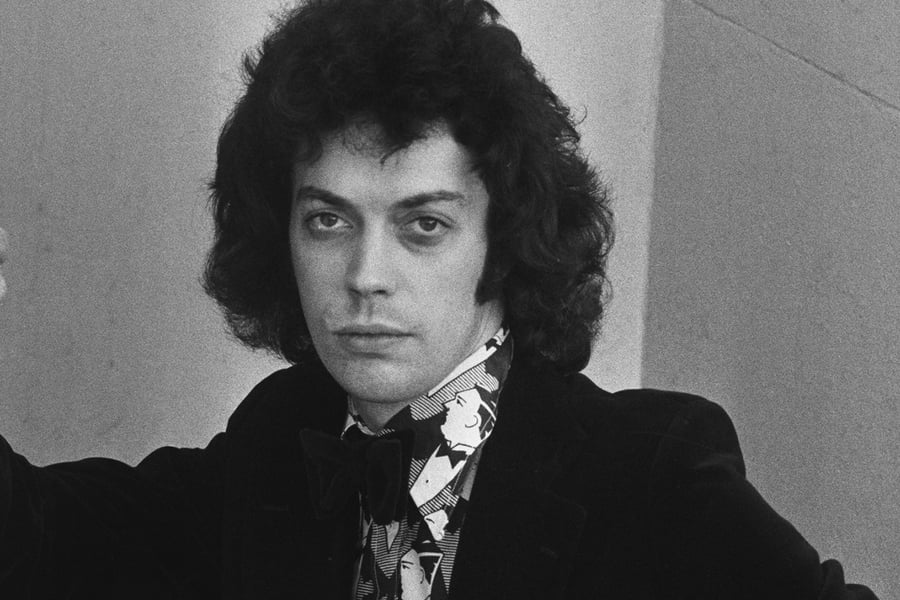
Tim Curry, the actor best known for playing the “sweet transvestite” Dr. Frank-N-Furter in The Rocky Horror Picture Show and Stephen King’s murderous clown Pennywise in It, died Tuesday night, Variety reports. He was 80.
No cause of death has been disclosed. Curry had lived with various ailments following a 2012 stroke.
Curry’s charming swagger, golden voice, and perfect lipstick pout made him a cult-movie legend when The Rocky Horror Picture Show became a midnight-movie success in the mid-Seventies. It was a role that would follow him for the rest of his career. Nevertheless, he’d continue to play oddballs and underdogs — such as the butler Wadsworth in Clue and the Lord of Darkness in Legend (both in 1985) — before scaring the bejesus out of mainstream TV viewers as Pennywise. His deep baritone and British accent helped him find work as a voice actor in cartoons like FernGully: The Last Rainforest (1992) and Star Wars: The Clone Wars (early 2010s).
The actor was born Timothy James Curry in Grappenhall, England, to a Royal Navy chaplain and a school secretary on April 19, 1946. At age six, he became a soprano in his church choir. By his teenage years, he discovered acting and went on to study literature and performing arts at a Birmingham university, according to his 2025 memoir, Vagabond. “At the time I wasn’t really sure whether I wanted to be an actor or a singer, so I talked my way into Hair and postponed the decision for another year or so,” Curry told The New York Times in 1990. He played Woof in Hair in London’s West End in 1968 and went on to appear in other theatrical productions and TV shows.
He landed the role of Dr. Frank-N-Furter — an impish, Frankenstein-like doctor with a fetish for cross-dressing (“He’s the ultimate seducer,” Curry once said) — in 1973 in what was then known as The Rocky Horror Show, a campy sci-fi musical romp that was conceived by Richard O’Brien, who wrote the work’s score, lyrics, and book. Although the actor originally presented the mad scientist as a German, based on the name, he pivoted to doing it in a distinguished English accent after overhearing a conversation on a London bus. “I thought, ‘That’s it, he should sound like the Queen,’” Curry once recalled. When music producer Lou Adler saw the production, he decided to bring it to the Roxy Theatre in Los Angeles, and Curry came along with it.
When Rolling Stone asked Adler in 2015 what struck him about the London production, he answered, “Tim Curry’s legs, to begin with. As much as he had a manly feel about him, it was seeing him dressed as Frank-N-Furter in heels. When it was playing at the Roxy, even if I didn’t go for the whole show, I always made sure I was there for the entrance.”
“It was one of the most blistering, shocking, sexy entrances that has ever been onstage,” Susan Sarandon once said.
Love Music?
Get your daily dose of everything happening in Australian/New Zealand music and globally.

Adler would eventually produce the film version of the work — The Rocky Horror Picture Show, featuring Sarandon, Barry Bostwick, and O’Brien as co-stars — which famously bombed when it came out in 1975 but soon became a midnight-movie sensation where fans would dress up as the characters on the screen, sing along and act out the action, and throw props like rice and toast during key moments of dialogue. Its cult success made it one of the longest-running theatrical releases in history.
In an interview about the movie’s 40th anniversary in 2015, Curry said what still resonated with him about the film was the message of one of its songs. “The thing that resonated for me, more than anything, was ‘Don’t dream it, be it,’ which was a really good slogan,” he told Today.
He took that carpe-diem sentiment and launched a singing career after Rocky Horror, putting out three albums in the late Seventies and early Eighties; his debut, Read My Lips (helmed by Kiss, Pink Floyd, and Alice Cooper producer Bob Ezrin), improbably featured a roots-reggae version of the Beatles’ “I Will.” None of the LPs were massive hits. His biggest musical success was a sax-laden, speak-sung single called “I Do the Rock,” which made it to Number 91 on the Billboard Hot 100 in 1979.
Curry continued acting, earning a Tony in 1980 for originating the role of Wolfgang Mozart in Amadeus, a year after it opened on Broadway. He’d later get Tony nominations for his roles in My Favorite Year (1993) and Spamalot (2005).
“When I was playing Mozart, I really read very little about him, because I thought what was really important was to play not only Peter Shaffer’s Mozart but also the Mozart who’s seen through the eyes of his enemy Salieri,” Curry told the Times in 1990. “I think that if you get too close to the character, if you do too much historical research, you may find yourself defending your view of a character against the author’s view, and I think that’s terribly dangerous.’”
He spent much of the Eighties and Nineties drifting between film and television roles, appearing in Annie (1982), Clue (1985), Legend (1985), and the series Wiseguy (1989). In 1990, he made his unforgettable turn as the demon clown in the TV miniseries adaptation of Stephen King’s It. “I’m fascinated by movie villains,” he said in an interview around the time of his role as Pennywise. “I enjoyed Lon Chaney. In some ways, I think that horror movies have gotten a little too far from the mind.… I personally think that what is most horrifying is the moment of decision behind somebody’s eyes when they decide to kill somebody, rather than [seeing] a pint of blood.”
By the Nineties, he found himself being typecast as “butlers and villains” in U.S. films, but he said such roles were “irresistible to play since they’re much more fun.” He was able to find solace in voice work, lending his pipes to dozens of animated series and movies, from FernGully to the live-action cartoon Dinosaurs (1992 to 1994). His vocal portrayal of Captain Hook in Peter Pan and the Pirates (1991) won him a daytime Emmy. He’d play side roles in The Hunt for Red October (1990) and Charlie’s Angels (2000), and he made appearances on series including Criminal Minds, Monk, and Will & Grace.
In 1990, Curry outlined what he felt was a “moral and political responsibility of the artist” that he took into account when he decided on roles. He carefully considered what a role said about the world, asking himself whether or not he should take it on. “They’re the kind of questions any artist in the 20th century would be asking himself,” he told the Times. “Why am I doing this? Am I doing this for any kind of really valid reason? I think artists are driven by the engine of their own talent, but it’s a question of what use they put it to.”
In 2012, Curry suffered a stroke at his home in Los Angeles and was seen in a wheelchair in subsequent years. He generally retreated from public view, making a rare appearance as the criminologist in Fox’s TV remake of The Rocky Horror Picture Show in 2016. It was a full-circle moment for the actor who had spent much of the previous four decades distancing himself from Frank-N-Furter. “I finally sorted through that,” he told the Times in 2015 of his ambivalence toward Rocky Horror. “I realised I’d been lucky. I still feel lucky.”
Despite never becoming a leading star in a major film, the actor, who kept his private life under wraps, was happy to work in a niche later in his career, whether in voice work or in front of the camera, because it didn’t dominate his life. “I’ve been dealing with [fame] for quite a long time, and I’ve always been pretty slow to promote myself,” he said in 1997. “I’ve managed to work pretty steadily without having to throw myself at the public and say, ‘Here I am.’”
From Rolling Stone US

