





























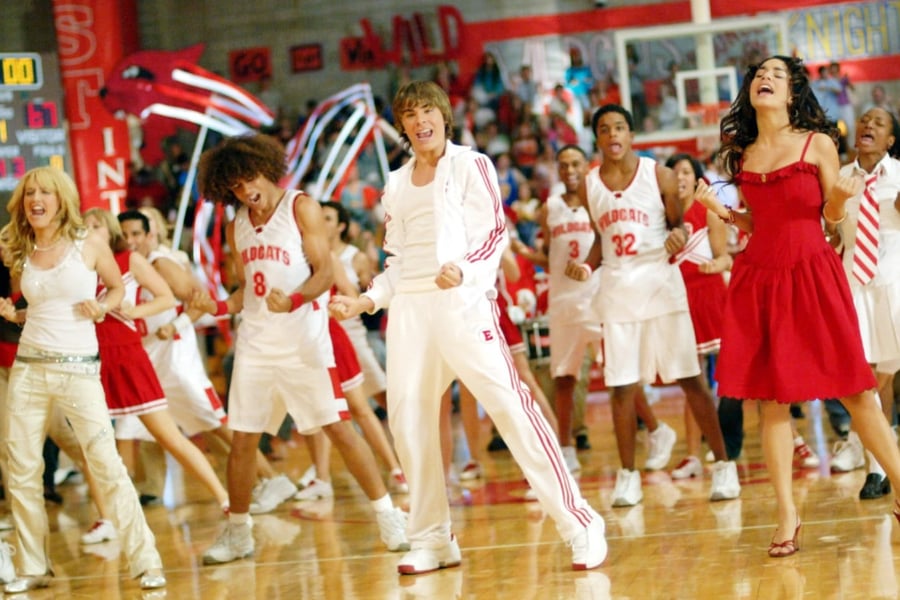
Inside the walls of East High School, there are only two things that really matter: basketball and the dulcet tones of musical theater.
This was the world the Disney Channel Original Movie High School Musical dropped waiting preteens into when it debuted on Jan. 20, 2006. Twenty years later, High School Musical and the subsequent two films stand as one of the most impactful series ever created by the children’s channel — not only setting records for DCOMs, as their devoted fans call them, but remaining pop culture fixtures long after the curtain closed on the final film’s theatrical release in 2008.
There are many arguments to be made about why this 2000s era of Disney movies seem to have more staying power than originals released during the age of streaming, like less cable viewership, less content made specifically for older age groups, or reduced attention spans. But one lesson from the success of High School Musical is abundantly clear: The films worked, and were loved, because they took the concerns and frustrations of being a kid and didn’t make them the butt of the jokes. Yes, the charting songs that leaned far more pop than traditional musical theater acted as certified earworms and the group choreography that was memorable and easy enough for children to learn. But by also taking the inner lives of teens seriously, the creators of High School Musical built a film that became a generation’s touchpoint for chasing what you love.
Directed and choreographed by Kenny Ortega (Hocus Pocus, Newsies), High School Musical centers around basketball player Troy Bolton (Zac Efron), as the captain of the basketball team. As he enters his junior year, he feels forced to choose between his skill on the court or a newly discovered passion: singing. This revelation is jumpstarted when he meets Gabriella Montez (Vanessa Hudgens) at a New Years Eve party and they share a magical duet, “Breaking Free.” The two think they’ll never see each other again. There’s also a revolving cast of characters, like musical theater snob Sharpay (Ashley Tisdale), her pianist brother Ryan (Lucas Grabeel), and Troy’s puppy-dog-esque best friend Chad Danforth (Corbin Bleu), all with varying levels of excitement about Troy’s sudden interest in arpeggio scales.
But when Gabriella is revealed to be a new student at East High, her inability to agree to the set social hierarchy quickly catches fire. She’s a STEM wiz who loves to sing and has intense stage fright. Why shouldn’t Troy, a basketball star, also join her on stage? These moments play out in the musical number “Stick to the Status Quo,” where groups in the high school cafeteria remind outliers “It is better by far/ to leave things as they are.” As Troy’s commitment to basketball wavers, his frustration leek out on the court in “Get’cha Head In the Game,” as a simple basketball practice is interrupted by his spotlighted questioning, “Why am I feeling so wrong/My head’s in the game, but my heart’s in the song.”
High School Musical is by no means a grounded Disney offering. The idea of a high schooler’s biggest problem being choosing between a high-profile basketball game and the callbacks for a literal high school musical is obviously comical. In fact, looking at the film as an adult can feel a tad baffling, watching teens sweat and cry and emote over what feel like non-issues. But to kids watching High School Musical on its release, the film touched on some of the biggest issues that can take over a teen’s mind: parental pressure, future careers, grades, detention, school work, romance, friendships, and the knowledge of a new phase of life rapidly approaching over the horizon. Gabriella’s concerns about school aren’t vanity; she knows high grades and participation could mean her single mother won’t have to take out loans to pay for her college. Troy’s fears aren’t just about playing basketball professionally, he’s also afraid choosing music will mean letting down his dad and best friend. Even Ryan and Sharpay, in their sequined garbs and professional mics, use the theater program as a way to claim the attention they’re not getting at home. By making the characters’ concerns full-length musical numbers, High School Musical acknowledges just how all encompassing these problems can feel.
There’s plenty of humour — like basketball player Zeke (Chris Warren) and his obsession with perfecting a chocolate chip cookie recipe or Sharpay and Ryan’s matching outfits and vocal warmups. But the kids are never the butt of the joke. That usually falls to the adults, like the constant bickering between Mrs. Darbus (Alyson Reed), the music teacher, and Coach Bolton (Bart Johnson), Troy’s dad. There’s also the Evans parents, a rich white couple who have so much free time they’ve decided to vaguely commit to Buddhism, leaving them too busy buying new saris to actually parent. But in a medium dominated by villains and heroes, the films spend time making it clear to audiences that even characters that might act as plot foils have their own worries and fears.
Love Music?
Get your daily dose of everything happening in Australian/New Zealand music and globally.

One of the reasons High School Musical feels like such an anomaly now because of how Disney Channel original movies changed following its success. Prior to High School Musical, the original films that debuted on the channel were purposefully low budget, often cast unknowns or were essentially two hour long episodes for existing shows. This included films like the 1993’s Heidi, 1998’s Halloweentown, or 2001’s The Luck of the Irish. High School Musical followed a similar format — Efron, Tisdale, and Hudgens were all virtual unknowns before starring in the musical. But High School Musical’s ratings smash made the movie franchisable and sellable — something far more common for the films given the budgets and attention warranted by a theatrical release. There were HSM necklaces, binders, t-shirts, books; pretty much everything Disney could fit the logo onto. But this wasn’t a new princess — it was a made-for-tv movie.
The channel didn’t have another movie come close to High School Musical’s ratings until the 2008 premiere of Camp Rock. After that, Disney Channel Originals mainly became vehicles for already existing Disney stars with their own television series. These were semi-original stories, but had already established stars to act as the main draw, like the Selena Gomez and Demi Lovato film Princess Protection Program or Zendaya and Bella Thorne’s Frenemies in 2012. Even when Disney brought back Ortega for their Descendants franchise in 2015 — a film about the children of Disney villains — IP took precedent time and time again above the story. (By the third film, they had run so far out of main Disney villains that they resorted to using periphery characters like the son of Mr. Smee from Peter Pan.)
At a time when popular culture often eschews family friendly versions of high school depictions for gritty realistic takes on adolescence, High School Musical remains a pop culture fixture. Not because the average teen sees their lunchroom break into song every single day, but because everything feels bigger, larger, world-ending when you’re that age. And High School Musical invites people to sing about it — until they break free of what’s holding them back.
From Rolling Stone US

