



























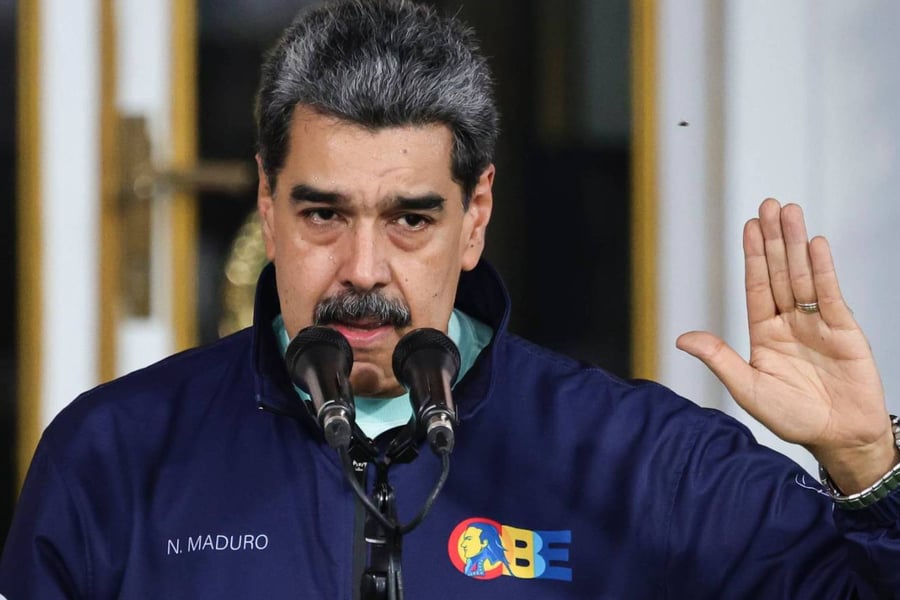
In the early hours of Saturday, President Donald Trump announced that American forces had carried out a “large scale strike against Venezuela and its leader, President Nicolas Maduro,” capturing both him and his wife, Cilia Flores, in a not-so-covert operation that rained American munitions over Caracas, Venezuela’s capital.
Trump’s announcement was followed by a statement from Attorney General Pam Bondi that Maduro “will soon face the full wrath of American justice on American soil in American courts,” on newly filed charges related to “Narco-Terrorism Conspiracy.”
The United States has not deposed a foreign leader in such a direct manner in decades, and concerns were immediately raised about the legality of such a move against a sovereign nation. Details of the operation and its justification remain hazy, and the action is sure to have a dramatic impact on the region and the world. Here’s everything we know so far.
Who is Nicolás Maduro?
Nicolás Maduro has been the president of Venezuela since 2013, after serving as vice president under Hugo Chavez. His tenure atop the oil-rich nation has been characterized by economic collapse, rights abuses, and illegitimate elections. The United States indicted him in 2020, under Trump’s first administration, on charges related to corruption and narco-terrorism. The second Trump administration slapped additional charges on Maduro on Saturday, after U.S. forces attacked Venezuela and captured him.
In 2025, Maduro began a third six-year term as president of the country despite credible evidence that he lost the 2024 election by a significant margin to opposition candidate Edmundo González, a stand-in candidate for Maria Corina Machado, a popular opposition leader who had been barred from running against Maduro.
What exactly happened in Caracas?
Following weeks of escalating military operations and deadly U.S. airstrikes against small vessels in the Caribbean that the Trump administration claims were running drugs, the U.S., including a Delta Force unit, attacked the Venezuelan capital on Saturday.
A spokesperson for the Venezuelan government confirmed to multiple media outlets that at least four strategic Venezuelan targets had been hit by U.S. airstrikes, including Fort Tiuna, Caracas’ primary military base, and La Guardia port.
Love Music?
Get your daily dose of everything happening in Australian/New Zealand music and globally.

In an interview on Sunday with Fox News, Trump — who watched the strikes for his Mar-a-Lago residence, where he was spending the holidays — said the Venezuelan first couple were captured in a “highly guarded” compound. “It was like a fortress, actually,” he added. The president revealed that the operation was originally scheduled to take place on Christmas, but was delayed due to poor weather.
According to sources who spoke to CNN, Maduro and his wife were sleeping when captured, and dragged from their bedroom by elite U.S. forces.
The president told Fox News that the couple were transferred by helicopter to the U.S.S. Iwo Jima, which will transport them to New York, where the new charges against Maduro and his wife were filed.
Were there any casualties?
Trump told Fox News that there were “a few injuries but no deaths on our side.”
“I think we had nobody killed, I have to say, because a couple of guys were hit. But they came back and they’re supposed to be in pretty good shape,” he added. “We lost no aircraft. Everything came back. One of them was hit pretty hard, a helicopter, but we got it back.”
In a televised appearance, Venezuela’s attorney general, Tarek William Saab, stated that “innocent victims have been mortally wounded and others killed by this criminal terrorist attack,” but he did not provide casualty figures.
In a press conference on Saturday, Trump said that the attack had been “deadly.”
What are Maduro and Flores charged with?
In 2020, under the first Trump administration, Maduro (along with over a dozen other Venezuelan officials associated with his government) was indicted on charges related to alleged involvement in “a corrupt and violent narco-terrorism conspiracy between the Venezuelan Cartel de Los Soles and the Fuerzas Armadas Revolucionarias de Colombia (‘FARC’).”
The charges against Maduro included narco-terrorism conspiracy, cocaine importation conspiracy, possession of machine guns and destructive devices, and conspiracy to possess machineguns and destructive devices. On Saturday, Bondi made public a superseding indictment adding the Venezuelan first lady to the charges against her husband.
Does the U.S. have the authority to do this?
The capture of Maduro raised immediate concerns about its legality under international law. The Trump administration isn’t the only government to desire Maduro’s removal from power, but direct intervention to force his ouster by U.S. military operatives appears to be a direct violation of Venezuelan sovereignty.
Members of Congress have indicated that they were not informed of the operation ahead of time, and that the Trump administration did not seek constitutionally required congressional authorization for its now-months-long military campaign against Venezuela.
“Secretaries [Marco] Rubio and [Pete] Hegseth looked every Senator in the eye a few weeks ago and said this wasn’t about regime change. I didn’t trust them then and we see now that they blatantly lied to Congress,” Sen. Andy Kim (D-N.J.) wrote on social media. “This strike doesn’t represent strength. It’s not sound foreign policy. It puts Americans at risk in Venezuela and the region, and it sends a horrible and disturbing signal to other powerful leaders across the globe that targeting a head of state is an acceptable policy for the U.S. government.”
In a statement released Saturday, the United Nations wrote that “independently of the situation in Venezuela, these developments constitute a dangerous precedent. The Secretary-General continues to emphasize the importance of full respect — by all — of international law, including the UN Charter. He’s deeply concerned that the rules of international law have not been respected.”
What is the Trump administration claiming?
The United States has not recognized Maduro’s government since 2019, when the first Trump administration endorsed Venezuelan opposition leader Juan Guaidó as the legitimate president of Venezuela.
On that basis, the Trump administration is arguing that their capture of Maduro does not constitute a violation of Venezuelan sovereignty as it is not a recognized government.
In response to the news, Secretary of State Marco Rubio re-shared a July post in which he wrote that “Maduro is NOT the President of Venezuela and his regime is NOT the legitimate government.”
“Maduro is the head of the Cartel de los Soles, a narco-terror organization which has taken possession of the country, and he is under indictment for pushing drugs into the United States,” the post read.
The U.S. government has for months been using allegations of narco-terrorism as a justification for its escalating military actions in the region — with particular focus on the Tren de Aragua cartel. However, a 2025 National Intelligence Council report found that “the Maduro regime probably does not have a policy of cooperating with TDA and is not directing TDA movement to and operations in the United States,” adding that “the small size of TDA’s cells, its focus on low-skill criminal activities, and its decentralized structure make it highly unlikely that TDA coordinates large volumes of human trafficking or migrant smuggling.”
Regardless of the on-the-ground reality, the Trump administration is poised to continue an interventionist policy throughout the Americas. According to the 2025 National Security Strategy, Trump’s government intends to “reassert and enforce the Monroe Doctrine to restore American preeminence in the Western Hemisphere,” adding “Trump Corollary” to the influence principle.
“They now call it the ‘Don-roe Doctrine,’ Trump said Saturday, “American dominance in the Western hemisphere will never be questioned again.”
Who takes over in Venezuela?
It’s not clear.
When asked on Fox News, Trump refused to outright endorse Venezuelan opposition leader Maria Corina Machado, who was awarded the Nobel Peace Prize last year. “We’re going to have to look at it,” the president said, adding that Venezuela has “a vice president, as you know, and I don’t know about what kind of election that was.”
In a press conference late Saturday morning, Trump indicated that his administration intended to “run” Venezuela for the time being. “We’re going to run the country until such time as we can do a safe, proper and judicious transition,” he said, adding that he intended to “have our very large United States oil companies, the biggest anywhere in the world, go in.”
“We are ready to stage a second and much larger attack if we need to do so,” he warned.
Corina Machado, who was barred from seeking office by the Maduro regime, was not the official candidate in the 2024 Venezuelan election. Instead, she ran as the shadow candidate behind former diplomat Edmundo González, who is currently living in exile in Spain after being targeted by the Maduro regime.
The majority of Maduro’s inner circle and heads of government remain in power in Venezuela, and it’s unclear if the political opposition will be able to gather the institutional support necessary to force a full dissolution of Maduro’s government, or what role the U.S. will play.
From Rolling Stone US

