





























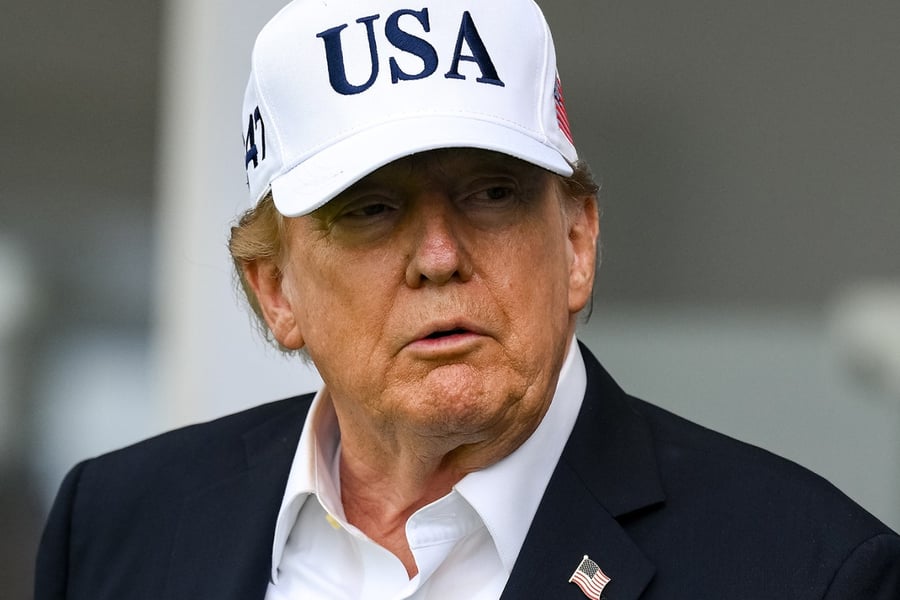
President Donald Trump is aware of the panic over the possibility that one day we will all be ruled — or worse — by machines. But when asked directly about artificial intelligence, he doesn’t seem all that worried.
On Monday, the president claimed that fears about AI-driven social collapse were a “HOAX,” later describing himself as the “Hoax Buster” and comparing AI scepticism to the “Global Warming Scam.”
“Concerning AI, when, in the History of Business, did anyone see the Leaders of an Industry call for Regulation that, if strongly implemented, will drive them into oblivion and bankruptcy?” Trump wrote on Truth Social. “AI taking over the World, destroying Humanity, and all other things bad, is a HOAX.”
Trump wrote hours earlier that the only “guardrail” necessary is a “High IQ” president.
Trump’s comments come in the midst of a chaotic media frenzy around the safety of AI, one that was kicked off by a series of high-profile industry defections and loud warnings about the dangers of the rapidly developing technology. On Sept. 8, a prominent AI safety researcher named Jacob Coxton resigned from Anthropic, one of the industry’s largest companies, claiming that both it and its main rival OpenAI were acting irresponsibly and “gambling with our lives.”
“The people building AI earnestly believe that it could kill us all by the end of the decade,” Coxton wrote on X. “This is not a marketing stunt.”
I resigned from Anthropic today. I spent the last three years doing pretraining research at both OpenAI and Anthropic. Neither company is acting responsibly. They are racing straight to self-improving superintelligence and gambling with our lives. More thoughts below.
Love Music?
Get your daily dose of everything happening in Australian/New Zealand music and globally.
— Jacob Coxon (@hilbertspaess) September 9, 2026

Coxton’s announcement prompted an industrywide response, including a lengthy essay from Anthropic’s CEO Dario Amodei that acknowledged and even agreed with many of Coxton’s concerns, urging peers in the industry to begin limiting the capabilities of the software. AI stocks took a nosedive, and politicians started facing consistent inquiries as to their stances on various points of contention in the industry.
The core of the AI-phobic argument is that the unrestricted growth of AI technology is approaching a point in which computer algorithms become so advanced that they are able to improve themselves — and even make decisions — without the input of human programmers. (Amodei calls it “recursive self-improvement.”) That future would mean that AI systems would gain the ability to affect the world outside of human input, which people fear could be enormously damaging if the algorithms decided to act maliciously. It’s not a singularity, per se, but more a runaway train on a global digital scale.
Anthropic and other AI companies appear to be conscious enough of this that they have actively asked for more government regulation, admitting that the free-market system they’ve been working in could produce a disastrous outcome as competitors race to outdo each other.
The AI debate is a thorny, deeply complex topic, one that is clearly crying out for a steady hand to moderate the relationships between government regulators and the anarchic mess of private companies all seeking to profit off the technology. But instead, we have Trump, who has been unclear, if not clueless, about the issue and how he plans to deal with it.
When asked last week about putting up guardrails for the industry a day after Coxton’s social media post, Trump brushed off the threat, claiming “we’ll have a little gear” to flip that will stop the “robots” if we “really don’t like” them.
Q: The worst case is that AI will turn against humanity. Do we have guardrails?
Trump: It’s going to be fine. We’ll always have something to stop them. We’ll have a little gear. Boom. ‘I really don’t like that robot.’ pic.twitter.com/uQOWJGb4fN
— FactPost (@factpostnews) September 9, 2026
A few days later, Fox News aired an interview in which the president claimed that the U.S. had “the biggest guardrails” on the rapid progress of AI, and that he said would keep Americans safe.
The president’s vague answers cover a ton of ground with very little specificity. He claims that the U.S. had very smart people working on AI security, that China had very few, and that the U.S. was nevertheless winning the AI race with its major geopolitical rival, calling AI a “golden goose.”
Ingraham: What guardrails can be in place so we ensure that we can win the AI race against China but still reassure the American people who are freaking out about data centers and reassure them that we are on the right course and not endangering humanity?
Trump: Let’s talk about… pic.twitter.com/f9Gq8z51nz
— Acyn (@Acyn) September 11, 2026
Trump delivers this kind of mushy rhetoric on a daily basis. On Sunday, for example, he told reporters that he personally uses AI, but then immediately clammed up when they asked him what he used it for.
It seems like the administration as a whole is struggling to find a lane on how to deal with an urgent societal crisis. On Monday, Vice President JD Vance tried to play the optimist, saying, “I don’t think Americans should be scared of anything,” in relation to the technology.
Vance continued, taking a line that seemed to be a more measured version of Trump’s Truth Social post the same day.
“Personally, I feel a little bit weird about the fact that you have so many frontier AI tech companies kind of coming to the government and begging the government to regulate them. It feels a little bit to me like a bit of a Trojan horse,” Vance said. “So I think we just have to be careful about this.”
The administration doesn’t seem to be exercising much care, though, decrying regulation, pushing data centre construction, and generally embracing AI at every opportunity. Later on Monday, the Pentagon posted an edgy graphic touting an “AI-FIRST WAR DEPARTMENT” and noting that prioritising “Americanism” over “effective altruism” means the military must be “AI DOMINANT.”
Americanism, not effective altruism.
The United States will continue to be AI DOMINANT! 🇺🇸 pic.twitter.com/CQDt5s72Jl
— Department of War CTO (@DoWCTO) September 14, 2026
The Trumpian lane, then, appears to be that concerns over AI are overblown. With the stock market so heavily leveraged toward several massive companies — like OpenAI and Anthropic — that are riding on the success of the technology, any pushback can have wider economic effects, which would be more trouble for a president whose approval ratings are already in the dirt. It’s also clear that Trump sees AI as a zero-sum game between himself and China — telling Fox News that he liked the saying “whoever wins AI, wins.”
There also appears to be a dash of old-fashioned cronyism. On Monday, Nvidia CEO Jensen Huang reportedly pushed back on the rampant AI doomerism while at a conference hosted by the Trump-friendly tech podcast “All-In.” While onstage for an interview, Huang received a call from Trump, put it on speakerphone for the audience to hear, and then thanked Trump for his Truth Social posts. Huang’s company makes the computer chips that are essential for running most AI computations, and he has been close with Trump in recent years, speaking with him several times over the phone, including once at an internal company all-hands meeting.
It’s worth noting that some of the loudest cautionary voices from inside the AI industry — like the Anthropic CEO, Amodei — have clashed with Trump in the past. In February, as the Iran war kicked off, the Trump administration cancelled a $200 million contract with Anthropic after the company refused to allow the Department of Defense to use certain features of its Claude AI for surveillance or autonomous weapons. In response, Trump designated Anthropic’s products a “supply risk,” severely damaging their ability to compete for government contracts. A judge recently found that Trump’s retaliation was “illegal and baseless.”
In a sign of how sentiment toward the industry may be shifting, Elon Musk — a Trump ally who was so incensed about Anthropic’s refusal to allow the military to use its technology earlier this year that he alleged the company “hates Western civilisation” — responded to its CEO’s warning this weekend by writing, “Dario is right.”
Trump hasn’t been swayed, though — at least not yet. On Monday, Speaker of the House Mike Johnson told reporters that the president would lead a meeting between Congress and AI leaders by the end of this week.
Only a supercomputer — preferably, one programmed with stock prices — could predict what his rhetoric will look like by then.
From Rolling Stone US

