






























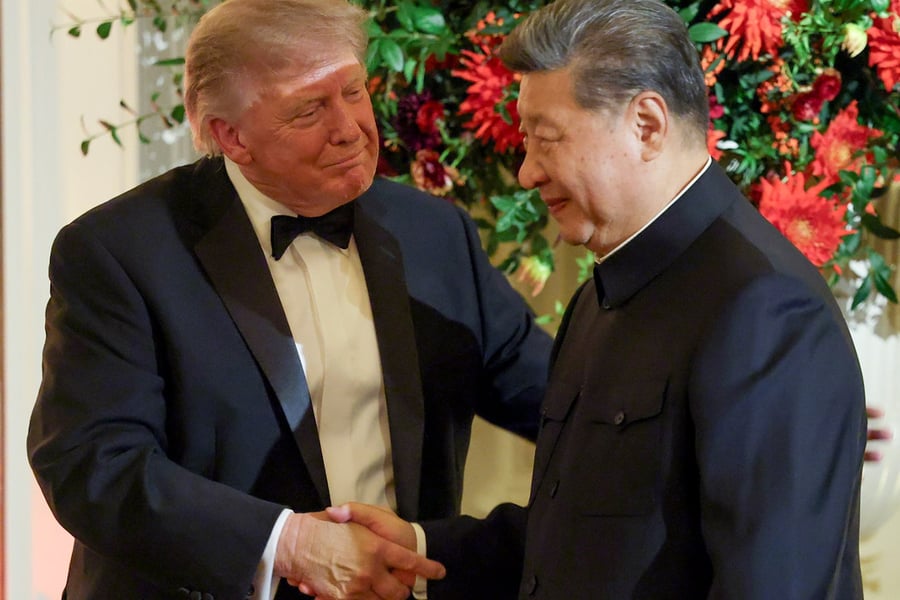
During Chinese President Xi Jinping’s lavish state visit to Washington, D.C., last week, Donald Trump supposedly made the rival a tantalizing offer: How would you like to buy some of America’s finest weaponry?
In the past, U.S. military technology has been a closely guarded secret, especially as China is concerned. Special forces soldiers and spies have fought and died to keep pieces of fallen fighter planes out of Chinese hands, while Chinese intelligence services have devoted decades of work to cracking the secrets of the U.S. arms industry. But according to David Perdue, the U.S. Ambassador to China, Trump mentioned that the U.S. could send some of its weaponry to China, for a price.
“President Trump continues to say, ‘Hey, we sell arms to other people around the world,’” Perdue said on Fox News Sunday. “He actually asked President Xi [if he] would he like to buy some at one point.”
Trump denied this while fielding questions from reporters on Monday, claiming that he and Xi didn’t discuss the U.S. sending weapons to China. “He may have been talking about Taiwan. I think he was talking about Taiwan,” the president added, noting that he would have to ask Perdue about it.
If Trump did make the offer, it’s easy to pass it off as an off-handed comment, the kind of thing he tosses off to a world leader without thinking it through. And the actual institutions in charge of prospective arms deals have been quick to deny that there is any kind of U.S.-China armed trade deal in the works. The White House and State Department both issued denials, with the latter noting that U.S. law would prohibit an arms sale to China.
And yet, Trump has done exactly this kind of precedent-breaking international maneuver before. He accepted a ludicrously expensive jet from the Qatari royal family, despite glaring security flaws and a clear conflict of interest. He recently agreed to send Israel $2.8 billion in taxpayer-purchased arms. And an arms deal to China would certainly fit within Trump’s worldview: everything is deals, after all, so why shouldn’t the military be on the table?
U.S. arms sales to Taiwan have been a major factor in the relationship between the two countries for decades. Trump has already indicated that he takes a softer stance than his predecessors there: He has been delaying the latest such deal, a $14 billion shipment that has already been approved by Congress for months.
Love Music?
Get your daily dose of everything happening in Australian/New Zealand music and globally.

The worst problem with an arms deal to China, however, is that we don’t know where those weapons will eventually end up. Sure, the same could be said of most U.S. arms deals, but China is actively arming and allowing a flow of technology to states whose interests are diametrically opposed to the United States. Chinese arms have been flowing to both Russia and Iran, not to mention North Korea, for years. China’s support of smaller adversary states is a large part of how it balances the scales with the much-larger U.S. military when it comes to advancing their geopolitical ambitions.
But it’s been clear throughout both his terms in office that Trump doesn’t view the world in those kinds of nuanced, layered terms. The United States is the greatest weapons manufacturer that has ever existed. We have things that everyone wants. If there’s money to be made, why not sell? After all, if anything bad happens as a result, he won’t be the one paying the price.
From Rolling Stone US

