




























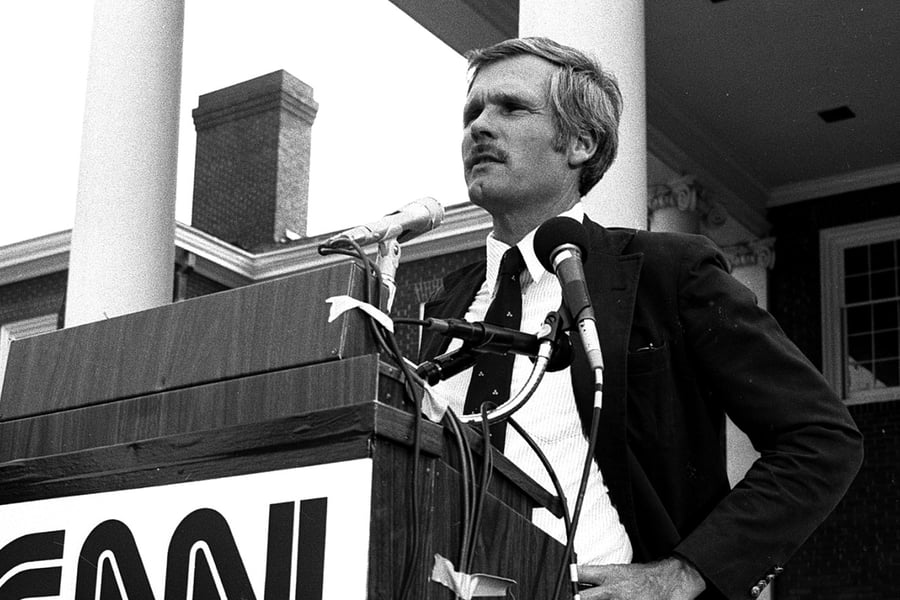
Ted Turner, the media mogul and philanthropist behind the cable channels CNN, TBS, TNT, Turner Classic Movies, and the WCW who also courted controversy, died at his home near Tallahassee, Florida on Wednesday, according to The New York Times. A cause of death is not yet public, though Turner was diagnosed with Lewy body dementia in 2018; he recovered from a mild case of pneumonia in 2025, according to CNN. He was 87.
Turner’s vision of a 24-hour news station revolutionized both news and TV when he launched the Cable News Network in 1980, foreshadowing the internet’s immersive news environments. “I worked until 7 o’clock, and when I got home the news was over,” Turner once said, per CNN. “So I missed television news completely. And I figured there were lots of people like me.”
The channel’s instant success allowed him to launch Turner Broadcasting System, better known as the “superstation” TBS, which broadcast sports and entertainment in the early Eighties five minutes after the hour and half-hour marks of on-the-nose corporate TV, in case viewers were flipping channels.
In 1988, he launched a sister channel, Turner Network Television (TNT), which initially showed classic movies from MGM’s archives, which Turner bought in 1985. Turner Classic Movies, which first aired in 1994, took over classic movies as TNT began broadcasting more sports. The Cartoon Network arrived in 1992, showing the classic Hanna-Barbera cartoons Turner acquired. In 1996, TBS merged with Time Warner to become one of the world’s biggest media companies.
“Ted was an intensely involved and committed leader, intrepid, fearless and always willing to back a hunch and trust his own judgement,” Mark Thompson, Chairman and CEO of CNN Worldwide, said in a statement.
Nicknamed the “Mouth of the South,” Robert Edward “Ted” Turner III was born to cotton farmer Robert Jr. and the daughter of a grocery chain owner, Florence Rooney, in Cincinnati on Nov. 19, 1938, though Ted grew up in Georgia. After college, Turner worked for his father’s company, Turner Outdoor Advertising, but also spent time partying and sailing. (He’d later be crowned Yachtsman of the Year by the United States Sailing Association in 1970 and 1973.) When his dad died by suicide, Turner defied advice and invested in an Atlanta TV station, which he dubbed WTCG (Turner Communications Group), in 1970, kickstarting his TV career.
Turner’s investment in the station, which plunged him into debt, portended the volatile way he conducted business. He went deeper into debt in 1976 when he bought the Atlanta Braves at a nadir, investing $500,000 cash and committing himself to $8 million at six percent interest over the next decade. The Times notes that the team is now worth $1.175 billion. He broadcast all of the Braves’ games on WTCG. Another risky expenditure was paying to use an RCA satellite to syndicate his station, renamed TBS, around the country, beginning in 1976.
Love Music?
Get your daily dose of everything happening in Australian/New Zealand music and globally.

“I never worshiped money,” he told Time in 2008. “I started from a middle class family. I didn’t finish college because I couldn’t afford to.”
As his profile expanded, so did his personal legend. Allegations of racism and singing Nazi songs outside a Jewish frat house while in college and placing KKK signs outside a Black frat house eventually circulated (and he made further racist and antisemitic remarks, suggesting unemployed Black people could transport missiles on their backs for a missile program in 1985.) Portraits of him as a cheating drunk, who was unfaithful to his first wife, Julia Nye, also surfaced. The philandering continued into his second marriage, to Jane Smith. He had children with both women.
Although Turner claimed to be an ultra-conservative Republican, he befriended Fidel Castro (“Castro’s not a Communist,” Turner reportedly once said, “he’s like me, a dictator.”) and defended China’s communist government, according to the Times. He also angered conservatives by giving $1 billion to the United Nations (UN) to aid refugees and provide humanitarian help to countries in need, and bemused people in favour of hunting, a sport he enjoyed, by reserving land for nature preserves.
“There’s a lot of people who are awash in money they don’t know what to do with,” Turner told Larry King after donating the money to the UN. “It doesn’t do you any good if you don’t know what to do with it. I have learned the more good that I did, the more money comes in. You have to learn to give. You’re not born as a giver. You’re born selfish.”
Turner later married Jane Fonda, a liberal environmentalist nicknamed Hanoi Jane for decrying the U.S. invasion of Vietnam, though his infidelity continued and the marriage ended a decade after “I do.”
But it’s Turner’s creation of never-ending news that may be his longest-lasting political legacy, as it paved the way for MSNBC and Fox News. The popularisation of personalities like Lou Dobbs and Larry King paved the way for Fox News’ Sean Hannity and Greg Gutfeld. But the station also made great strides in journalism, too, earning a Peabody Award for its coverage of the Persian Gulf War, positioning Turner as Time’s Man of the Year in 1991.
Around this time, Turner’s fortunes turned, as his investments in film properties began paying off. He now owned the rights to Gone With the Wind, The Wizard of Oz, Casablanca, and Citizen Kane, as well as The Flintstones and The Jetsons. His ballooning fortune reached a peak when he accepted $7.5 billion in Time Warner stock to step down as CEO of TBS when the companies merged (eventually becoming much more when AOL purchased Time Warner for $160 billion, before the dot-com bubble burst). Turner resigned from the board of the company in 2003. He subsequently lost control of CNN, the Braves, the basketball team the Atlanta Hawks, and other business holdings.
In 2008, Turner mused on his legacy of creating 24-7 news in an interview with Time, responding to a question about whether he worried constant news diminished the value of the news. “No,” he said. “I think it whets people’s interest.”
From Rolling Stone US

