





























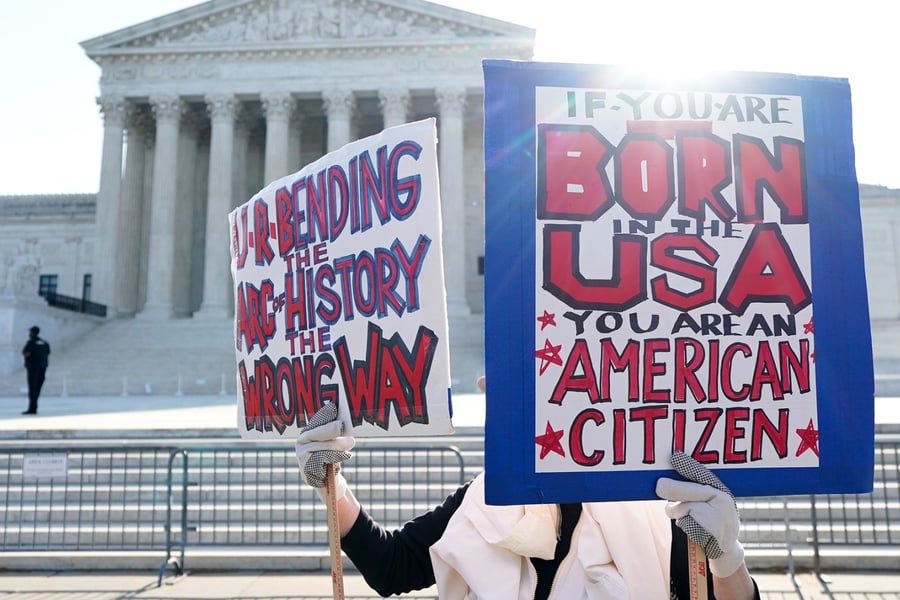
The Supreme Court ruled on Tuesday that birthright citizenship — which guarantees citizenship to anyone born or naturalized in the United States — is constitutional.
“Children born in the United States to parents unlawfully or temporarily present are ‘subject to the jurisdiction’ of the US and are citizens at birth under the Fourteenth Amendment’s Citizenship Clause,” Chief Justice John Roberts wrote in the majority opinion.
The ruling shouldn’t be too shocking, considering the 14th Amendment is pretty explicit in guaranteeing the right, but Donald Trump and his administration have long been claiming that it shouldn’t apply to everyone. Trump issued an executive order almost immediately after retaking office last year attempting to nullify birthright citizenship, arguing that the amendment’s “subject to the jurisdiction thereof” stipulation leaves room to exclude certain categories of people.
Trump’s order was challenged in court, and lower courts subsequently halted its implementation. The president appealed, and the Supreme Court agreed to take up the case. The justices heard oral arguments in April, and appeared skeptical of the government’s case against the right.
Conservative Justice Amy Coney Barrett joined Roberts and the court’s three liberal justices in upholding birthright citizenship. Conservative Justices Clarence Thomas, Samuel Alito, and Neil Gorsuch dissented. Conservative Justice Brett Kavanaugh partially dissented, but agreed Trump’s executive order should be struck down.
Trump has been railing against the right to citizenship throughout his second term, calling it a “hoax” and a “scam” and claiming that American cannot live “with the shackles of birthright citizenship.” The president seemed aware that the Supreme Court could rule against him, sharing an article Tuesday morning about how his efforts to end birthright citizenship “may succeed with or without SCOTUS.” The piece noted that congressional Republicans are waiting in the wings with legislation aimed at curtailing the right, should the Supreme Court deem it constitutional.
Following the ruling on Tuesday, House Speaker Mike Johnson (R-La.) said he was “disappointed,” telling reporters that “we will continue to look at that” and that “you can amend the Constitution to fix that.”
Love Music?
Get your daily dose of everything happening in Australian/New Zealand music and globally.

Trump weighed in a few hours later: “The Supreme Court upheld Birthright Citizenship, which is too bad for our Country, but we can easily make it up in Congress through Legislation, with the support of the President, that has now been determined during this process. No long and unwieldy Constitutional Amendment is necessary! Congress should start TODAY to work on ending expensive and unfair to our Country, Birthright Citizenship. They will have my Complete and Total Support!”
Rolling Stone spoke to attorney Christopher M. Lapinig about the significance of birthright citizenship last year. “It essentially was part of the efforts to make sure that slavery would not happen again, or anything resembling slavery would not happen again. And so the drafters of the 14th Amendment were abolitionists, right? They were anti-slavery, and they created this language with the idea of anti-subordination in mind,” Lapinig explained. “And what that means is essentially that they wanted to make sure that no person in the United States would be subordinated or relegated to second-class citizens or something else by virtue of their race or their ethnicity or national origin.”
Trump and his administration had other ideas. The Constitution is clear on birthright citizenship, though, so much so that the conservative-controlled Supreme Court couldn’t rule against it, dealing a major blow to the president and his anti-immigrant agenda.
From Rolling Stone US

