



























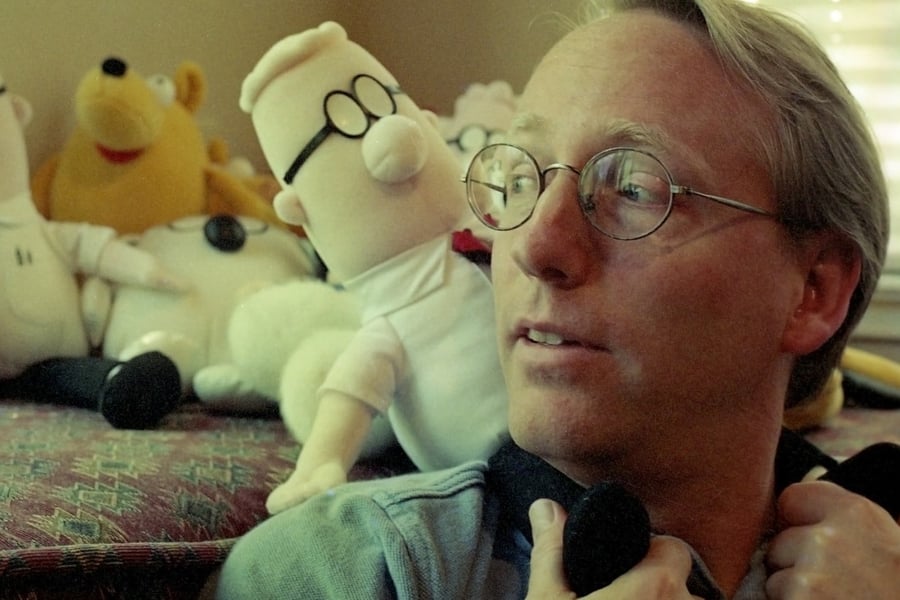
Scott Adams, creator of the long-running comic strip Dilbert who courted controversy as a late-career political and social commentator, died today after a battle with cancer. Adams’ ex-wife, Shelly, confirmed his death in a video message. He was 68.
Shelly Adams relayed a message Scott wrote to his fans earlier this month. “For the first part of my life, I was focused on making myself a worthy husband and parent, as a way to find meaning,” Scott wrote. “That worked, but marriages don’t always last forever and mine eventually ended in a highly amicable way. I’m grateful for those years and for the people I came to call my family.”
He went on to write that he needed a “new focus”: “I looked for ways I could add the most to people‘s lives.” He discussed the success of his 2014 book, How to Fail at Almost Everything and Still Win Big. “I still hear every day how much the book changed lives,” he wrote. “My plan to be useful was working.”
Via Shelly, Adams wrote of his podcast Real Coffee With Scott Adams and concluded his message by looking back on his life. “I didn’t plan it this way,” he wrote, “but [the podcast] ended up helping lots of lonely people find a community that made them less lonely. Again, that had great meaning to me.
“I had an amazing life,” Adams added. “I gave it everything I had. If I got any benefits for my work, I’m asking that you pay it forward as best as you can. That’s the legacy I want: Be useful and please know I loved you all to the very end.”
Adams revealed on his podcast last May that he’d been diagnosed with prostate cancer, and the disease had already spread throughout his body. Adams admitted that his prognosis was not good, and he spent much of the year trying various treatments. He eventually pleaded with Secretary of Health and Human Services Robert F. Kennedy Jr. and President Donald Trump to receive access to the cancer drug Pluvicto.
“He was a fantastic guy, who liked and respected me when it wasn’t fashionable to do so,” Trump wrote in a statement. “He bravely fought a long battle against a terrible disease. My condolences go out to his family, and all of his many friends and listeners.”
Love Music?
Get your daily dose of everything happening in Australian/New Zealand music and globally.

While some of these treatments appeared to alleviate Adams’ pain, his condition did not improve. In a message shared on Jan. 1, Adams said he’d lost all feelings in his legs and was struggling with “ongoing heart failure.” “The odds of me recovering are essentially zero,” he said. ”I’ll give you an update if that changes, but it won’t.”
Though a fan of comics and avid illustrator from his childhood, Adams began his career in the white-collar world he would end up lampooning with Dilbert. He graduated from college in 1979 with a degree in economics, and he got his first job as a bank teller in San Francisco (where he claimed he was robbed twice at gunpoint). Over the next several years, Adams took on a variety of jobs at the bank, all while drawing comics on the side, including early versions of the character that would become Dilbert. He often peppered these drawings into presentations for upper management.
“My comics weren’t funny in the ha-ha sense,” Adams wrote in the intro to a Dilbert compendium, “but they reminded people of their jobs, and that seemed to be enough.”
Adams eventually left the bank, pursued an MBA, and got a new job at Pacific Bell. Even as he tried to climb the corporate ladder, he continued to draw and eventually started pitching Dilbert comics to various publications. While his initial efforts proved unsuccessful, in 1988 the newspaper syndication service United Media offered him the chance to fully develop the strip.
Dilbert debuted in April 1989, and within a few years it was running in 150 newspapers. But Adams still wasn’t making enough money to quit his day job. Looking for an easy way to solicit reader feedback, he made the tech-savvy (for the time) move of including his AOL email address in the strip. He quickly learned that readers didn’t want to see Dilbert at home or about town, but at his office.
Just as email helped Adams fine-tune the strip’s workplace theme, the emerging dot-com boom helped make Dilbert an ideal comic for the mid-Nineties. “Technology workers embraced Dilbert as one of their own,” he wrote in the compendium. “The media embraced Dilbert as a symbol of the downsizing era, which overlapped with the first part of the dot-com buildup. Dilbert became shorthand for bad management, oppressed cubicle workers, and high-tech life.”
By the end of 1995, Dilbert was in 800 papers, and Adams was finally able to leave his job at Pacific Bell. The following year, he published The Dilbert Principle, a business book mixed with comics, that began a New York Times bestseller.
The book’s title came from Adams’ inversion of the Peter Principle, a maxim that employees are promoted because of their successes, but eventually reach a point where they are no longer competent. The Dilbert principle — traced back to a quote in a 1995 strip — posited that managers and higher-ups are actually successful morons whose stubbornness is confused for real leadership qualities.
“[I]n many cases the least competent, least smart people are promoted, simply because they’re the ones you don’t want doing actual work,” Adams said in a 2002 interview. “You want them ordering the doughnuts and yelling at people for not doing their assignments — you know, the easy work. Your heart surgeons and your computer programmers — your smart people — aren’t in management.”
Adams would enjoy massive success in the decades to come. By the new millennium, Dilbert was syndicated in 2,000 newspapers in 57 countries, and running in 19 different languages. There were copious Dilbert books and other merchandise, desktop computer games, and an animated TV show that aired for two seasons. (A live-action Dilbert pilot was even made, but never aired, with a rare copy existing in the Library of Congress.) Adams also published several non-Dilbert books, including a pair of novels, and several memoir/self-help/pop-science texts.
One of these, 2017’s Win Bigly: Persuasion in a World Where Facts Don’t Matter, captured the themes and thinking that would come to define the final decade of Adams’ life. A few years prior, Adams was one of the few people to correctly predict that Donald Trump would become president based on his powers of persuasion.
At the time, Adams was often critical of Trump, and in his book he described himself as an “ultraliberal”; still, as someone long-fascinated with the art and power of persuasion, he was awed by Trump’s rise to power, and often wrote glowingly about it. This made Adams a favorite among Trump supporters, who backed his work amid heavy criticism on social media. Adams later said one of the reasons he wrote Win Bigly was “so many people who supported me on Twitter specifically asked me to write it,” and he called the book “a favor returned.”
Over the next few years, Adams became a prominent figure in the conservative media ecosystem. While he continued to write and draw Dilbert, he also hosted the popular podcast, Real Coffee With Scott Adams, which frequently featured interviews with right-wing figures like former congressman Matt Gaetz and commentators Dave Rubin and Greg Gutfeld.
Adams’ politics appeared to shift, too, and he soon found himself embroiled in culture war controversies, often surrounding race. In 2022, over 75 newspapers dropped Dilbert after Adams introduced the strip’s first Black character, which he then used as a prop to mock “wokeness” (the character identified as white and LGBTQ+ for work purposes).
A year later, hundreds more papers — including the The Washington Post, Los Angeles Times, and the entire USA Today network — dropped the comic after Adams called Black Americans a “hate group” that white Americans should “get the hell away from” after a conservative organization poll claimed to show that many Black people didn’t think it was OK to be white. Adams insisted his comments were “hyperbole,” while also doubling down as an ostensible cancel culture martyr.
“Has anyone else been canceled while literally no one disagreed with them?” he wrote in one tweet at the time. “My critics don’t disagree with my advice (seen in context). They are justifiably angry that it is rational. I am too.”
Despite no longer being syndicated in newspapers, Adams continued to publish Dilbert on his website, alongside his regular Real Coffee episodes. It wasn’t until November 2025 that Adams was forced to finally stop drawing Dilbert due to complications from his cancer. Still, he continued to write the script, while his art director took over the illustrations.
From Rolling Stone US

