






























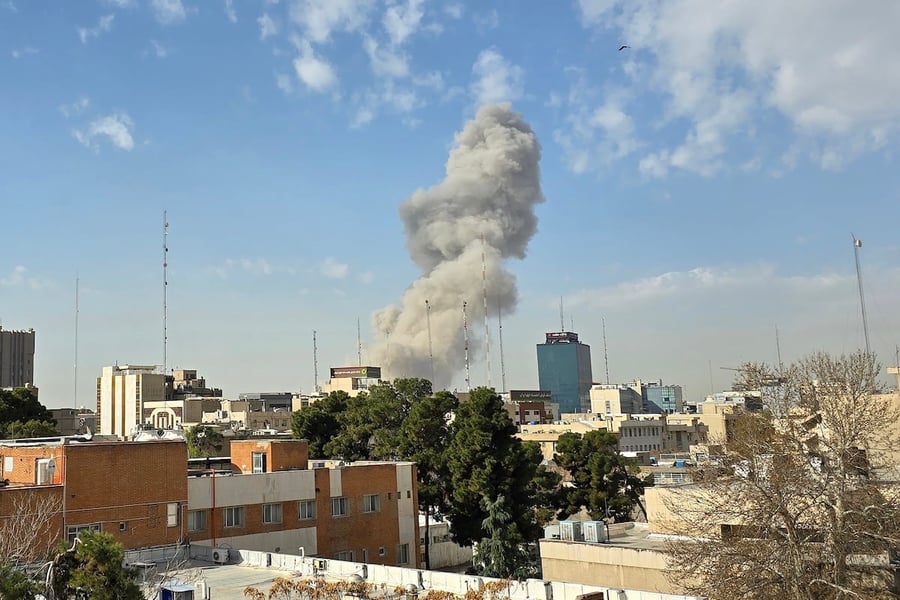
When America and Israel started a new war on Saturday, they quickly succeeded in killing Iran’s supreme leader, the 86-year-old Ayatollah Ali Khamenei.
This achievement prompted a burst of chest-thumping acclamation from a braying mob of war enthusiasts — those who Robert Graves, the World War I soldier and poet, memorably described as “the froth of the city.”
“The thoughtless and ignorant scum / Who hang out the bunting when war is let loose / And for victory bang on a drum,” Graves wrote, observing the euphoria of his countrymen who never had to fight — first when the war began in 1914, and then when Armistice was announced in November 1918.
For almost 50 years, the Islamic Republic of Iran and the United States have been locked in a shadowy conflict that has ebbed and pulsed in fitful cycles of violence through eight U.S. presidents. Now, the U.S. has chosen to turn that conflict into open, direct war — but no one in the government seems to have a clear objective in mind, let alone a plan to achieve an endgame.
The Trump administration’s initial justification for launching the war was that there was an “imminent” threat Iran would launch missiles against American forces in the region. Setting aside the fact that those forces were being built up for the obvious purpose of attacking Iran, by the end of the weekend even this flimsy construct was revealed as a transparent lie in congressional briefings.
Defense Secretary Pete Hegseth, speaking at a press conference on Monday, tweaked the casus belli, saying action was required because Iran was building a “conventional shield” to protect its nuclear program. Presumably, this is the same nuclear program American warplanes struck last June, achieving “total obliteration.” So another lie, either then, or now… or both.
The truth is the United States, at the prompting of the Israeli government, believes a campaign of bombing and killing from the air will turn hostile Iran into a docile, toothless foe. Drunk with hubris after the successful operation to capture Venezuelan President Nicolás Maduro — which left his regime intact — Washington believes it can bomb Tehran into submission.
Love Music?
Get your daily dose of everything happening in Australian/New Zealand music and globally.

But Iran is not Venezuela. While the administration was clearly eager to claim victory after killing Khamenei, the Islamic Republic is not a cult of personality, and its oppressive regime is not wholly dependent on the life of one leader.
President Donald Trump made it clear that he hoped the Iranian people would shoulder the burden of regime change.
“To the great proud people of Iran, I say tonight that the hour of your freedom is at hand,” the president said in a video released as the bombs began to fall. “Stay sheltered. Don’t leave your home. It’s very dangerous outside. Bombs will be dropping everywhere. When we are finished, take over your government.”
“It will be yours to take. This will be, probably, your only chance for generations,” Trump said.
Trump indulged such magical thinking earlier this year, when he promised “help is on its way” to anti-government protesters who were taking to the streets across Iran. Help was not on its way: the U.S. did not have the military assets in place to take meaningful action. The protesters were slaughtered — the high estimate is 30,000 killed, although the precise number is still debated.
The January protests and crackdown indicated structural weakness in the Iranian regime, and was just the latest example of significant civil unrest that began over social and economic grievances. But the U.S. doesn’t appear to be offering anti-regime actors much of a plan beyond bombing and killing.
A direct challenge to the government, known as “the System” in Persian, must contend with not only with Iran’s sizeable military, but the Islamic Revolutionary Guard Corps (IRGC) — the armed force charged with the protection of Iran’s government — as well as its volunteer paramilitaries, known as Basij.
After observing America’s invasion of Iraq in 2003, the IRGC instituted the “Mosaic Doctrine,” designed to ensure the survivability of the regime.
“They understood that the leadership could be decapitated either through assassination or precision strikes,” Farzan Sabet previously told Rolling Stone. Sabet is a researcher focused on the Middle East at the Global Governance Center, and runs the blog Iran Wonk. He says the doctrine “created the capacity for IRGC regional and provincial headquarters to assume responsibility for local security, either in the case of a domestic emergency, or in the case of a foreign hostile threat.”
That appears to be exactly what has happened since the decapitation strike against Khamenei and Iran’s senior leadership. Surviving IRGC and Basij militiamen have dispersed across their areas of responsibility, hoping to avoid strikes on command-and-control facilities and maintain their grip over the country.
The CIA reportedly assessed that hardliners would take over if Khamenei and the senior leadership was eliminated; it may not be clear for some time who is actually calling the shots.
Trump over the weekend indicated he was willing to reopen talks and find an off-ramp. While behind-the-scenes diplomacy may be occurring, some Iranian officials are publicly signalling they are digging in for a long fight.
Iran’s air force and navy do not have the capability to stand toe-to-toe with the U.S. and Israel. But Tehran can continue to “horizontally escalate” by finding other targets of opportunity for its proxy networks, and for its own missiles and drones.
These have already begun striking across the wider Middle East — even hitting as far away as a British airbase in Cyprus. Military facilities in Kuwait, energy infrastructure in Saudi Arabia, and even high-end hotels in Dubai have been struck, with Iranian munitions impacting in at least eight countries so far. Oil tankers and ships in the Persian Gulf have been attacked, and shipping through the Strait of Hormuz — through which 20 percent of the world’s oil passes — is now at a standstill.
Iranian-backed militias in Iraq have fired on facilities in Kurdish-controlled territory, and assaulted the Green Zone in Baghdad, leading to clashes with security forces in the capital city. In Pakistan, protesters outraged by the killing of Khamenei have attacked American consulates, with dozens killed in clashes so far. In Lebanon, at least 50 people have been killed after Israel conducted airstrikes in response to rockets fired across the border by Iran’s proxy Hezbollah.
Chaos is spreading and casualties are mounting. In Iran the civilian death toll is already in the hundreds, including more than 150 victims at a girls’ school — which appears to have been struck by the U.S., although there is little conclusive information establishing the precise details surrounding the strike.
There is no example of a sustained air campaign that doesn’t cause significant civilian harm, and the U.S. and Israel are conducting hundreds of sorties each day. Nevertheless, they cannot quickly defeat Iran’s military, nor in a few days destroy its ability to strike far from its borders with ballistic missiles and one-way attack drones — let alone dismantle the IRGC and its proxies. Strikes will continue, and given that many of these munitions are falling in densely packed urban areas, there is no question that innocents will die at American hands — and potentially in large numbers.
Iran is killing civilians as well, with at least 10 dead in strikes on Israel, and a handful in Gulf states targeted by missiles and drones.
Military casualties are mounting as well. At least six U.S. service members have already been killed, and more than a dozen wounded in strikes. Iran has not released numbers of military personnel killed; it may not even have reliable information about that at this early stage. But Israel estimates more than 1,000 IRGC members have died so far.
The Iranian regime is fighting for its existence, and its goal is to plunge the region into the fire along with it, apparently in the hope that it can inflict enough pain that other nations will beg Trump for a ceasefire.
But the number of dead will climb as the war grinds on, a continued accounting in a ledger of death that goes back for decades.
That ledger includes 63 Lebanese and Americans, killed in an Iran-backed bombing at the U.S. Embassy in Beirut in April 1983; 346 U.S. Marines, French paratroopers, and civilians, killed in their barracks in twin truck bombings in October the same year; 290 passengers aboard Iran Air Flight 655 over the Persian Gulf, mistaken for a fighter aircraft and shot down by USS Vincennes in July 1988; and 176 passengers aboard Ukrainian Airlines Flight 752, mistaken for an American cruise missile and shot down by Iranian air defenses in January 2020.
It also includes thousands of Americans and Iraqis killed and wounded by improvised explosive devices with “Explosively Formed Penetrators,” a technology proliferated across Iraq by the IRGC, intended to destabilise America’s ill-fated occupation. It includes Israelis, Syrians, Iraqis, and others.
And perhaps the ledger should include the tens of thousands of Iranians tortured, imprisoned, and executed by the Islamic Republic since the revolution in 1979; and those who suffered a similar fate under the U.S.-backed Shah’s Savak security service after the coup that installed him in 1953.
Surely the Iranian regime has committed great evils against its neighbours, its people, and the United States, and it deserves to fall. Perhaps the United States can close the ledger on all of this, and the end result will be a new beginning with Iran.
This administration, which promised common sense and America First, vowed not to embark on namby-pamby woke crusades or get caught up in forever wars and nation-building. Instead, it is proving itself to have the most revisionist foreign policy in American history, galavanting about the world with a powerful military, no sense of accountability, and a comic book worldview of good-versus-evil.
So forgive me, dear reader, for being sceptical that any of this is going to be easy or simple, and questioning if death and destruction in the present are worth a nebulous promise of a better future, with no roadmap for getting there. Forgive me for doubting this new war will bring about peace.
From Rolling Stone US

