





























In 1967, as the death count of American soldiers in Southeast Asia reached 20,000, Norman Mailer published a short, brilliant book called Why Are We in Vietnam? It was a work of fiction, not a political tract, and the plot itself had nothing to do with the war that was dominating American news and dinnertime debate. In fact, the word “Vietnam” did not appear — other than on the title page — until the very last paragraph of the novel.
Why Are We in Vietnam? is, instead, about a hunting trip on the northern edge of Alaska. The book’s narrator is a crass Texas teenager named D.J. Jethroe, whose father, Rusty, is a swaggering, rapacious executive with something called Central Consolidated Combined Chemical and Plastic (“4C and P” for short). Rusty, a “high-grade asshole,” takes D.J. and his best friend, Tex, along on his quest to kill the scariest grizzly bear he can find, along with two of Rusty’s ambitious corporate lackeys, whom D.J. refers to as “M.A.’s,” or “medium assholes.”
Here’s the Spark Notes version: Unsatisfied with smaller game like foxes and caribou, Rusty goads the reluctant tour guide into bringing the party up close with a snarling grizzly. D.J. shoots the bear first, felling him, but Rusty finishes him off as he lies bleeding and immediately steals credit for the kill. The sniveling M.A.s, of course, fall all over themselves to back up the boss.
Disgusted by this charade and weary of all the macho bullshit, D.J. and Tex strike out alone and unarmed, come face to face with the naked beauty of the tundra, and repress an urge to sleep together. Instead, terrified by their feelings, the boys surrender to the violent, corporatist culture in which they’ve been raised, trudging back to camp with what they believe to be a mission from God: “Fulfill my will, go and kill.”
Only on the book’s final page do we learn that D.J. is telling us this story a few years later, at a dinner party held in his honor at the Jethroes’ Dallas mansion. The next day, he and Tex, now 18, will be shipping off to war. And thus the book’s final, chilling line: “Vietnam, hot damn.” (Let’s be real, you weren’t going to read it anyway.)
At a time when Americans debated theories of what underlay a widening war (fear of falling dominoes, white paternalism, a thirst for tin and rubber), Mailer offered an explanation by way of a parable. Why were we in Vietnam? Because the country’s ruling class — embodied by white, male Texans like Rusty Jethroe and Lyndon Johnson — had turned its rage and insecurity on the rest of the world.
Mailer lays out a rapid-fire list of Rusty’s 16 laments about chaotic 20th century America, starting with the clamoring for equal rights among housewives and minorities, and going on from there: “Africa is breaking loose. The adolescents are breaking loose.… The European nations hate America’s guts. The products are no fucking good anymore.”
Love Music?
Get your daily dose of everything happening in Australian/New Zealand music and globally.

And then, finally, there’s a number 17: “He, Rusty, is fucked unless he gets that bear, for if he don’t, white men are fucked more and they can take no more.… If he is less great than God intended him to be, then America is in Trouble.”
When I first read Why Are We in Vietnam? in college, I was blown away by Mailer’s subversive sleight of hand — the idea that you could pose a serious question on the cover and then somehow answer it with a seemingly unrelated digression. But the novel, which earned a National Book Award nomination when it was published, has largely disappeared from the contemporary canon.
Maggie McKinley, a Mailer scholar who wrote the foreword to the most recent edition, told me that even she doesn’t teach the book to her students at Harper College, in part because it’s packed with racial and sexual language that would offend just about every modern sensibility. It’s pretty much 200 pages of nonstop triggering.
And yet, there’s as much profundity in Why Are We in Vietnam? today as there was 60 years ago. If you really want to understand why Trump and his slavish acolytes, after essentially annexing Venezuela, are suddenly hell-bent on seizing the Arctic wilderness from a NATO ally (the hard way or the easy way, as they like to say), then you can ransack all the libraries in America, but I doubt you’ll find a more relevant book.
YOU CAN’T BLAME JOURNALISTS and academics for trying to ascribe a single, rational theory to the president’s foreign policy. Generally speaking, we’re used to sorting the chapters of American history in the world by philosophical constructs: “isolationism,” “containment,” “peace through strength,” and so on. We’re not trained to treat “batshit crazy” as an actual worldview.
And so analysts in Washington have been spinning their heads around like a bug-eyed Linda Blair in The Exorcist, trying to find some kind of familiar rubric to explain Trump’s foreign policy. Is he an isolationist? (Last time I looked, isolationists didn’t go around launching missiles on three different continents, so no.) Is he a converted neocon? (Trump would hand half of Ukraine to the Russians tomorrow, so if he’s a neocon, I’m a Rastafarian.)
Trump has been linked, at various times, to James Polk’s “manifest destiny,” to Woodrow Wilson’s “moral diplomacy,” to the “Monroe Doctrine” of the 19th century (which Trump calls the “Donroe Doctrine”). Basically, if somebody had an idea about foreign policy before the advent of air travel, chances are Trump has gotten credit for reviving it.
The White House itself, in its official national security strategy, labeled its approach as “flexible realism” — a slogan so vapid and anodyne that I had to look it up four times before writing this sentence, because I kept mixing it up with other meaningless buzzwords, like “muscular” and “internationalism.” All it comes down to, really, is what Trump himself has said more plainly — that his own sense of morality is “the only thing that can stop me.” How’s that for realism.
Mailer, though, who was mostly known for glorifying a kind of American machismo in his work, would have had no trouble recognizing Trump’s worldview for what it really is: manifest masculinity.
Trump’s origin story is rooted in the same white, male insecurity that Rusty Jethroe personifies; it’s possible he would never have run for president in the first place had the nation’s first Black president not mocked him at a correspondents’ dinner. (I don’t think any of us in that ballroom, Barack Obama included, understood then the depth of Trump’s rage and racial grievance.) His last campaign was animated by a cultural backlash against “#MeToo” and “wokeness.” His decade of political dominance has coincided with the rise of what we call the “manosphere” — a chorus of angsty men who feel marginalized in society because they don’t know how to skin animals and beat each other up.
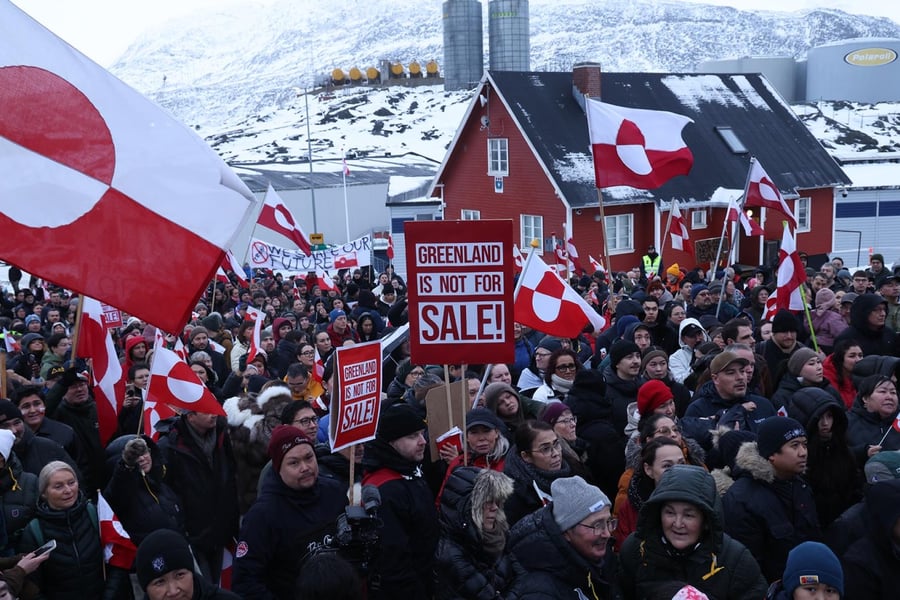
Why do we need Greenland? It’s not because of rare-earth minerals or fast-thawing shipping lanes; these things are negotiable. It’s not just because Trump always has to have his way with other world leaders, as others have noted. No, it’s because the social forces that began to accelerate in Mailer’s time have now reached critical mass.
In about 20 years, no matter how many ICE raids you carry out, America will be a majority-minority country, with all of us white men increasingly outnumbered. For Trump and his followers, this augurs the end of American dominance. The president sees his movement, rightly, as the last stand of a dying social order.
And so Trump seeks domain over his own Arctic wilderness, accompanied by his own fawning band of M.A.’s — guys like J.D. Vance and Stephen Miller and Pete Hegseth. (Perhaps the “M” here stands for “major” rather than “medium.”) As Miller put it recently to Jake Tapper: “We live in a world, in the real world, Jake, that is governed by strength, that is governed by force, that is governed by power. These are the iron laws of the world since the beginning of time.” Pretty tough words from a guy who once painted hair onto his head for a TV hit.
Greenland is Trump’s feral grizzly, and it must be subdued. He needs it because it’s the biggest damn iceberg on any grade-school map, and thus he must own and exploit it. He needs it because, having set out on this adventure, he can’t now go back to his adoring fans at CPAC, trailed by his bobbleheaded M.A.’s, without being able to tell them how he bagged the place all by himself.
Trump needs to possess Greenland, just as he needs to run Venezuela and terrorize Minnesota, because white men are fucked, and if he is less great of a president than God intended him to be, America is in Trouble. And if all of this destabilizes the community of free nations — if it emboldens more practiced autocrats to seize their own prey, drawing America into the kind of real war that can’t be won with a couple of drone strikes while we’re all soundly sleeping — then that’s just the price you pay for reestablishing the natural order of things.
Greenland, hot damn.
From Rolling Stone US

