




























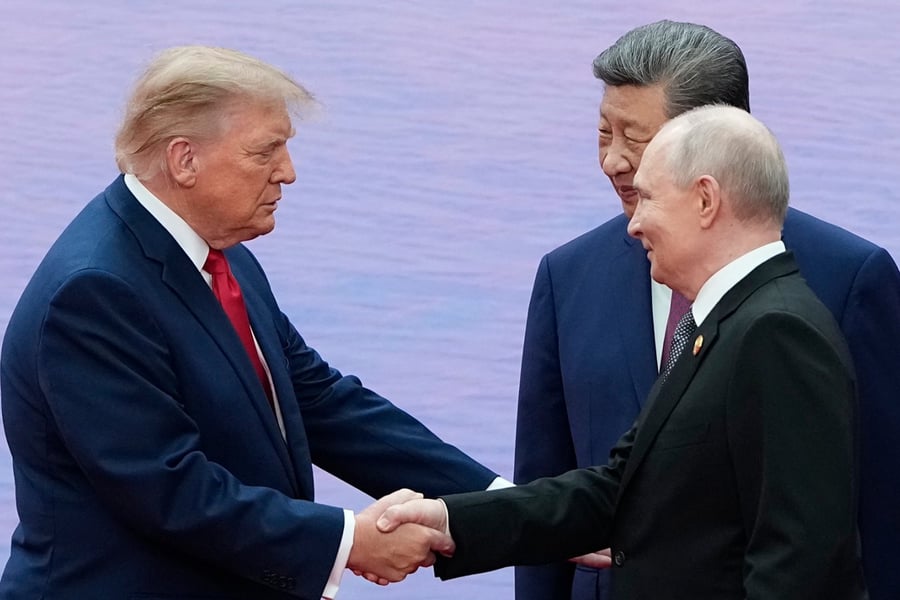
President Donald Trump promised a “historic trilateral meeting.” He failed to deliver.
The American president billed Thursday’s summit with Chinese President Xi Jinping and Russian President Vladimir Putin as an opportunity to resolve intractable conflicts and bitter economic disputes through his signature brand of personal diplomacy.
But Trump’s need for public validation has always been a vulnerability, and America’s smartest opponents know how to exploit it. In China, Trump made a spectacle of himself fawning over authoritarian leaders who view the United States as a rival. They left with diplomatic legitimacy and strategic breathing space. He left with little to show in return.
“Peace through strength,” the White House posted on official social media channels, over a video of the three leaders meeting in Shenzhen, a major financial and technology hub in southern China.
Why viewers were meant to understand three old men in suits — Xi, Putin, and Trump are 73, 74, and 80 years old, respectively — walking down a hallway in slow motion as a projection of American strength is anybody’s guess.
“A meeting in search of an agenda,” The Guardian dubbed it.
“A meeting that could have been an e-mail,” a former British diplomat observed.
Love Music?
Get your daily dose of everything happening in Australian/New Zealand music and globally.

Critics and supporters alike speculated the gathering might become a “New Yalta,” invoking the 1945 summit where the “Big Three” — Franklin Roosevelt, Joseph Stalin, and Winston Churchill — negotiated the shape of the postwar world. Those talks charted a course for a new international order, built around the United Nations, national sovereignty, and collective security — which, despite immediately running aground on Stalin’s violated promises to permit free elections in Eastern Europe, had more or less survived to the present.
There were fears that a modern “Big Three” would formally abandon that system altogether in Shenzhen, in favour of classic Great Power competition and spheres of interest. Each leader has their own interest in limiting the reach of international institutions. Instead, Shenzhen was a snoozefest: long on photo ops, short on substance.
Yesterday’s crowning achievement was the “China-Russia-United States Heads of State Declaration toward Peace,” which having lived and worked in China, I can assure you sounds better in Mandarin. At least, you can say it faster —《中俄美三国元首和平宣言》or “Zhōng é měi sānguó yuánshǒu hépíng xuānyán” — which amounts to the same thing.
I’ve read it so you don’t have to. It says the three countries should cooperate on UN reform, stable energy markets, limiting abuses of International Criminal Court (ICC) jurisdiction, and avoiding nuclear war.
Sharp-eyed readers will note that one of those items is curiously specific.
Given Russia’s ongoing war in Ukraine and the U.S.-Israeli war on Iran, there are surely more pressing concerns than the ICC’s jurisdiction.
The court has no independent police force, and relies on member states to execute warrants. It has never issued warrants for American or Chinese citizens, but it did so recently for Putin and a crop of his cronies. That complicates his ability to travel, if nothing else, so statements decrying the ICC and calling on states to disregard its jurisdiction are a de facto gift to the Russian president.
It’s also a boon to Trump, whose administration has made opposition to the ICC a rallying cry. The court is a convenient punching bag for sceptics of “globalism,” from Trump and his MAGA base to revisionist powers like China and Russia. What authoritarian leader doesn’t want their state officials shielded from international prosecution?
Certainly it was easier for the three leaders to launch an attack on international law than tackle the contentious issues that could have been on the table. Consider the trade war sparked by Trump’s tariffs on China, the wars in Ukraine and the Persian Gulf, or competition over artificial intelligence.
The race to control advanced semiconductors, computing capacity, and the most powerful AI systems are already a major source of tension between Washington and Beijing. Control of semiconductor production could well become the proximate cause of a shooting war, while AI-enabled weapons are already killing humans on the battlefield. Meanwhile, rogue or maliciously employed AI agents pose a threat somewhere between “the website is down” and “civilisation-ending.”
How the competition over AI plays out could well shape economic and military power for generations, and for the moment, the United States appears to be leading the race. Yet the summit produced no public commitment on AI, and certainly nothing to ensure America retains its lead.
That AI was discussed but didn’t make the final cut says a lot about the dangers of the Trump presidency, even in its lame duck twilight years. Trump isn’t good at the painstaking work of diplomacy. Even if he is not experiencing a serious age- and/or dementia-related mental decline — and there are indications he may be — he has never been good at focusing on details, or sustained attention. Under Trump, the world is missing out on opportunities for peace and progress.
Xi and Putin are playing a much longer game. They understand that Trump has been humbled by his party’s defeat in the midterm elections, that he is constrained, and that his presidency has a finite horizon. Theirs is not. Neither leader has reason to engage with Trump on contentious matters as they wait to see what will come next in Washington.
Trump, as ever, mistakes personal chemistry for leverage. He embraced Putin and called him “my friend.” Xi received centre stage, presiding over the proceedings, later berating Trump in their one-on-one over Taiwan, warning Washington to “keep doing the right thing to avoid major setbacks in U.S.-China relations.”
In return, Trump received no commitments about issues that matter. No progress toward peace in Ukraine, no assurances about Taiwan, no help resolving the Iran war, no AI framework, no nuclear arms-control deal, no breakthroughs on tariffs or agricultural trade.
A former German diplomat observed ahead of the summit that the United States seemed to have forgotten one of its greatest strategic advantages: a global network of partners and allies, built over decades. Trump and his administration have worked tirelessly to alienate allies. In their place, he offers friendship to America’s rivals.
The Shenzhen summit was historic, in the narrow sense that it had never happened before. Trump put the authoritarian leaders of China and Russia on a pedestal beside the American president. He legitimised Putin, gave Xi a grand stage, and presented both as equal partners in managing the world.
He made concessions in exchange for spectacle. And he forgot that there’s a difference between historic and consequential.
From Rolling Stone US

