



























When he first campaigned for president a decade ago, Donald Trump pointed to his singular achievement in public service: a skating rink. A primetime video at Trump’s nominating convention recounted the legend of Wollman Rink, on the edge of Central Park, as if it were the beaches of Normandy — how Trump had grown tired of seeing the dilapidated rink from his panoramic office window and decided to do something about it, how he had taken over the project from the city and delivered a beautiful surface in record time. OK, maybe Trump couldn’t tell you what the nuclear triad was, but he was a guy who knew how to build stuff, first class all the way.
So I guess it’s fitting that the most powerful symbol of Trump’s second term is the sickly green Reflecting Pool at the base of the Lincoln Memorial, which is pretty much just a long skating rink that you don’t even have to freeze. Trump hired a company that worked on one of his golf courses to refinish the pool, and the contractor installed temporary machines to keep algae from blooming, but then Trump’s Park Service ordered the machines removed because they were ugly and the country was trying to have a birthday party here, for fuck’s sake, and within hours the algae started taking over, and then long sections of the “American-flag blue” paint started breaking off like icebergs, and now the site upon which Martin Luther King Jr. once gazed while describing his dream of racial unity looks like an abandoned hotel pool in a horror flick. First class, indeed.
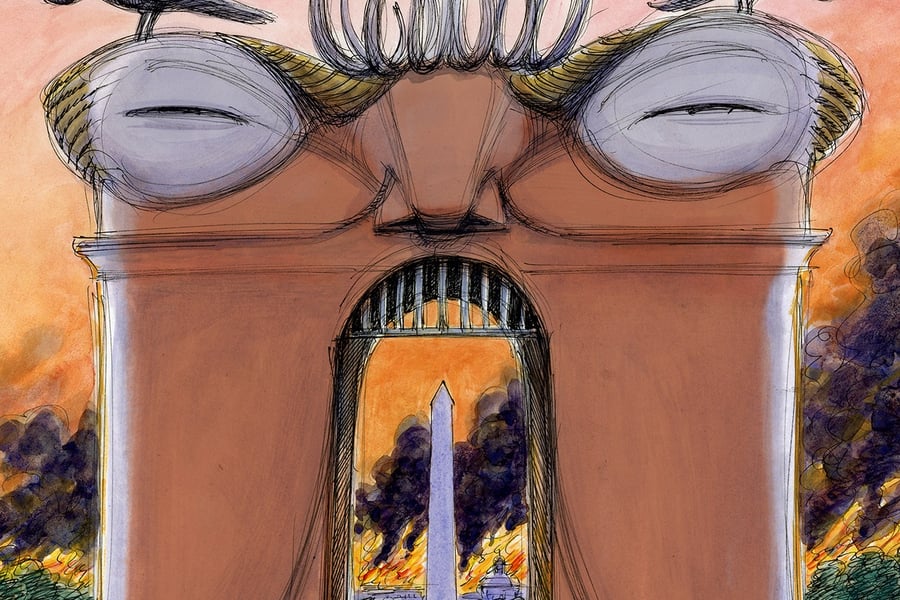
The revamped Reflecting Pool was just one of the many projects Trump has loosely tied to the country’s 250th anniversary, although you get the feeling that his frantic building binge is more about his birthday than ours. Having long ago reduced the East Wing to a semi-permanent pile of rubble, he’s forging ahead with plans to build a gold-leaf ballroom that will dwarf the rest of the White House. Down the street, across the Potomac from Lincoln and a stone’s throw from Arlington National Cemetery, Trump intends to raise up a Napoleonic arch, taller than the Lincoln Memorial, adorned with angry-looking, faux-fascist eagles and lions. According to Maggie Haberman and Jonathan Swan, the authors of Regime Change, Trump considered topping the arch with a replica of his own raised fist, although perhaps even Trump could see how an arm sticking out of a building might be distracting, like a goiter.
Meanwhile, the president is moving forward with plans for a sprawling statue garden of heroes on the National Mall, which would include lots of generals and Founding Fathers, as well as cultural icons like Elvis Presley, Kobe Bryant, and the Canadian-born Alex Trebek. Having already remade the Oval Office with splashy gold finishes — along with a sign that says “the Oval Office” in loopy cursive, reminiscent of the breakfast buffet at a Days Inn — Trump is pushing to repaint the grey Eisenhower office building, one of the city’s most elegant landmarks, in contractor white. What Trump isn’t building, he’s rebranding; his name still adorns the Institute of Peace (after a judge ordered it stripped from the Kennedy Center), and his glowering visage appears on giant banners draped over the buildings of several federal agencies.
There’s an unmistakable theme to Trump’s Washington makeover, aside from his own desperate sprint against mortality. Trump wants the city to project American might and dominance, the gaudier the better. He was impressed, during his first term, with lavish military displays in Paris and Moscow, which is why he insisted on his own costly parade of tanks to commemorate his birthday last year. To Trump, a modest Washington, with its low limestone buildings and reflective memorials, is a city for losers. He wants a capital that will trumpet our conquests and intimidate our rivals. His vision reminds me of the memorial I once visited in Saddam Hussein’s Baghdad — a massive archway ringed with hundreds of helmets taken from dead Iranian soldiers. (I almost hesitate to mention this, for fear that Trump will find inspiration in it.)
This is all in keeping with Trump’s essential approach to world affairs, which I’ve described previously as “manifest masculinity.” There’s a gaping insecurity in Trump’s architectural designs, a need to display for the world the needy, tarps-off manliness that his movement celebrates. In Trump’s Washington, self-consciously Christian white men aren’t just going to sit by and be replaced by immigrants and Jews and feminists; they’re taking supplements and working out bare-chested like Bobby Kennedy, or shotgunning beers like Kash Patel, or bragging about their lack of mercy like Pete Hegseth. If it’s possible for architecture to evoke the woodsy funk of a Burning Man circle jerk, then that’s what Trump is going for. Just a bunch of bros standing around, master-building.
WHAT STRIKES ME AS MOST remarkable about Trump’s plan for Washington, though, is just how head-spinningly disconnected it is from what he is actually doing everywhere else. While Trump reimagines the capital as an advertisement for swaggering, unrivalled power — the embodiment of John Kennedy’s vision of a country that would “pay any price” and “bear any burden” for a free world — he’s busy trying to jettison that burden as fast as humanly possible. He pulls soldiers from Europe, denigrates NATO, and quietly concedes spheres of influence to Russia and China — a swift undoing of a century’s worth of American foreign policy. He has decimated the foreign-aid programs that for decades made America the most influential force in Africa and Latin America, at the cost of what was, relatively speaking, pocket change.
Love Music?
Get your daily dose of everything happening in Australian/New Zealand music and globally.

And then, of course, there’s Iran, where Trump stumbled into war and now plaintively sues for peace, mainly because he never even entertained the military sacrifices that would have been necessary to win. Trump’s war, it seems clear now, will end up strengthening the Iranian regime, alienating much of its pro-democracy movement, and creating a permanent toll road for oil tankers that will enrich the mullahs, even as they continue enriching vast stores of uranium. And all this while recklessly bleeding the military’s store of munitions, laying bare for the rest of the world the exhaustible limits of American power. The fierce lions and eagles on Trump’s arch would be more at home in the Chronicles of Narnia than standing guard in Trump’s Situation Room, where the president recently convened an urgent meeting on the Epstein files. The better symbol there would be a jackass.
What Trump’s seeking to build in Washington, then, with his arch and his statues and his menacing banners, isn’t anything close to a manifestation of his own global leadership. He would turn the city into a theme park trafficking in nostalgia, an Epcot Center for the American Century. Tourists can bask in an approximation of American greatness, while Trump systematically obliterates the real thing.
On some level, Trump probably understands this and is doing the thing he does best in the world, which is to supplant reality with self-promotion; it’s extremely Trumpian to memorialise himself as the American emperor while at the exact same moment dismantling the empire. But it’s probably also true that Trump fundamentally doesn’t understand what Kennedy was talking about in his inaugural address — the staggering burden it took to honour that promise, the towering cost in both life and capital. It’s a patriotic language that Trump, who made $2 billion off the presidency in only his first year back, simply doesn’t speak. He asks not what you can do for your country, but rather what we can do for him.
I don’t worry much about the permanence of Trump’s city of dreams and his Ozymandian ambitions. He has only a few months until the voters likely deal him a stinging rejection, after which he will immediately become a bystander to the next campaign. It will be harder to get his calls returned, much less forge ahead with grand architectural plans. There may never be an actual arch (aside from the “Spinal Tap” Stonehenge model that’s inspiring much laughter in Washington), and I’m guessing Trump will be lucky if his name ends up permanently affixed to a rest stop on I-95. Politics is unforgiving that way.
The things that Trump is unbuilding, however, may never be restored. For 250 years, the greatest strength of America, in the eyes of the world, was its ironclad commitment to a peaceful transfer of power every four years, no matter how drastic the shift in party or personality, without somehow spinning into chaos. This was the thing at which other countries marvelled. And yet, not halfway into Trump’s second term, that strength has suddenly become the weakness that most alarms our allies. Nations who for decades relied on American consistency have been made to understand that not only do we change power every four years, but we can change our minds and our values just as fast, walking away from promises and abandoning long-held convictions. That realisation is reshaping the world, for better or worse, and it will make it exponentially harder for future presidents to wield the influence of American leadership. But at least they’ll get a ballroom out of the deal.
From Rolling Stone US

