



























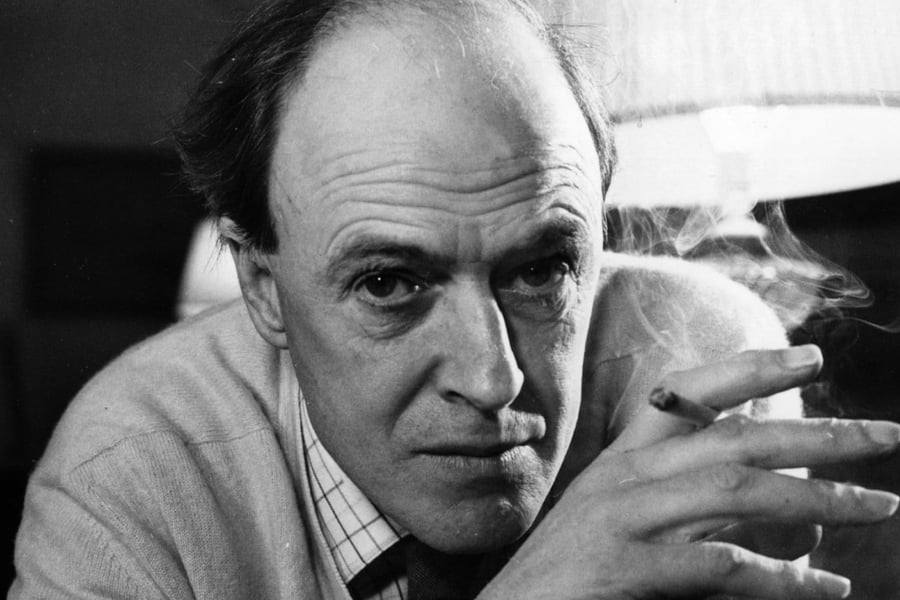
To most Americans, Roald Dahl is a children’s book author — the imaginative, intimidating, and somewhat insane mind behind beloved books like Matilda, Charlie and the Chocolate Factory, James and the Giant Peach, and The BFG. Those who know his work a little better might be aware of his adult short fiction, some of which was adapted for the 1960s anthology show Alfred Hitchcock Presents — or even his R-rated adult work like Switch, Bitch and My Uncle Oswald, which deal with themes of colonialism and sexual violence. Then there’s his biography — he was a fighter pilot for England, a spy in Washington, D.C., a Hollywood screenwriter, an inventor of life-saving medical technology, a father, and a husband and eventual caregiver to a Hollywood starlet.
Dahl is also remembered for his bigotry — editions of his children’s books have been edited to take out fatphobic and misogynist comments, and the 1971 film Willy Wonka and the Chocolate Factory had to be tweaked so the title character didn’t come off as a plantation owner. Then there’s his virulent antisemitism, which he expressed then doubled down on in the early 1980s, and for which he refused to ever apologize. And yet Dahl is still everywhere: Streaming as both live-action Wes Anderson films and animated features; in theaters, starring Timothee Chalamet; and on Broadway, starring John Lithgow.
It’s these many layers that attracted writer Aaron Tracy to make a podcast about his life and work, digging into the most problematic parts of his story. The Secret World of Roald Dahl, from iHeart Studios and Imagine Entertainment, stares down the controversy while celebrating his work. “I would not have been interested in Dahl if he was just one thing, if he was just antisemitic, or if he was just a monster, or even if he was just a children’s author,” says Tracy. “It’s the fact that he contains multitudes that makes him so fascinating.” Rolling Stone caught up with Tracy to discuss his project.
How did you come to be hosting this 10-part podcast on Roald Dahl?
I make a lot of podcasts. I hadn’t done a nonfiction narrative before, and I really wanted to. A lot of the podcasts I do are scripted fiction, and they occupy this funny little niche corner of the podcast world. I loved the idea of sort of moving into what is considered more mainstream podcasts. And I stumbled on Roald Dahl’s story, and I just couldn’t believe how much I didn’t know.
I have two little kids, and I read a ton of Dahl growing up. But as I researched Dahl and learned about the antisemitism and some of the more prickly parts of his personality, I just wanted to know more to help me figure out whether I was going to give his stuff to my kids or not.
And where did you land?
I think it’s such a complicated issue. In the second half of the [podcast], I bring on people like Roxane Gay and Claire Dederer to talk about what we should do about the work now, knowing what we do about Dahl’s very clear antisemitism. It kind of surprised me. Everybody had a different answer, a different feeling, about what we should be doing. I think where I land is, the stories are fantastic. It would be a shame to lose them. I think it’s about providing context. I’m very happy to share his stuff with my kids. Probably edit a little bit of it as I read it, in real time. You know, take out the fatphobia and stuff like that, but also when they’re able, have a conversation with them about who Dahl was.
In the podcast, you essentially devote two whole episodes to art versus artist.
So many of my favourite filmmakers over the years have been exposed as monsters. For whatever reason, I’m still able to watch their films and I’m still able to read the books of novelists who have been exposed as monsters. So it feels kind of hypocritical for me to then deprive my kids of Roald Dahl if I’m still willing to watch and read all those other things myself. But I think that’s not cut and dry. And so I was really interested in hearing what other people who are much smarter on the subject than I am, had to say about it.
Love Music?
Get your daily dose of everything happening in Australian/New Zealand music and globally.

Roxanne Gay said, there are so many geniuses out there, why do we need to waste our time on those who we know did horrible things in real life? So, she just moves on. People like Claire Dederer are more where I land, which is they still very much want to grapple with the work and provide context.
You went on the film podcast What Went Wrong to talk about the production of Willy Wonka and the Chocolate Factory, the 1971 Gene Wilder movie based on Dahl’s Charlie and the Chocolate Factory. What was it like rewatching that?
Willy Wonka, both the movie Willy Wonka and the book Charlie the Chocolate Factory are very much Dahl’s indictment of American capitalism. So that feels timeless. The more sort of bigoted stuff, like Dahl’s [racist] depiction of the Oompa Loopas are, of course, terrible, and the fatphobia that you see with his depiction of some of the kids is terrible. But, yeah, that movie and that book is a good example of how it’s on us if we want to engage with the work to hold both things in our heads. This is a guy who could write these incredibly bigoted figures, and then also write this really searing indictment of American materialism.
What do you think of the more recent adaptations?
The Wes Anderson movies are fantastic. I think it’s just such a good melding of two very unique artists. Obviously, Wes Anderson has his own very specific aesthetic and tone to his films, but he does feel like Dahl’s spiritual partner in many ways. Specifically, The Wonderful Story of Henry Sugar was the best. The way that Anderson presents Dahl as a character played by Ralph Fiennes is so true to the text. And so I think Dahl absolutely would have loved it. But even being so faithful to the text, it doesn’t detract from all the fun Andersonian stuff we all love. I just love that story because it feels very much like, if not quite an apology from Dahl, it’s what Dahl wishes his life was like. A guy who starts off as a total jerk and then through the power of intense focus and intense work — meditation — comes out on the other side, years later, as a better man. As a more generous, more giving man. And I really do think that’s what Roald Dahl wishes for his own life — his devotion to his work would make him a better person.
West Anderson is a great pairing. For being American, Wes Anderson is so British.
That’s right, he’s, like, the most British of Americans. And you know, the other perfect spiritual collaborator with Dahl is Alfred Hitchcock. They made a bunch of shows together for Alfred Hitchcock Presents. Obviously, Hitchcock is British himself, but has that same dark, gallows humour, the same sort of macabre tone to his work, the surprise endings. They were a perfect match. But I think Wes Anderson is in many ways even, even more perfect.
What were your thoughts on Tales of the Unexpected, the BBC anthology show Dahl did for the BBC in the 1970s, versus the work that he did with Alfred Hitchcock?
It just felt like an extension of the Alfred Hitchcock series, which makes sense, because Dahl, had many unhappy experiences in Hollywood but he had a great time with Albert Hitchcock. And so it makes sense to me that 30, 40, years later, he would decide to go back to that well.
I didn’t realise how much of a history he had in Hollywood. What were his experiences there?
So he’s 26 years old, and he wrote a propaganda piece called The Gremlins, which is really just about British-American cooperation, but it gets published, and Eleanor Roosevelt gets her hands on it. And she calls Dahl to the White House because she wants to meet the author. And either Eleanor or someone in her circle then passed the story to Walt Disney. And Walt fell in love with The Gremlins and brought Dahl out to Hollywood, and threw him a lavish welcome party with tons of celebrities, like Charlie Chaplin and so many other bold-faced names, all of whom were dressed up like gremlins. I keep picturing what it must have been like for 26-year-old Dahl with no credits to his name, to be confronted with all this, it must have been such a giant head trip. And then things started going downhill. Dahl was not really at a place in his trajectory where he was ready to compromise. He wanted his vision or nothing. And that’s not how movies are made, so Disney eventually let the project go.
Dahl struggled for a lot longer. He refused to give up. I think that there was a real chance that he was going to become like one of those other great novelists who just fell apart in Hollywood, like F. Scott Fitzgerald, or Faulkner, Aldous Huxley, and so many others. Dahl eventually wrote a screenplay called Death, Where is Thy Sting-a-ling-ling? that Robert Altman was going to direct. And it went into production with Gregory Peck starring. And then the head of the studio saw the dailies and shut it down. Again, another failure. But then Dahl was saved by an amazing offer that came in that he was tailor-made for, which is the fifth James Bond movie [You Only Live Twice]. James Bond was originated by Ian Fleming, who was Dahl’s partner in the Irregulars [the group of British spies Dahl was part of in D.C.], and Dahl himself was a spy for MI6. So, you could not have put him in a better situation. And he wrote it, and it killed. And he was set.
One of the really surprising things you talk about in the podcast is Roald Dahl, the inventor.
Of all the things I learned about Roald Dahl, this is the most romantic, most heroic. It started with a tragedy. His son, Theo, was just three months old, and his nanny took him out on the Upper East Side of Manhattan, and a taxicab hit the stroller, and Theo went flying. Theo was rushed to the hospital and had to have surgery after surgery, he was then in and out of the hospital for many years, and developed hydrocephalus, which is basically water on the brain. At the time, there was no valve in existence that would help drain water from the brain without causing infection. I always think about, God forbid, what I would do in that kind of situation. I would just hope that the doctors figure something out. That’s not Dahl. Dahl decides he’s going to figure this out himself. He called a toy maker that he knew, and he called a brain surgeon that he knew, and he put them together in a room. And they just threw ideas at the wall until they came up with slight modifications to the valve that would help drain water from the brain without causing infection. And they did it. Dahl decided that it was very important that they not make any money from it, so that it could be distributed widely. And it ended up being distributed around the globe. Over 3,000 children ended up using this valve. I mean, he had no medical training. He was not a neuroscientist. He was a writer. What did he know about creating a medical device?
Dahl was a lot of things. The new Broadway play, Giant, goes into some detail on his antisemitism, taking place after the publication of a notorious 1983 book review he wrote about Israel’s invasion of Lebanon, and a subsequent interview he gave in which he doubled down on his anti-Zionist and antisemitic remarks. What did you think of it?
I loved it. I’m such a huge fan of that kind of storytelling. It all takes place in one afternoon, and I thought it did such a good job. You really feel like you understand Dahl after seeing it. It explores so many tricky themes, specifically the antisemitism, of course, but also what artists owe to their public, and whose right it is to speak out on political topics.
What has the listener reception to the podcast been? What kind of feedback have you gotten?
It’s been amazing. I talked to Mark Henry Phillips, who’s the fantastic editor and sound designer on the show, and he was just in shock at how big a success it’s become. When I first presented it to him, he was like, the only limited series that work are true crime. You’re basically presenting to me the idea of just you, who’s never hosted a show before, just speaking into the microphone about one subject, without very many clips, for 10 episodes. Like, this should not work. And so we’ve all been blown away.
That must have been a tough ask, to make a show of this length without a lot of audio clips. Did that influence your decision to work with ElevenLabs, the AI voice company, to create audio of Dahl?
I didn’t want to use AI. Maybe we’re splitting hairs here, but it’s not exactly AI, it’s Mark performing. All throughout the series, we use a lot of actual clips of Roald Dahl. But then for some of what Roald Dahl said that we don’t have clips for, like journal entries, Mark would read Roald Dahl’s writing, and then, using ElevenLabs, he was able to adjust his voice so he sounded like an older British man of Dahl’s era. Obviously I would want to use the real Dahl in all the clips that we possibly could find. But when that was not possible, I thought this was a cool way to do it. It just felt like it made Dahl’s work come alive much more than if it had just been me reading it.
So Giant is incredible, but for now at least, you have to be in New York and with a ticket to be able to see it. Are there any dramatisations of his life that exist on TV or film?
Isn’t it surprising that there really aren’t? If you go on IMDb, you know, and look up Roald Dahl as a character, so few things come up. I’ve always been fascinated by the fact that there are so few great movies about writers. Adaptation is a great one, Shakespeare in Love, Heartburn, but the common thinking is that writers live too internally. Their lives are not dramatic enough, the stakes aren’t high enough. There was a movie a few years ago where Hugh Bonneville played Dahl about the death of Olivia, his daughter. And there was a TV movie where Dirk Bogarde played Dahl, many years ago, with Glenda Jackson as Patricia Neal, about Patricia Neal’s strokes and how Dahl rehabilitated her. But I’m not sure how much traction the Hugh Bonneville one got. So, I think we’re due.
From Rolling Stone US

