




























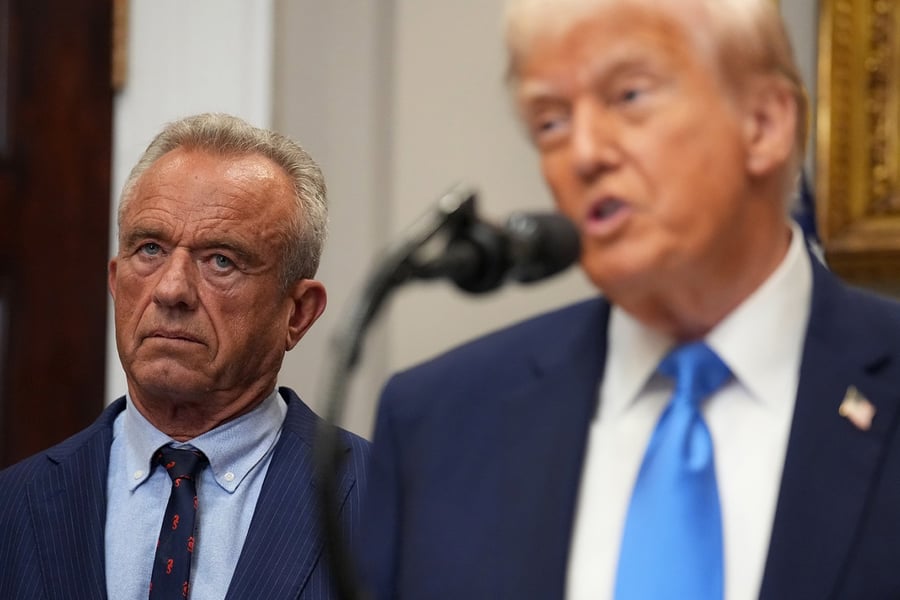
On Nov. 26, 2025, the day before Thanksgiving, calls flew between top officials of the Health and Human Services Department, as they learned they’d been blindsided.
The day before, the FDA withdrew a proposed rule requiring manufacturers of cosmetic products that contained talc to test them for asbestos. The withdrawal bore the name of Health Secretary Robert F. Kennedy Jr.
But few, including Kennedy, his top deputies, or staff within the FDA office that regulates products made with talc, seemed to know the proposed rule was being withdrawn or where the directive had even come from, according to five sources with knowledge of the events. However, lawyers for Johnson & Johnson appeared to be well-prepared for the rule withdrawal. The company had been struggling to defend itself against thousands of lawsuits alleging that asbestos in its talc baby powder had caused ovarian and endometrial cancers.
And in a California courtroom on Nov. 25 — little more than three hours after the withdrawal appeared on the FDA website, and three days before it was posted in the federal register — a Johnson & Johnson lawyer, defending the company against one of the many lawsuits, was ready. He used the FDA document in an attempt to discredit the plaintiffs’ expert witness, who specialised in the health effects of inhaling talc particles, a court transcript shows.
The lawyer asked the expert, “You know that the proposed rule that was shown to the jury — it was the very first document in this case — was withdrawn by the FDA as of this morning. You know that, right, sir?”
The expert answered, “I wasn’t aware of that.”
While the wording of the FDA withdrawal purported to advance Kennedy’s priorities, in fact, it undermined them. It explained that, due to the complexity of asbestos testing, withdrawing the rule to require it was actually in line with Kennedy’s Make America Healthy Again (MAHA) agenda, and would help to “ensure safe additives in the American food and drug supply.”
Love Music?
Get your daily dose of everything happening in Australian/New Zealand music and globally.

When Kennedy found out about the withdrawal, his top deputy, Stefanie Spear, scrambled to piece together who was behind it. Normally, a reversal like that would have been carefully reviewed by FDA staff. But the withdrawal had instead been coordinated by White House lawyers and officials at the Office of Management and Budget (OMB), which has been dismantling the federal work force and regulatory infrastructure in Trump’s second term.
They pushed through the withdrawal after a White House visit from Johnson & Johnson executives, according to two of the sources. Two senior administration officials say the withdrawal “went through the process it’s supposed to go through” and that the OMB routinely rewrites rules as part of its responsibilities.
For Johnson & Johnson, the withdrawal was heaven sent. It allowed the company’s lawyers to argue successfully that it had fully complied with all required, and proposed, FDA testing rules. The jury sided with Johnson & Johnson and found that the company had not been negligent in selling its talc-based powder.
A Johnson & Johnson company spokesperson says, “The proposed rule was flawed and published without the requisite assessment of its adverse impact on the American public. We support the administration’s efforts to ensure that gold-standard science prevails for the benefit of American patients.”
It wasn’t just Johnson & Johnson that benefited — because talc is an ingredient used widely in baby powder, cosmetics, medication, and even candy, withdrawing the proposed Biden-era testing rule offered significant relief to numerous companies.
“It was a heavily coordinated pharma job to have that thing revoked and have [Johnson & Johnson] lawyers include it in their trial argument within 24 hours,” says one of the five sources familiar.
Kennedy’s HHS was supposed to purge cozy relationships and conflicts of interest from health care policy; to rid the food supply of contaminants sickening Americans, from pesticides to artificial dyes; to stop advancing Big Pharma’s interests and, instead, scrutinise the safety profile of multiple vaccines.
But the withdrawal, which left Kennedy in the dark, shows the limits of his influence in the Trump administration and the way the White House has used the MAHA coalition for votes and talking points, while undermining its priorities when politically advantageous. It was a “first case,” says an FDA official, of “who supersedes in decision-making.” And it would not be the last.
In response to detailed questions, an HHS spokesperson says, “President Trump and Secretary Kennedy are united in their commitment to Make America Healthy Again. While others are focused on political narratives, HHS is focused on delivering results.”
White House spokesman Kush Desai says the two movements are indivisible: “MAHA is MAGA and MAGA is MAHA because a nation can only be as great as the health of its citizenry.”
‘I Have to Be Very Careful That Bobby Likes Us’
In February 2025, when Kennedy took the helm of HHS, the federal government’s largest agency with a $1.7 trillion budget, he promised a Make America Healthy Again revolution that would tackle chronic disease in America.
Trump’s backing of the MAHA agenda would allow him to accomplish this, as Kennedy said at his swearing in, claiming the president had been sent by God and had kept “every promise that he’s made to me.”
During the 2024 campaign, Kennedy had sold Trump on what he claimed was a broad vote-winning coalition, from suburban soccer moms focused on healthy eating to medical-freedom activists outraged by the public-health mandates of the Covid era. In turn, Trump pledged full support, declaring that Kennedy could “go wild” on health care. Kennedy’s allies wasted no time in creating MAHA advocacy and political organisations.
In its salad days, the revolution seemed popular enough to unite red-state governors and wellness influencers and get corporate giants like General Mills to pledge they’d remove artificial dyes from their food products by 2027. In a January cabinet meeting, fast-food-loving Trump noted the political benefit of the MAGA-MAHA alliance, remarking: “I read an article today where they think Bobby is going to be really great for the Republican Party in the midterms, so I have to be very careful that Bobby likes us.”
But over Kennedy’s 16-month tenure, while the MAGA White House has paid lip service to Kennedy’s agenda, its big-money alliances with tobacco, pesticide, and talc companies have repeatedly undercut MAHA priorities, and have even taken Kennedy and his deputies by surprise. Meanwhile, Kennedy’s weak leadership skills, drifting attention, and the operational naivete of his handpicked staff have led to chaos so detrimental that agency lawyers have repeatedly warned officials that their policy rollouts fail to comply with regulations, or will not survive legal challenges, according to documents obtained by Rolling Stone.
In one frustrated email, an agency lawyer chastised HHS political appointees for having an “unrealistic” plan to vet new nominees’ conflicts of interest in time for a crucial vaccine-advisory committee meeting.
Vicious infighting and head-spinning staff turnover have further imperilled the MAHA agenda, say current and former HHS officials. One of MAHA’s central planks — shrinking the vaccine infrastructure — was blocked this March by a court order and further stymied by GOP polling, which found that the attack on vaccines and the soaring measles case count, is unpopular.
As the MAHA-MAGA compact has faltered over many months, Kennedy has reverted to stunts and marginalia: plunging into an ice bath wearing jeans, doing chin-ups in an airport, and even delving into the question of extraterrestrial life with a visiting billionaire at an HHS meeting. And that’s reportedly with a shortened 10 a.m. to 4 p.m. daily schedule and infrequent attendance of staff meetings. “Bobby is remarkably diminished,” a Kennedy ally says. “He has had his wings clipped, big-time. He’s struck me as tired.”
MAHA-MAGA started with a shotgun wedding born of mutual self-interest, which led to a strained marriage and a relationship that is now veering toward irrevocable differences, leading a retired FDA official to ask, “Was it really a marriage, or was it a mirage from the beginning?”
There are flickering signs that the White House still backs Kennedy’s agenda, such as Trump’s late-May executive order reiterating that health agencies should align vaccine policy with that of peer nations and recommend fewer shots. The MAHA coalition expects that HHS will soon take action to rein in ultra-processed food, which could help reverse the ill will.
Still, divorce is on the table, according to interviews with more than 35 sources, including current and former HHS officials and advisers, some of whom requested anonymity to speak candidly, as well as dozens of previously undisclosed internal HHS and advisory-committee emails, memos, and text messages revealing events reported for the first time.
The MAHA-MAGA alliance is one of “damaged trust,” says a source involved in federal MAHA policy. “There is a general feeling that the reform era is declining.”
Both HHS and the White House defended the commitment to reform. “Under Secretary Kennedy’s leadership, HHS is removing petroleum-based food dyes from the food supply, expanding nutrition education, lowering prescription drug costs, strengthening rural health care, restoring America’s leadership in clinical research, and increasing transparency and accountability across our public-health institutions,” says an HHS spokesperson.
White House spokesman Desai says, “The Trump administration is in regular contact with key stakeholders in this movement, from everyday parents to researchers to farmers, to continue delivering on the MAHA agenda, which remains a key political priority.”
‘A Construct Born of Political Expediency’
By mid-2024, Kennedy faced a political wilderness.
Running for president as an independent, his campaign was dwindling. He would soon be entirely shut out by Democrats, with Kamala Harris’ campaign reportedly ignoring his overtures that he would endorse her in exchange for the promise of a cabinet post.
MAHA was a “construct born of political expediency,” says the Kennedy ally. The MAHA movement “was a coalition assembled in real time during the election, when Bobby had to pivot from the realisation that the Democrats had locked him out. They were not going to allow him into the tent at all.”
Trump, however, welcomed Kennedy, who appeared alongside him at rallies and spun off a new name for his coalition that echoed Trump’s famous campaign slogan — instead of Make America Great Again, it was Make America Healthy Again.
The result was a “grand brokering of peace between a formerly democratic candidate and a president who is formerly a democrat,” says a current HHS official.
There was one thing that united the two movements: “Mistrust of government is the huge overlap between MAGA and MAHA,” says the Kennedy ally.
Kennedy’s campaigning paid off, and eight days after winning the election, Trump tapped him to be his health secretary. Many of Kennedy’s fans were jubilant. As Vani Hari, the food influencer known as the Food Babe, who campaigns against processed food, told me in those first heady days, “When you have an entire group of people now talking about … how to stall chronic disease, it’s so good for humanity, and so good for the country. This is our time.”
But others remained sceptical. Robyn O’Brien, a former Wall Street analyst turned crusader for more transparency in the food supply, took note of the widely circulated photo of Kennedy eating McDonald’s with Trump on his private plane in the weeks after his election victory. “That was the earliest sign of who was in charge,” she says. “I thought, ‘They’ve got him.’”
Almost immediately, a struggle over access to Kennedy emerged within HHS. His Principal Deputy Chief of Staff and Senior Counselor Stefanie Spear, an environmental activist who had worked with him for more than 15 years, became his gatekeeper.
Spear herself had never run anything larger than an environmental newspaper, Ecowatch, with a roughly four-person staff, which Kennedy helped her develop into a digital news site, while he was at the helm of the Waterkeeper Alliance, a nonprofit that helps protect waterways. In 2020, she followed him to Children’s Health Defense, the anti-vaccine organisation he led, then served as press secretary for his presidential campaign.
At HHS, almost every email and call to Kennedy runs through Spear, say four current and former HHS officials. Working out of an adjoining office to his, she made and brought in his lunch sometimes, says a former HHS official, who described Spear as having an “impenetrable hold” on Kennedy.
The dynamic within HHS soon came to resemble that which had roiled Children’s Health Defense: Kennedy remained disengaged in day-to-day operations, while staff fought over access to him. “It’s a repeated pattern,” the Kennedy ally says. “He’s a transformational leader, he’s an effective attorney, but he delegates all management.”
He is so conflict-averse, says an HHS insider, “he couldn’t confront an apple on a desk.” The broken organisational structure has led to chaos inside the agency. At least one staff member quipped that they needed a Reagan-Berlin Wall moment to urge the White House to tear down the barrier around Kennedy that Spear had erected.
The wall is still firmly in place.
Amid the tumult, the body count has mounted quickly, leaving gaping vacancies. As a former HHS official explains, Kennedy is “not acting as a day-to-day leader of the department. He’s empowering a couple of people to be surrogate leaders for him,” but they don’t have the experience either. “All the instability and turnover is the proof.”
‘Out of the Blue’
On June 9, 2025, it looked like Kennedy’s promised revolution was at hand.
He fired all 17 members of the Advisory Committee on Immunization Practices (ACIP), the crucial committee that advises HHS and the Centers for Disease Control and Prevention on which vaccines the nation’s children should take.
The mass ouster was met with headlines of alarm around the country, as well as congressional scrutiny. “Secretary Kennedy is firing the 17 medical experts that advise our nation on immunisation practices so he can stack the panel with a bunch of anti-vaccine wackos,” Congressman Frank Pallone Jr. (D-New Jersey), ranking member of the House Energy and Commerce Committee, said in a statement.
But Kennedy had taken that radical step in order to tackle a “crisis of public trust,” he explained that day in a Wall Street Journal opinion piece. He argued that the committee had been “plagued with persistent conflicts of interest and has become little more than a rubber stamp for any vaccine.”
Given his expressed concerns, it seemed that a well-planned rollout of carefully vetted members would be forthcoming. But when eight new members of the committee were announced on June 12, even one of the most controversial, Dr. Robert Malone, a former mRNA researcher who had railed against Covid-19 restrictions, says that he learned of his appointment “out of the blue. I only heard of it when it was announced.”
In some cases, new members were named with almost no review of their finances or credentials, which brought a frantic effort to vet them and admonishment from an agency lawyer, internal HHS documents show.
“Just get these people to submit their financial disclosures ASAP; their timely action is required,” an HHS lawyer wrote to Stuart Burns, a CDC official allied with Kennedy. “CDC [Office of Strategic Business Initiatives] and the ethics officials cannot start their review until that occurs.”
The haphazard process led one nominated member, Dr. Michael Ross, to withdraw shortly before the first meeting of the new committee, after a review of his financial holdings.
Last December, another nominated member, Dr. Jon Poling, a neurologist based in Athens, Georgia, was vetted while driving at night on his way to the ACIP meeting. He had to pull over to the side of the road to respond to questioning by HHS staff, who had only received his financial disclosure materials a few days earlier, according to HHS records obtained by Rolling Stone. He did not participate in the next day’s meeting and withdrew from the committee due to financial conflicts.
Poling’s previously unreported nomination to the ACIP can be read as an effort to form a committee more likely to make two claims: that vaccines cause autism and that the government secretly believes this to be the case.
In 2002, the Poling family sued HHS after their 33-month-old daughter Hannah was diagnosed with autism. Her symptoms appeared shortly after she received multiple vaccine doses during a single doctor’s visit, which aggravated her underlying condition of mitochondrial dysfunction, the family alleged in a lawsuit that the government settled in 2010 for more than $1.5 million.
As Time magazine reported in 2008, “There’s no denying that the court’s decision to award damages to the Poling family puts a chink — a question mark — in what had been an unqualified defense of vaccine safety with regard to autism.” Yet the article also identified numerous confounding issues in Hannah’s case that could have produced her symptoms. Numerous well-designed studies have found no link between vaccines and autism.
Poling declined to comment.
“The notion that all the members of the committee were anti-vaxxers was 100 percent false,” says Raymond Pollak, a transplant specialist appointed last September. He acknowledged, however, that the committee members were “much more oriented towards personal autonomy. While they recognised the benefits of vaccines, they wanted the focus to shift from the government telling me what to do to ‘I decide for me and my family.’”
Alien Presence Among Us
By last December, measles cases were burning through northwest South Carolina and across the Arizona-Utah border.
By year’s end, the roiling outbreaks would reach 2,288 cases — a more than 700 percent increase from 2024 — leave two children dead, and threaten to topple the measles-elimination status the U.S. earned 26 years ago.
It was, by any measure, a moment of crisis that required the health secretary’s full attention. That month, Kennedy had waged an airport pull-up competition with U.S. Secretary of Transportation Sean Duffy. And he was also turning his attention to more esoteric topics.
Robert Bigelow, 82, the billionaire owner of Budget Suites, founder of Bigelow Aerospace, and a major Republican donor, had been sent over by the White House to meet with Kennedy at his executive offices at the Hubert H. Humphrey building. The meeting was ostensibly to discuss his ideas for tackling homelessness, aspects of which fall under the remit of HHS. But he and Kennedy soon delved into an unrelated topic that dominated the meeting: the matter of UFOs and paranormal activity. Bigelow has funded research into UFOs for years, and on the campaign trail, Kennedy advocated for the government to disclose any information it had on the phenomenon.
During the meeting, the two men concurred on the likely existence of aliens. Bigelow pressed Kennedy to have Trump disclose information about the alien presence among us, which would help confirm what Bigelow had long asserted: the idea that they’re here.
Kennedy then shared his own experience with UFOs, and how he’d become aware of certain alien species, according to two sources familiar with the meeting.
Looked at one way, Kennedy was ahead of the curve. Within months, Trump would order the release of government files related to UFOs and unidentified aerial phenomena (UAPs). But for some in the Humphrey building who learned of the meeting, it confirmed their view that Kennedy was adrift at a pivotal time for the agency and not focused on its most pressing responsibilities.
Through spokespeople, both Bigelow and Kennedy declined to comment on the meeting.
In fact, Kennedy had far more consequential matters to consider. On Dec. 18, HHS officials were preparing to unveil the most sweeping change to the U.S. vaccination schedule in decades. The announcement would rest on a report being prepared by two of Kennedy’s handpicked allies, who’d risen to prominence as Covid contrarians: Tracy Beth Høeg, a Danish American sports-medicine physician and epidemiologist with no experience in drug regulation, was serving as acting director of the FDA’s Drug Evaluation and Research Center; Martin Kulldorff, a biostatistician and epidemiologist who’d been a prominent voice against Covid lockdowns, had been appointed chief science and data officer for HHS’ assistant secretary for planning and evaluation.
Their report recommended that the U.S. should align its vaccination schedule with the “superior practices” of other peer nations. It assessed that vaccinations for 11 diseases should remain recommended for all children, while six vaccinations for diseases including meningococcus and respiratory syncytial virus should be moved to a category called “shared clinical decision-making,” in which families can consult their physicians to decide whether to take them.
But agency lawyers, who had only gotten a new draft of the sensitive report the day before, deemed it unfinished, without listed authors, and without an actual schedule for the vaccines to be administered, except to recommend in general terms that the U.S. follow the same schedule as that of Denmark. The lawyers didn’t believe the report would survive legal challenges as written, HHS documents reveal.
The release was postponed for two weeks, and a revised report was released on Jan. 2. Høeg and Kulldorff did not provide comment.
Nonetheless, within days, lawyers for the American Academy of Pediatrics (AAP) asked a Boston judge to halt the proposed changes. As it turned out, the HHS lawyers had good reason to be concerned.
Meanwhile, word had already come down from Trump’s Chief of Staff Susie Wiles: HHS had until New Year’s Eve to do what it wanted with vaccines, and then it would be over until after the midterms.
‘Renting MAHA Voters’
In February, one of MAHA’s top leaders operating from outside the Trump administration, Tony Lyons, issued a memo to GOP congressional leaders, urging them to make MAHA voters a “permanent part of the GOP coalition.”
For years, under his Skyhorse imprint, Lyons has published Kennedy’s controversial bestsellers, which have advanced unproven medical treatments and claimed to expose vaccine harms. Today, Lyons also heads MAHA Action, the movement’s advocacy arm, as well as the related MAHA PAC, which aims to help elect dozens of MAHA Republican candidates in the midterms.
The memo cast MAHA as a “once in a generation political gift to the GOP,” but underscored the movement’s vulnerability. “The Republican Party is renting MAHA voters,” it stated. “They haven’t decided to purchase them yet.” Those voters could stay home or vote Democratic, unless the GOP committed to making MAHA issues a more central part of its platform, the memo warned.
On Feb. 12, the day after Lyons issued his memo, Kennedy announced that Chris Klomp, a health care entrepreneur who was running the Medicare program at the Centers for Medicare and Medicaid Services would also be put in charge of all HHS operations. The expansion of Klomp’s role was widely interpreted as an effort by the White House to help reduce turmoil at HHS. It was not a moment too soon, as the strained alliance was about to hit its darkest hour.
Less than a week later, Trump issued an executive order on the pesticide ingredient glyphosate, the main ingredient in the weedkiller Roundup that is classified as a probable carcinogen by the World Health Organization and which Kennedy had spent years as an environmental lawyer crusading against. The executive order designated access to it as essential to agriculture and national security and proposed shielding its domestic producers from liability, to protect U.S. manufacturing of the pesticide ingredients.
It was an astounding, abject defeat for the MAHA movement. As the wellness influencer Alex Clark told the Wall Street Journal, “It feels like MAHA is going through a breakup, or just found out our husband was having an affair.”
Four days later, Kennedy endorsed Trump’s executive order, claiming in a post on X that it “protects two pillars of national strength: our defense readiness and our food supply.” MAHA Action, the organised cheering squad for Kennedy, then celebrated the “win,” declaring it a “generational pesticide off-ramp” and praised him for playing the long game.
For those watching skeptically on the sidelines, Kennedy’s endorsement was confirmation that MAHA was not only a hollow vehicle for reform but was actually providing a “moral alibi” for retrograde environmental and agricultural decisions, says Robyn O’Brien, the food-transparency advocate. “I cannot stay quiet on this,” O’Brien says. “Decades of work by citizens and farmers were unwound with the stroke of a pen.”
Desai, the White House spokesman, says Trump’s executive order on glyphosate was not an endorsement of the product, but sought to “strengthen our national security and end America’s decades-long reliance on foreign imports and supply chains.”
But to many in the MAHA movement, the glyphosate debacle was an unmistakable middle finger from the MAGA White House. “I don’t think the administration understood how extreme a knife to the heart of MAHA that was,” says Kelly Ryerson, who fights against glyphosate under the social media handle @glyphosategirl. It was quickly followed by another gut punch.
In early May, the White House pushed the FDA to approve fruit-flavored vapes, over the protest of the agency’s commissioner Marty Makary. The FDA had previously blocked the products, for fear they would attract young users.
The move came just days after an R.J. Reynolds Tobacco Company subsidiary donated $5 million to a MAGA super PAC on April 30, and top company executives lunched with Trump at his Florida golf club two days later.
The pressure to approve the fruity vapes led Makary — a Kennedy appointee who championed MAHA priorities — to resign, followed out the door by more HHS officials loyal to him. Among them was HHS Assistant Secretary for Public Affairs Rich Danker, a political appointee who nonetheless cited in his resignation letter the “approval of e-cigarette flavors that would appeal to children, and expose them to nicotine addiction, lung damage, and higher risk of cancer.”
White House spokesman Desai says Trump “consistently pledged” to expand access to products that “help adults quit smoking. The only guiding factor behind the Trump administration’s decision-making is gold-standard science.”
R.J. Reynolds did not respond to a request for comment.
‘We Are Indeed Disposable’
Kennedy pledged that, as a MAHA leader, he would put an end to the corporate corruption and undue influence that were secretly making Americans sick.
But despite the idealistic claims, HHS officials watched as the agency bent to politics as usual. Not only did it yield to backroom deals from the MAGA White House, it also gave friendly treatment to a growing circle of Kennedy hangers-on, from peptide purveyors to a British businessman pushing a medical device to reduce snoring, according to two sources familiar with the stream of favours.
The MAHA elite, from inside and outside of HHS, gathered monthly on Mondays for invitation-only cocktails and presentations at the private club Ned’s, near the White House. Kennedy and his ever-present deputy Spear put in appearances, and allies with health-related business interests jostled to attend, according to two frequent guests.
Inside the agency, they sometimes leapfrogged the queue, pushed by Spear and others. “It was not unusual for Stefanie to reach out for ‘help’ with an issue, when she was placing pressure on CDC or FDA for desired results for friends and associates,” says the HHS insider. “We would get messages: ‘Make sure you set up this meeting.’”
As a former federal health source put it, Spear dispensed favours “like a cardinal within the Vatican of HHS.”
And then there were those considered enemies, such as the American Academy of Pediatrics. Last December, five months after the AAP first sued the agency, claiming HHS changes to U.S. vaccine policy were unscientific and unilateral, Kennedy cancelled $12 million worth of research and treatment grants to the organisation. “It was fairly brutal,” says the HHS insider. “It was never said, ‘Target them,’ but it was understood, ‘No one would be upset.’”
Nowhere was the political meddling from the top of HHS more evident than on the vaccine-advisory committee ACIP, whose members Kennedy had purged and then replaced with those he claimed would operate more independently.
By statute, the ACIP is supposed to use a “transparent, evidence-driven decision-making process,” with members drafting the language they vote on in working groups. But some of the new committee members appointed by Kennedy soon complained to one another in bitter text messages that HHS was interfering with their deliberations.
The agenda and the language the committee voted on routinely came directly from Kennedy’s office, particularly Spear and an aide, Dr. William “Reyn” Archer III, a vaccine critic who had served as Texas state health commissioner. It was “presented to us with no prelude,” says a committee member. It was “Stefanie and Reyn controlling the proceedings.”
An HHS spokesperson didn’t respond to questions about political meddling and favouritism.
The intervention culminated at the early-December ACIP meeting at the CDC’s Atlanta headquarters, with the committee poised to take one of its most controversial votes, on whether to end the recommendation that all infants should get a hepatitis B vaccination at birth. Spear and Archer changed the voting language so often that it made “no immunological sense,” the committee member recounts.
“This is the third version of the questions that we have received in 72 hours, and we’re trying to evaluate a moving target,” Dr. Joseph Hibbeln, a psychiatrist and committee member stated during deliberations, noting his concern over the committee’s lack of independence. “I protest the description that the ACIP members have been consulted in developing these questions.”
As Malone, the former mRNA researcher who chaired the meeting, recounted in an unpublished manuscript obtained by Rolling Stone, the committee was not acting independently: The meeting was preceded by three days of negotiations over voting language involving the secretary’s office, the White House counsel, HHS lawyers, CDC career staff, and members of the committee, some of whom threatened to resign over the interference.
“The motion language passed through more drafts than I am able to reconstruct from memory,” Malone writes, adding that the result was a “nonstandard” process.
On Dec. 5, the committee finally voted eight to three to no longer recommend a universal hepatitis B vaccine at birth.
Two physicians who served on prior ACIP committees expressed astonishment that Kennedy’s deputies would be dictating the voting language of an independent committee. Dr. José Romero, a pediatric-infectious-disease specialist who served on the ACIP committee from 2014 to 2021, and as chair for his last three years, says, “In all that time, I never heard directly or indirectly there were wording changes from the secretary of health’s office.” He says that unless the ACIP members craft their own voting language, then the vote “represents the desire of the administration,” and not “the American people,” as intended.
During the December meeting, the committee chair Dr. Kirk Milhoan, a pediatric cardiologist, complained that they were “puppets on a string as opposed to really being” an independent advisory panel. His remark, made privately to a fellow member during a lunch break, was picked up on a sound feed used by meeting attendees, including medical organisations. Milhoan tried to walk back his statement, claiming to the press that he meant industry groups, not HHS, were attempting to pressure the committee.
Several months later, Milhoan would make similar complaints in a private group chat with fellow members that was obtained by Rolling Stone. “I have been very blunt with as high as I could go regarding the disrespect to this committee and the risk of losing many members if clear actions are not taken very soon,” he wrote.
“This is a high-stakes game, and we are pawns,” Malone responded.
To which Milhoan replied, “True, we are indeed disposable, similar to soldiers storming the beaches of Normandy.”
Milhoan says that because committee members were being threatened and vilified, he was seeking “more physical and employment protection” from HHS, and did not comment on political interference.
In January, HHS released its far-reaching recommendations to downsize the vaccination schedule to target 11 diseases instead of 17. But by March, a U.S. district court judge in Boston issued a preliminary injunction, blocking Kennedy’s revamped schedule and the work of the dysfunctional ACIP committee. In his ruling, the judge noted that the committee members “appear distinctly unqualified,” with six of them lacking “any relevant vaccine-related experience or expertise.”
The slight, which HHS did not rebut publicly, was the final straw for Malone. He resigned, stating in a text message to members that was leaked to the media, “Hundreds of hours of uncompensated labor, incredible hate from many quarters, hostile press, internal bickering, weaponized leaking, sabotage.” He added, “I have better things to do.”
‘It’s Time to Separate’
The Andes Hantavirus that swept through a Dutch-flagged cruise ship this spring was a good reminder, if one was needed, that infectious diseases are indifferent to the needs of tricky coalition building.
In late May, Kennedy invoked the Public Readiness and Emergency Preparedness Act to provide liability protection to manufacturers developing experimental hantavirus treatments, a legal mechanism also used in developing Covid-19 vaccines.
But the move was swiftly denounced by even his closest allies. “Bobby, I remember so many inspiring strategy discussions during your campaign,” Del Bigtree, a prominent anti-vaccination activist, posted on X. “Providing liability protection to corporate interests for a virus that killed three people out of 7 billion was not one of them.”
As the MAHA coalition is learning the hard way, D.C. is no place for a purity test. MAHA “came with such fanfare, but it’s a juvenile movement. It’s not experienced,” a current HHS official says. “If something is amiss or doesn’t happen on the timetable they want, they immediately go ballistic.”
Meanwhile, numerous HHS agencies, and key divisions within them, sit leaderless with thread-bare staffing. There is currently no Senate-confirmed CDC director, FDA director, National Institute of Allergy and Infectious Diseases director, or surgeon general. And at the FDA, the acting commissioner is a little-known lawyer, who rose to prominence due to being Don Jr.’s hunting buddy.
Even MAHA’s purported political clout — and the claim by MAHA PAC that it would raise $100 million to support candidates in the midterms — has proved to be less of a bang than a whimper. As Politico recently reported, the political action committee has less than $400,000 in available cash, and of the 40 candidates it has endorsed, most are running for state offices. Of the four running for Congress, two are in safe seats. “The general expectation is if Republicans lose control [of Congress], then that would be the cleaning out of the MAHA stable,” as an FDA official puts it.
Lyons, who leads MAHA Action and is co-president of MAHA PAC, calls any notion of ebbing support for MAHA or its coalition with MAGA a “desperate, false, manufactured narrative.” The coalition, he says, is “stronger than ever” and is delivering “epic wins” that are making Americans healthier. “The MAHA-MAGA coalition will win the midterms in 2026.”
There is rampant speculation that Kennedy will be replaced after the midterms, possibly with Dr. Mehmet Oz, who has run a largely drama-free operation as the administrator of the Centers for Medicare and Medicaid Services. Oz has swatted the rumours away, saying publicly that Kennedy is there to stay.
But inside the gloomy halls of HHS, there is far less optimism about Kennedy’s future and the fate of the MAHA-MAGA experiment. This is “one of the darkest periods of public health in the history of America,” says the HHS insider, adding, “Even though we’re married, it’s time to separate.”
From Rolling Stone US

