






























President Donald Trump’s sudden turnaround in his ill-conceived war with Iran has left the crisis unresolved, as hostilities continue across the Middle East and a key global trade route remains at risk.
Although many observers — and global oil futures — initially reacted positively to a potential end to the fighting and the prospect of a diplomatic solution, it is clear there may not be enough trust and goodwill between Washington and Tehran to bring the war to a halt. Analysts say the Islamic Republic is convinced it has the upper hand in negotiations, while the U.S. is keen to find a way out of an increasingly unpopular war with global economic repercussions.
The difficulties of turning a ceasefire into a lasting deal were apparent immediately.
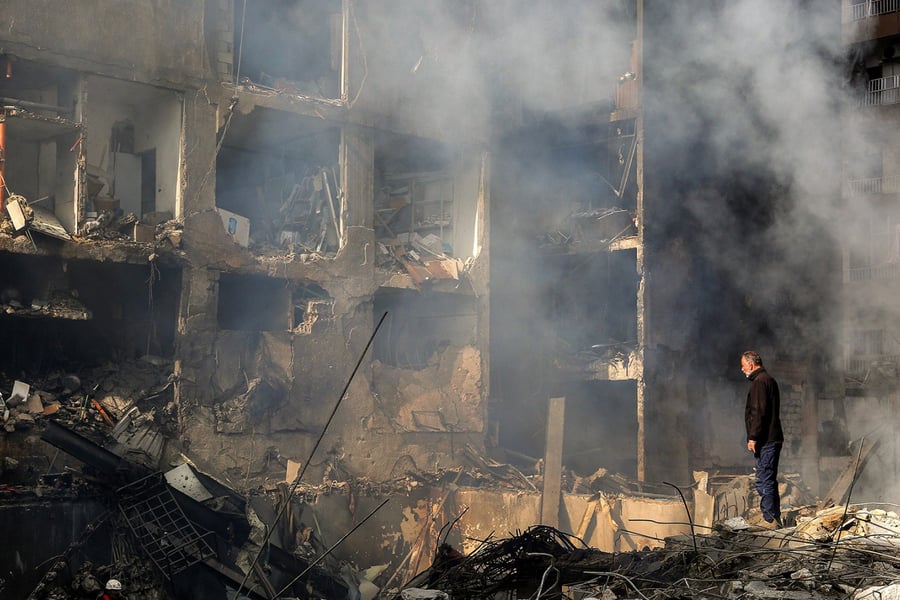
Both Iran and Israel carried out air, missile, and drone attacks across several countries within hours of the announcement Tuesday night. The most dramatic and deadly were in Lebanon, where Israel said it conducted more than 100 airstrikes against “Hezbollah targets” in 10 minutes across the country — many in the densely populated capital Beirut.
Videos taken at the scene show massive explosions from aerial bombs sending plumes of dust and showers of debris into the sky amid apartment buildings and crowded streets in the middle of the day. Lebanese civil defence officials said their initial estimate was that 254 people had been killed and 1,165 wounded. Reporters from the Associated Press said they saw charred skeletons trapped in burned out cars in the streets.
When asked on Wednesday afternoon whether Lebanon had been included in the ceasefire, White House Spokesperson Karoline Leavitt said that it had not, echoing an earlier comment from Trump.
That position was at odds with a statement released by Pakistan’s prime minister — who brokered the deal — announcing the ceasefire. Iran asserts Lebanon must be included in any ceasefire agreement.
Love Music?
Get your daily dose of everything happening in Australian/New Zealand music and globally.

Iranian parliamentary speaker Mohammad Bagher Ghalibaf — one of the key negotiators — accused the United States of violating the “workable basis on which to negotiate,” saying “in such a situation, a bilateral ceasefire or negotiations is unreasonable.”
“Lebanon and the entire Resistance Axis, as Iran’s allies, form an inseparable part of the ceasefire,” Ghalibaf wrote on Thursday. “Ceasefire violations carry explicit costs and STRONG responses. Extinguish the fire immediately.”
Vice President J.D. Vance — Ghalibaf’s counterpart in planned upcoming talks — took a different view, saying that Lebanon “had nothing to do” with the war between the U.S. and Iran, and calling Ghalibaf’s position “a reasonable misunderstanding.”
“He said there are three points of disagreement. That must mean there’s actually a lot of points of agreement,” Vance said on the tarmac in Budapest, enroute to Islamabad. “No ceasefire ever goes without a little bit of chopiness.”
Indeed.
Israel, the United Arab Emirates, and Kuwait all reported being targeted by Iranian missiles or drones after the ceasefire, and the U.S. embassy in Baghdad reported that a diplomatic compound had come under attack by drones launched by Iranian-backed militias. Iran claimed it had retaliated after the U.A.E. its attacked energy facilities.
“Iran absolutely sees itself in a position of strength,” says Nicole Grajewski, an assistant professor at the Center for International Research at Sciences Po in Paris, and an expert in Iranian foreign policy. “They are willing to test the ceasefire with action.”
Grajewski says that she believes talks will go forward regardless of the public dispute over the details of the ceasefire, saying the Iranians pushed hard to negotiate directly with Vance — who reportedly opposed the war in the first place. She said the regime believed he would behave more reasonably than many of his counterparts in the administration — most notably Steve Witkoff and Jared Kushner.
Another key provision of the ceasefire — and one of critical importance to the United States — is the status of the Strait of Hormuz. Ships hoping to navigate the strait — through which about 20 percent of global oil and natural gas exports travelled prior to the war — have been left idling at anchor across the Persian Gulf, for fear of attack by Iranian missiles, drones, or mines.
That, too, appears complicated by vastly different interpretations of what has been agreed upon, with Trump saying the strait would open immediately, while Iran says it wants to retain control of how many — and which — vessels it allows to transit.
At least two ships successfully risked crossing the strait in the immediate wake of the ceasefire’s announcement, but officials in Tehran on Wednesday said that the waterway would remain closed as long as Israel was attacking Lebanon.
The Iranian navy broadcast messages on an open maritime radio channel on Wednesday, saying: “If any vessel tries to transit without permission, it will be destroyed.”
On Wednesday, Leavitt deflected direct questions about the apparent inconsistencies regarding the strait and the ongoing fighting by saying that whatever was being said by Iran in public was “not what was being said in private behind closed doors.”
It has been 40 days since the U.S. and Israel began their direct assault on Iran, with the administration offering erratic and conflicting justifications for the war — and outlining a dizzying array of protean goals for the military adventure. Only a handful of those goals had been accomplished when the president announced the ceasefire on Tuesday, just 90 minutes shy of an 8 p.m. Eastern Time deadline he had set for carrying out further massive attacks on infrastructure across Iran.
“A whole civilisation will die tonight, never to be brought back again,” the president wrote early Tuesday on social media. The statement from a man well-known for his hyperbolic callousness left even some of his supporters outraged, while many detractors said it was clear evidence of intent to commit war crimes.
Many observers in and out of Iran began to worry that the president’s unprecedented threat signalled his willingness to use nuclear weapons in the conflict — a charge the White House flatly denied.
Against this backdrop — and with evidence of American bombers already in the air, en route to Iran — the announcement of a breakthrough in negotiations was almost universally welcomed.
The conflict has alarmed energy experts and global economists who warn of increasingly dire impacts the longer it continues, and who were cheering on the high-stakes diplomacy that accelerated ahead of the deadline imposed by Trump, facilitated by Pakistan. Vance is said to have spoken directly with Ghalibaf, Iran’s parliamentary speaker, to secure a deal.
But the shape of that deal is ill-defined.
Some news reports quoted administration officials as saying they agree in principle with a 10-point plan submitted by Tehran as the basis for negotiations, but Leavitt denied this categorically on Wednesday, saying the plan was “literally thrown in the garbage” by Trump.
Indeed, Iran’s plan included a number of demands which would have been at odds with Trump’s public statements about his war aims, chief among them that the Islamic Republic be allowed to enrich uranium — an essential capability for the construction of a nuclear weapon. The plan also asserts that Iran must retain control of the Strait of Hormuz; that the U.S. must guarantee it will not attack Iran and will withdraw troops from the region; and that Washington would lift sanctions and pay war reparations to Tehran.
Trump, for his part, has said that the U.S. and Iran are working from a “15 point” plan as it conducts negotiations over the “next two weeks,” the president’s favourite art-of-phrase when pushing complex problems to the side.
“There will be no enrichment of Uranium,” Trump wrote on Wednesday.
Other administration officials ignored the fact that the ceasefire was the starting point for talks, and spent the morning saying the U.S. had won the war.
“Iran begged for this ceasefire and we all know it,” said Secretary of Defense Pete Hegseth in a press conference early Wednesday. “Operation Epic Fury was a historic and overwhelming victory on the battlefield. A capital ‘V’ military victory.”
For their part, a variety of official and unofficial Iranian social media accounts have been crowing about what they see as a U.S. defeat. Some Iranian embassies shared AI-generated videos of Trump waving a white flag and bowing in surrender — only to later delete the posts.
Despite the chest-thumping declarations of victory from both Americans and Iranians, it is difficult to make the case that any combatant has actually benefited from this war.
The Islamic regime — known as “the System” in Persian — remains in control of Iran, but its leadership has been decimated, its military dismantled, and its economy brought to its knees. The Iranian military has lost its air force and much of its naval forces, and human rights activists say at least 3,600 Iranians have been slain so far.
Meanwhile, the United States has already spent almost $50 billion to militarily defeat a much weaker foe — while being unable to secure a strategic victory. The second order effects of the conflict will have a long economic tail, far beyond the 30 percent increase in gas prices Americans are already seeing at the pump.
Tehran proved its ability to absorb blows from the world’s most powerful country, while bringing the global economy to the brink of disaster and continuing to carry out drone and missile strikes against its adversaries.
The U.S. has celebrated the killing of Supreme Leader Ayatollah Ali Khamanei, and of dozens of senior military and intelligence leaders that have been slain in U.S. and Israeli airstrikes — with analysts estimating nearly 50 percent of top- and second-tier leaders now dead. But anyone who was hoping that the war would result in the immediate fall of the regime has been left disappointed. Although there is little doubt the country’s political landscape has been radically transformed, the Islamic Revolutionary Guards Corps is now firmly in control of the country.
The war effectively eviscerated Iran’s already-ailing economy, destroying much of its industrial base and killing many of the officials responsible for running bureaucracies, state-sponsored enterprises, and other institutions.
“There’s been such a high level of attrition across the entire state that it’s difficult to find anything to compare it to,” says Farzan Sabet, a researcher focused on the Middle East at the Global Governance Center, who runs the blog Iran Wonk. “It injects a lot of uncertainty into Iranian society.”
In the short term the surviving hardliners will likely tighten their grip, while in the longer term it will create greater instability, as the ideologically committed veterans of the 1979 revolution — those who have survived the U.S.-Israeli decapitation strikes — becoming increasingly aged and out of touch, Sabet says.
However, most Iranians will have more immediate concerns if the bombs truly have stopped falling, he says, given the widespread physical damage done to industries across the country.
“They don’t have jobs to go back to,” Sabet says.
If the war resumes, total state collapse and civil war are more likely than any kind of painless regime change, he notes.
Meanwhile, in Israel, some opponents are livid about how Prime Minister Benjamin Netanyahu’s has conducted the war. Having oversold the likelihood of regime change while convincing the Americans to sign on to the war, the prime minister had alienated himself with a key ally.
They fear Trump, unsettled by the economic impact of a war that is unpopular in America, will walk away with the job unfinished.
“Netanyahu led us to a strategic collapse,” wrote Israeli opposition leader Yair Lapid. “A military success that turned into a political disaster.”
“Israel had no influence on the agreement signed tonight between the United States and Iran,” Lapid wrote. “Netanyahu has turned us into a client state that receives instructions over the phone on issues that concern the core of our national security.”
For his part, Netanyahu is confident that Israel will yet “achieve all of our goals.”
“This is not the end of the campaign,” he said.
From Rolling Stone US

