





























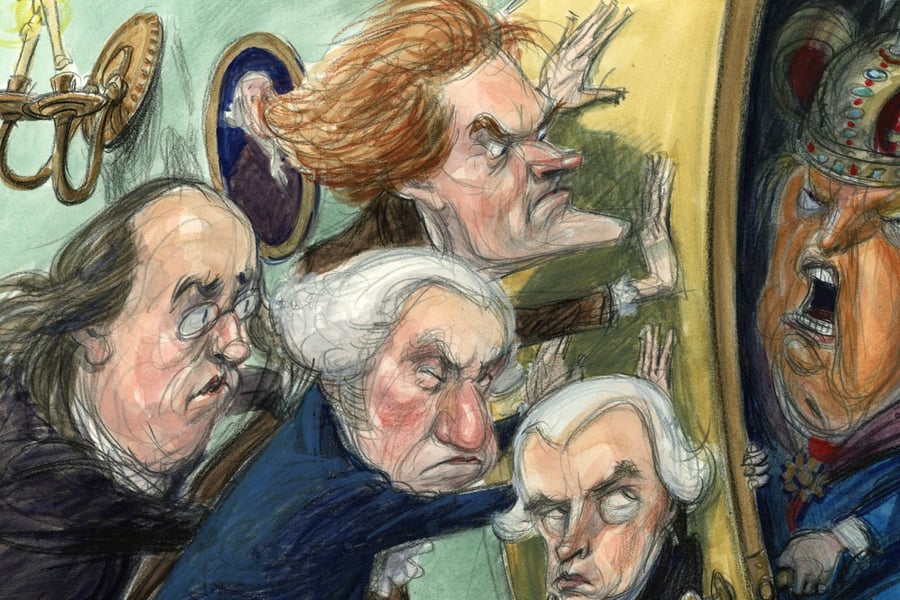
As our 80-year-old Mad King goes on midnight social media revenge benders from the White House, attacking the pope after attacking Iran, enriching his family by billions and comparing himself to Jesus, some of his supporters are now panicking and asking, “Who could have seen this coming?”
The answer, of course, is any sentient being not blinded by partisanship who lived through the first four years of Trump’s presidency, which included more than 30,000 lies, a mismanaged pandemic that killed a million Americans, and culminated with his attempt to overturn an election on the back of a big lie that led to an attack on our Capitol.
The dangers were so obvious that even the Founding Fathers could see them coming a quarter of a millennium ago.
The U.S. Constitution was designed to protect the rights of the people against the rise of a would-be tyrant. The founders understood they were embarking on a rebellious project that had never succeeded before. As John Adams scowled, “There never was a democracy yet that did not commit suicide.” Their aim was to build a structure that could withstand the forces that destroyed democracies in the past.
That’s why the founders explicitly warned about the dangers of a demagogue, the poison of hyperpartisanship, the corrosive effects of corruption and foreign influence, the politicisation of religion, and the erosion of the separation of powers.
Yes, by those basic standards, we’re living through the founders’ nightmare. But the right response is not civic despair but a defiant resolve to reclaim American patriotism and fix what’s been broken so that we can strengthen our democracy to survive the next 250 years.
So skip the saccharine Trump nationalism and “Dear Leader” iconography this July 4th. Instead, read the founders’ own words to serve as a North Star in chaotic and divided times.
Love Music?
Get your daily dose of everything happening in Australian/New Zealand music and globally.

Start with the Declaration of Independence — itself an anti-colonial screed against a mad king — and read through the list of grievances against King George. The echoes are unmistakable: The founders accused him of “cutting off our Trade with all parts of the world … He has obstructed the Administration of Justice … He has excited domestic insurrections amongst us … sent hither swarms of Officers to harass our people.” Just in case we missed the point, the founders added this line: “A Prince, whose character is thus marked by every act which may define a Tyrant, is unfit to be the ruler of a free people.”
James Madison and Thomas Jefferson pored through history in an extended document called “Notes on Ancient and Modern Confederacies,” studying the ways that ancient Greek republics collapsed. That research directly shaped the checks and balances of the separation of powers into three co-equal branches of government.
As the primary author of the Constitution, Madison had an engineer’s understanding of the weakness of the system he was trying to build. A democratic republic rests on the foundational principle that “the people will have virtue and intelligence to select men of virtue and wisdom,” he said at the 1788 Virginia Ratifying Convention. “Is there no virtue among us? If there be not, we are in a wretched situation. No theoretical checks — no form of government can render us secure.” Character is key in a democracy — and its degradation through the acceptance of lies and absurd sycophancy from Trump appointees expose how far the rot has gotten.
The Danger of a Demagogue
In The Federalist Papers, Alexander Hamilton, Madison, and John Jay repeatedly warned that the greatest danger to a democracy was a demagogue who divided fellow citizens into warring tribes. As Hamilton wrote in Federalist No. 1: “Of those men who have overturned the liberties of republics, the greatest number have begun their career by paying an obsequious court to the people; commencing demagogues, and ending tyrants.”
Hamilton perfectly anticipated the figure of Donald Trump in a letter to George Washington in 1792:
“When a man unprincipled in private life, desperate in his fortune, bold in his temper, possessed of considerable talents … despotic in his ordinary demeanour — known to have scoffed in private at the principles of liberty — when such a man is seen to mount the hobby horse of popularity — to join in the cry of danger to liberty — to take every opportunity of embarrassing the General Government [and] bringing it under suspicion — to flatter and fall in with all the nonsense of the zealots of the day — it may justly be suspected that his object is to throw things into confusion that he may ‘ride the storm and direct the whirlwind.’”
Read that a second time to let it sink in.
“Unprincipled in private life”: Check. “Bold in his temper, possessed of considerable talents”: Check. “Known to have scoffed in private at the principles of liberty”: For sure. “Embarrassing the General Government [and] bringing it under suspicion — to flatter and fall in with all the nonsense of the zealots of the day”: Well, that’s almost too on the nose — so much so that it was cited by now-Sen. Adam Schiff during Trump’s first impeachment.
Another relevant Hamilton quote argued that “the only path to a subversion of the republican system of the Country is, by flattering the prejudices of the people, and exciting their jealousies and apprehensions, to throw affairs into confusion, and bring on civil commotion.”
That is where we are as a nation right now — as a president deploys populist appeals to prejudice that pit Americans against one another, amplified by algorithms that increase suspicion and confusion. Now, we’re left anticipating the next civil commotion created by the Trump administration’s incompetence or malevolence.
Hyperpartisanship Is Poison
Washington, our first, and to date, only independent president, set the precedent for the peaceful transfer of power after two terms. He announced this decision in a farewell address, written to his “friends and fellow citizens.” It was a warning to future generations of Americans about the forces he feared could destroy our democratic republic. Chief among these were what we would call hyperpartisanship, followed by excessive debt, foreign wars, and foreign interference in our elections — all threats we face today.
Washington’s warning against hyperpartisan polarisation was most urgent. “The common and continual mischiefs of the spirit of party are sufficient to make it the interest and duty of a wise people to discourage and restrain it,” he wrote. “It serves always to distract the public councils and enfeeble the public administration. It agitates the community with ill-founded jealousies and false alarms; kindles the animosity of one part against another; foments occasionally riot and insurrection. It opens the door to foreign influence and corruption.”
This reads like a clinical description for the fevered unreason that has swamped American politics in the Trump era. It is crippling the ability of our government to function for the good of the people, as extreme ideologues and conspiracy theorists staff the administration in positions from the FBI and Homeland Security to Health and Human Services. Our country is beset by ill-founded jealousies and false alarms, as insane rumours are spread by elected and appointed officials.
But when my book, Washington’s Farewell, was published in 2017, the phrase about “riot and insurrection” felt like a distant concern. Four years later, on Jan. 6, 2021, we lived through exactly that — a partisan mob storming the United States Capitol in a violent attempt to stop the peaceful transfer of power. With Trump’s 2024 reelection, the pardoning of his duped shock troops was followed by an attempt to whitewash that history entirely — part of an administration-wide effort to censor inconvenient facts.
Foreign Interference and Corruption
It is the almost-throwaway line at the end of Washington’s warning — “It opens the door to foreign influence and corruption” — that speaks to the cause and effect of foreign influence and the unprecedented corruption we are witnessing.
America’s overseas autocratic adversaries are trying to weaken our country without firing a shot. Trump is at the very least considered a useful idiot in this effort.
Foreign influence on our elections has been clear since Russia’s pro-Trump influence operation in the 2016 election — detailed in a multivolume report from the bipartisan Senate Intelligence Committee. One of the classic examples of foreign disinformation in that campaign came in the form of competing protests outside of a Houston mosque, where both sides were recruited and inflamed by Russian disinformation half a world away.
In 2024, Trump’s abrupt flip-flop on TikTok after receiving a massive cash donation from one of its parent company’s biggest American investors, led him to outright ignore a bipartisan law — and a 9-0 Supreme Court order — banning the CCCP-owned social media giant. To the surprise of exactly no one, pro-Trump content was boosted around the election. The disinfo continues as AI efforts to normalise Trump are proliferating online today — trying to create the illusion that the deeply unpopular president has a broad, deep, and diverse base of support.
The foreign interference is increasingly connected to outright corruption. This was such a core concern of the founders that they put in prohibitions on what they called “emoluments” in the Constitution. This was the Constitution’s anti-corruption architecture.
But while past presidents have worked to avoid the appearance of a conflict — with Jimmy Carter even putting his peanut farm in a blind trust — “Trump has expressly organised his business interests in his second term to facilitate the receipt of foreign gifts,” as a scholar from the conservative American Enterprise Institute has noted. By some measures, Trump has enriched his family by billions of dollars since his second inauguration, much of it from foreign sources, from Qatari jets to cryptocurrency hustles. He has even been credibly accused of selling presidential pardons to benefit allies and supporters.
Separation of Church and State
The founders also warned us against the use of religion as a political weapon. Consider Trump’s posts comparing himself to Jesus, or the repeated invocation of Christian nationalism by the self-styled Secretary of War Pete Hegseth, who sometimes mistakes scripture for the script of Pulp Fiction.
This is not what the founders wanted. Jefferson emphasised the freedom of religion portion of the First Amendment to the Constitution — which states that Congress “shall make no law respecting an establishment of religion, or prohibiting the free exercise thereof” — by explaining that this amounts to “building a wall of separation between Church [and] State.” Just in case any current official tries to state that this freedom was intended to be limited to the predominant Judeo-Christian tradition, the 1796 Treaty of Tripoli has an answer for that: “The government of the United States of America is not in any sense founded on the Christian religion.”
Undermining the Separation of Powers
The separation of powers was designed to be a check against a tyrannical executive. As Madison wrote, “Ambition must be made to counteract ambition,” but he didn’t bet on the pervasive hyperpartisan polarisation that has made Republicans in Congress subservient to this president in particular. Because the number of swing seats with competitive general elections has plummeted by partisan design, we have a Congress of cowards who are afraid of the base of their parties because they might lose a primary. All of this creates a disincentive for constructive compromise across the aisle — and so little or no legislation gets passed. Added to this dynamic is an actual fear among many Republicans that their families’ safety could be at risk if they buck Trump.
But we’ve never quite seen the degradation of Congress as it exists today under the spineless Speaker Mike Johnson, who openly delegates his powers to the president, abandoning oversight of tariffs and war powers. That is a dereliction of constitutional duty.
This problem is compounded by the rise of an increasingly ideological Supreme Court, which is less likely to reason together with broad majorities and more likely to advance narrow partisan agendas even at the expense of precedent, as it did by overturning 50 years of a woman’s right to choose. This politicisation of the judicial branch has led directly to the declining trust in the Supreme Court.
How to Reunite the Nation
It is a dark irony that men who pretend to be superpatriots are the ones who have most violated these fundamental warnings from the Founding Fathers. Washington warned us to “guard against the impostures of pretended patriotism.” But then these Trumpists repeatedly confuse patriotism with partisanship and invoke a blood-and-soil nationalism that is the opposite of the American promise. This puts us in a dangerous place.
The worst response to this threat is civic despair: to look at the wreckage and conclude that the republic is broken beyond repair, that American democracy was always a sham, that the whole thing isn’t worth defending. That is exactly what those who would dismantle our institutions want us to believe. Cynicism, depression, and apathy are their most powerful weapons.
The truly patriotic response is to push back. Celebrating America’s independence is to celebrate a rebellion of citizens, who rejected the rule of a mad and distant king, who rose up to build a self-government where the people rule with both rights and responsibilities.
Recent history shows us that successful pro-democracy movements are patriotic, positive, peaceful, unified, and inclusive. We need to claim the founders’ wisdom for our own and resolve to rebuild the guardrails that have been broken. We have been given a great unifying cause: to strengthen American democracy for the 21st century. It will be a generational effort, cutting across government and culture, and providing an inspiring new founding agenda for the next presidents.
To combat the conditions that have enabled a demagogue’s rise, we need to take power back from the extremes through election reforms, like ending the rigged system of redistricting and instituting open primaries where independent voters can participate. We also need to tame the algorithms that elevate the most confrontational and conspiratorial voices among us through transparency and other social media reforms, like the Kids Online Safety Act.
To rein in corruption, we need to overturn the destructive Citizens United Supreme Court decision, to get big money out of politics, and strengthen the emoluments clause to ensure that no other president can enrich himself off the power of the office. To reassert presidential accountability, we need to pass the No Kings Act and reform the presidential-pardon process so it cannot be abused.
To heal our nation’s divides, we will need to rebuild the middle class by reshoring essential manufacturing, aided by vocational training, while developing a more inclusive form of capitalism that incentivises profit sharing. We need clear rules of the road around AI so that it can make government more efficient and effective without undermining our democracy or economy. Finally, we need an expanded version of national service to restore our common bonds while bringing back civics education so that each rising generation learns our full history as well as the rights and the responsibilities that come with being an American citizen. This is an ambitious and partial list, but all of the elements are broadly popular and would help reunite the United States rather than fuel further fragmentation.
Since the earliest days of our republic, America has been torn between a defiant native optimism and a profound pessimism about democracy’s prospects for success. But citizens are not subjects, and we cannot wisely wait for someone else to come save us. Government is us. So our charge this Independence Day is to draw on the best lessons of the past, determined to fix what’s broken, as imperfect people working to form a more perfect union. The United States remains, as Benjamin Franklin said, “a republic, if you can keep it.”
From Rolling Stone US

