





























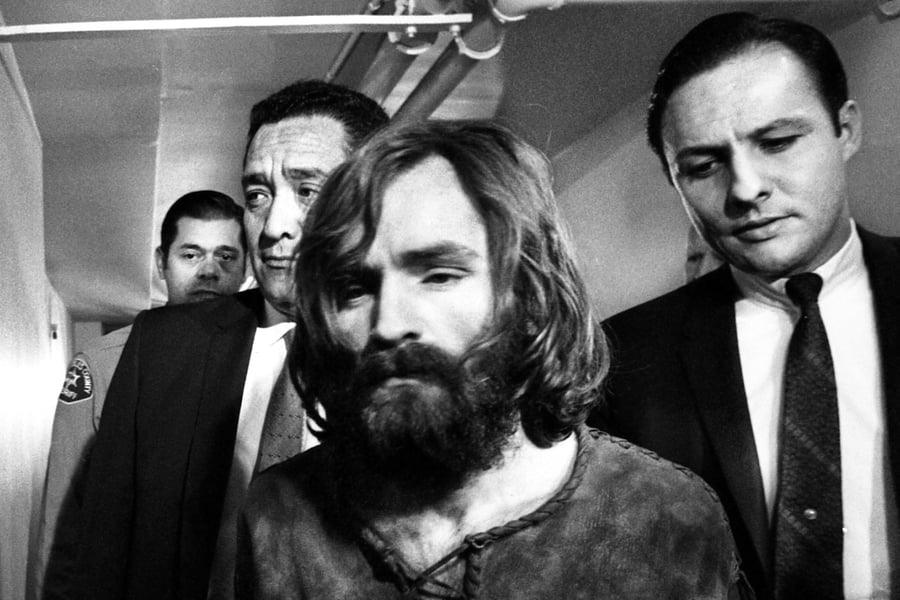
“Manson is the big bang of true crime,” Joe Berlinger tells me over Zoom from New York on a muggy summer afternoon. When we talk, it’s been 57 years and two days since Los Angeles woke up to news that Sharon Tate, the pregnant wife of one of Hollywood’s hottest young auteurs and a budding movie star in her own right, was stabbed to death in her home in Benedict Canyon, brutally murdered alongside four other people. Leno and Rosemary LaBianca, a middle-aged couple who owned a local chain of grocery stores, would be found dead in their Los Feliz home the following night. Since those murders, hundreds of books, documentaries, podcasts, specials, operas, made-for-TV-movies, and Hollywood blockbusters have been made about the case — a case which, for many people, is well closed.
Yet Berlinger is here to discuss his new three-part documentary, Conversations With a Killer: The Charles Manson Tapes, which premiered on Netflix this week. In it, Berlinger interviews numerous members of the Manson Family, including Bobby Beausoleil, who’s serving a life sentence in California, as well as Dianne Lake, Catherine Share, and Stephanie Schram, who knew Manson intimately but didn’t participate in the crimes. He talks with Jeff Guinn, author of the seminal 2013 biography Manson: The Life and Times of Charles Manson; Stephen Kay, part of the team who prosecuted Manson; and Linda Deutsch, who was a cub reporter covering the trial. (She died before the film came out; Berlinger dedicated it to her.) For those familiar with the case, Conversations won’t offer any new information. But for anyone curious about what really happened in the years and months leading up to the murders, and the media frenzy that accompanied the trial, it’s a thorough primer. And that, Berlinger says, is the point.
“There are many, many, many, many, many, many, many, many Charles Manson documentaries over the years,” he admits. His mission with this series is not to add something novel to the pantheon of theories explaining how a diminutive ex-con convinced a cadre of hippies and outcasts to commit some of the most horrendous crimes in modern memory, but to set the record straight. As targeted YouTube videos, angled documentaries, and AI-generated fare take over viewers’ screens, he sought to pull back the curtain. “Some [of the existing documentaries] are straightforward, but some explore crazy theories,” he says. “And I just didn’t want to be that guy.”
To be fair, Berlinger didn’t want to be a true-crime guy in the first place. “I hate the phrase true crime [when it’s] associated with my work,” he says. “It suggests you’re wallowing in the misery of others for entertainment purposes, and [there’s] no larger reason to tell the story. I always like to think there’s a larger reason to tell the story.”
Since the 1990s, Berlinger’s work has been on wrongful convictions — most famously with his 1996 documentary Paradise Lost: The Child Murders at Robin Hood Hills, which covered the case of the West Memphis Three. (He put out two more instalments, one in 2000 and one in 2011. The final entry was nominated for an Oscar.) “My films have helped get seven people out of prison over the years, three off of death row,” he says. “That my focus.” Berlinger ended up covering serial killers after a writer named Stephen Michaud offered him a set of taped interviews he’d done with Ted Bundy shortly before the murderer’s execution, which became 2019’s Conversations With a Killer: The Ted Bundy Tapes. “He reached out to me in 2018 and said, ‘Hey, I’m a big fan of your work. Love Paradise Lost. I found the tapes that I used to interview Bundy in 1989. Do you think there’s a show there?’”
That show would become the most-streamed documentary on Netflix that year, so Berlinger followed up with three additional seasons, one each on Jeffrey Dahmer, John Wayne Gacy, and David Berkowitz, better known as the Son of Sam. But by then, he was “serial-killered out,” in his words. So for the final season, instead of going niche, he decided to go back to where our true-crime fascination began. “This modern era of how the public consumes crime, and how crime is reported, begins with the Manson case,” he says. “I thought Manson was a great way to end.
Of course, to do a season of Conversations With a Killer, one must have access to conversations. Those came in the form of interviews done by a retired Mammoth Lakes, California, police detective by the name of Paul Dostie, who interviewed Manson between 2008 and the cult leader’s death in 2017. Dostie, who worked with a skilled cadaver dog, had become convinced that there were more bodies buried at Barker Ranch, the Death Valley outpost where the Manson Family fled after the murders. He’d brought his K9 out to the site in the late 2000s to investigate — “to his credit, [the dog] got excited at two spots,” Berlinger notes — but no bodies were found. Berlinger concluded that there wasn’t enough corroborating evidence to use Dostie’s theory as an element in the series. Instead of featuring his own interview with Dostie or an explanation in the film, he simply added a note to the beginning of each episode that the tapes had never been heard before by the public. “Of course, some of the material is not fresh. It’s been heard in many other documentaries,” he admits. “[But] the tapes are fresh.”
Love Music?
Get your daily dose of everything happening in Australian/New Zealand music and globally.

Ultimately, Berlinger’s goal was to strip back the mythology. Even without the question of more victims, the Manson case presented a new exploration of true crime, and the way the public processes it. During the Manson trial, “the press had unfettered access in a way that would never happen today,” he explains. “The trial itself wasn’t allowed to be filmed, but in the hallways, outside the courtroom, in back rooms, the press had unfettered access to Manson and the three Manson women [on trial]. And every day you’re feeding the monster of the daily headline.”
During the trial, prosecutor Vincent Bugliosi immediately set about aggrandising himself, too, hiring a writer to shadow him in court and pen what would ultimately become Helter-Skelter. In it, Bugliosi lays out the prosecutorial theory — one concocted to put away a man for murder who didn’t actually commit the crimes — that Manson was trying to jump-start a race war, called Helter Skelter. Yet as former Manson Family members recount in Conversations With a Killer, Manson was obsessed with a coming race war, but he had no intention of being the one to start it. “To this day, Helter Skelter is the bestselling true-crime book of all time, and it’s based on a myth. So what’s new about the doc is that we actually tell the banal truth of the story.”
The reality of the crime, as Berlinger came to see it, is morbid farce. First, in the summer of 1969, the Family had a run-in with a pot dealer called Lotsapoppa, who told Manson he was a member of the Black Panthers. (He was not.) Then a mescaline trade brokered by Beausoleil went sideways and ended in the death of UCLA graduate student Gary Hinman. To cover their tracks, Manson directed his followers leave marks on Hinman’s home that would suggest a connection to the Panthers. (“He was obviously obsessed with the Panthers,” Berlinger notes.) When Beausoleil was arrested for Hinman’s murder, Manson had the bright idea to stage yet another murder, leaving the same sorts of marks, so the cops would figure Beausoleil was innocent and let him free. “When the Tate murders weren’t in the newspaper as a Black Panther thing, they did the LaBianca murders,” he says. “It was just a series of blunders by an inept guy that led to this.”
Berlinger isn’t the first to tell the story straight — notable examples include Karina Longworth’s 12-part podcast Charles Manson’s Hollywood, and the 2017 Wondery series Young Charlie. But as he points out, many recent documentaries have delved into the case’s lingering questions, such as Errol Morris’ CHAOS: The Manson Murders, released last year. Though it largely sets out the same series of events found in Conversations, it posits that the CIA could have somehow been monitoring or involved with the Family. Manson and the other Family members weren’t arrested until that October, and it wasn’t until after they were in custody that authorities put together what happened, so some suggest that they were being protected by secretive government forces. Berlinger has a simpler explanation: “I’ve done a lot of legal cases over the years,” he says. “And sometimes the police get it wrong.” He adds, “I believe the best way to honour the victims’ memory is to be truthful and accurate.”
This, Berlinger believes, is the kind of thinking that ends in wrongful convictions. “You see it happening in Idaho,” he says, referring to the case of the four University of Idaho students killed by Bryan Kohlberger in 2022. (Berlinger also recently executive-produced the Netflix documentary The Idaho Murders: College Nightmare.) “There’s all sorts of alternative theories, people blaming the poor roommates who were too shocked to call [the police].” In another case he covered a few years ago, the murder of JonBenét Ramsey, the conspiracy theory that the six-year-old’s family — with a particular focus on her older brother, Burke — was behind her death has ramifications that persist to this day. “When my show came out, which was to really show how ridiculous it is to think that a nine-year-old boy could have done this to his sister, the Reddit crowd [was enraged],” he says. “There’s a certain group of people who postulate hurtful things to the point where poor Burke Ramsey — he’s an adult now, but he’s been so traumatised by being blamed. I just think it’s unhealthy and unfair to wallow in these conspiracy theories.”
With this documentary, Berlinger’s hope is not necessarily to pull the true-crime community away from searching for an explanation of the crime, but to give those who might not know about it a less salacious entry point. “A lot of people, believe it or not — especially a younger audience — are coming to these stories for the first time,” he says. “I just wanted to do something that is not mythologizing the case.”
From Rolling Stone US

