



























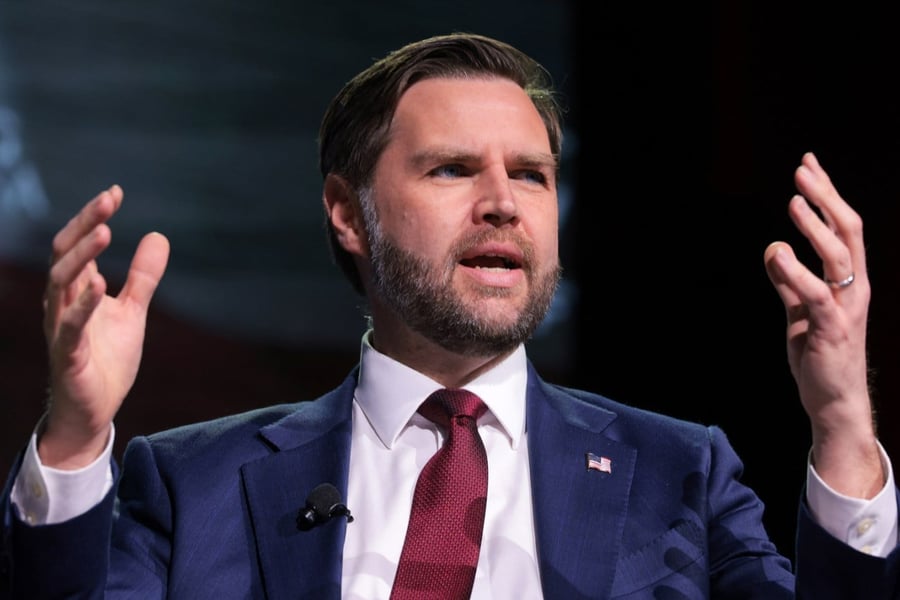
When Vice President J.D. Vance publishes his book Communion this June — a 304-page account of how his newfound Catholic faith transformed his life — he will do so as the second-ranking official in an administration engaged in open conflict with the first American pope.
On Sunday, just weeks after Vance announced his new book, Trump did something without precedent in the history of the American presidency: In a lengthy Truth Social post, the president lobbed insults at Pope Leo XIV, calling him “terrible,” “weak,” and bad for the Church. “I don’t want a Pope who criticizes the President of the United States,” he wrote, adding, “If I wasn’t in the White House, Leo wouldn’t be in the Vatican.” Two hours later, Trump posted an AI-generated image appearing to depict himself as Jesus Christ, a characterization the White House has since denied.
On the papal plane to Algiers on Monday, according to the National Catholic Register, Leo responded. “I have no fear of the Trump administration, or speaking out loudly of the message of the Gospel. That’s what I believe I am called to do, what the church is called to do.”
The backlash to the president’s posts by his own base was swift and severe. But Trump’s broadside did something far more consequential than stir outrage online. It exposed a structural contradiction at the heart of American Catholic conservatism: the ancient and unresolved tension between devotion to God and devotion to power — and the impossibility, in the end, of serving both.
In so doing, Trump has sprung a theological trap no political maneuvering can escape, which now ensnares the most powerful Catholics in his own administration. To understand its full weight, look no further than those in Trump’s inner circle, who now find themselves at an impossible Morton’s Fork of theological devotion and political allegiance.
AT LAST YEAR’S National Catholic Prayer Breakfast, J.D. Vance led attendees in prayer for an ailing Pope Francis, describing himself as a “baby Catholic.” Yet since his baptism at a Dominican priory in Cincinnati in 2019 — the culmination of years of engagement with Augustine, Girard, and the moral philosophy of the Church — Vance has become one of the most publicly Catholic figures in American political life.
There is a version of Vance — the one who exists in the pages of The Lamp, a Catholic literary magazine, in a 2020 essay entitled “How I Joined the Resistance” — who might have been appalled by what has happened this week. That Vance, writing about a late-night conversation at a hotel bar with a conservative Catholic intellectual who had been critical of the pope, said: “My growing view is that too many American Catholics have failed to show proper deference to the papacy, treating the pope as a political figure to be criticized or praised according to their whims.”
Love Music?
Get your daily dose of everything happening in Australian/New Zealand music and globally.

Six years later, Vance is one of those Catholics, having strayed from “deference to the papacy” into a mire of effrontery only the Trump administration seems capable of producing.
Last year, in an interview with CBS News’ Face the Nation, Vance accused the U.S. Conference of Catholic Bishops of prioritizing their “bottom line” over humanitarianism after the USCCB issued a statement condemning the Trump administration’s escalation of immigration enforcement. Cardinal Timothy Dolan of New York called the charge “scurrilous” and “not true,” and Vance has since apologised.
Since Trump’s Sunday night posts, Vance has gone further still, declaring on Fox News that “it would be best for the Vatican to stick to matters of morality,” and that the president of the United States should be left to “dictating American public policy.” At a Turning Point USA rally in Georgia on Tuesday, he said the pope should “be careful when he talks about matters of theology.”
It is a posture that now leads him, along with other senior Catholic officials in the administration, in lockstep with Trump into the worst U.S.-Vatican crisis in modern history.
Secretary of State Marco Rubio‘s paper trail is doctrinally more sophisticated than Vance’s. In his 2012 memoir An American Son, he wrote of his return to the Catholic faith as an adult: “I craved, literally, the Most Blessed Sacrament, Holy Communion — the sacramental point of contact between the Catholic and the liturgy of heaven.” At a State Department press conference last May, he delivered what may be the most theologically explicit affirmation of papal authority ever offered by a sitting American official.
“I believe that the pope is the successor of Peter appointed through apostolic succession and the intervention of the Holy Spirit through the cardinals. He’s the rock, and upon that rock he built the church.”
Three days before Trump’s online comments sparked outrage, Rubio delivered an address to Catholic scholars arguing that America represented “a renewal of a deeper civilizational inheritance rooted in Christian moral order,” declaring that to look upon the history of America is “to see the face of God.”
But Rubio has long maintained a careful compartmentalization, at times deploying the ideological off-ramp that the pope is “infallible on faith and morals, not on politics, science, or economics.” The bind for Rubio is that he articulates the doctrine of apostolic succession with precision and conviction, yet attempts to wall off the pope’s moral authority from his own policy decisions.
Despite White House claims that the pope is straying into political territory, Leo’s statements have remained precisely within the bounds of war, human dignity, and the ethics of violence — which is to say, within the bounds of what the Catholic Church has always defined as matters of faith and morals. Rubio’s careful stepping cannot account for a pope who declines to be separated.
Rubio has not commented on Trump’s attacks toward Pope Leo. Others in Trump’s orbit have not been so diplomatic.
Border Czar Tom Homan, perhaps the crudest and most openly combative administration official toward papal authority, is a cradle Catholic who attended a parish run by the same Augustinian order then educating the future Pope Leo XIV at Villanova University, according to Commonwealth magazine. Homan and Leo were, in a sense, formed by the same religious order, in the same era, under the same spiritual tradition. Yet, Homan has made a pattern of invoking his own Catholicism as license to challenge papal authority.
When the late Pope Francis called mass deportations “a disgrace” last January, Homan responded from the White House briefing room, according to The Hill.
“I’ve got harsh words for the Pope. I’m saying this as a lifelong Catholic. I was baptized Catholic, my first Communion as a Catholic, confirmation as a Catholic. He ought to fix the Catholic Church and concentrate on his work and leave border enforcement to us.”
In February, Homan offered to personally instruct the pope on the finer points of immigration policy: “I’d be happy to sit down and explain it to him. The Catholic faith is always in support of law enforcement. Always has been. And he should be too,” adding, “You ought to be fixing the Catholic Church, because they’ve got their own issues.”
This week, asked about Leo and the Church, Homan told reporters, “I wish they’d stay out of immigration. They don’t know what they’re talking about.”
Other Catholics in Trump’s orbit — such as Under Secretary of Defense Elbridge Colby, White House Press Secretary Karoline Leavitt, Transportation Secretary Sean Duffy, and Brian Burch, the United States Ambassador to the Holy See and former two-decade president of CatholicVote — have all remained silent about Trump’s rift with the pope.
IT WOULD BE a mistake to read what has happened over the past 18 months between the Vatican and the White House as a series of stumbles or faux pas. In Trump’s wake, Catholics in his administration have had to choose between their pope and a president whose agenda has been an affront to the “message of the Gospel” that Pope Leo says he and the Church are called to proclaim.
For decades, the invocation of papal and magisterial authority served Catholic conservatives as a reliable instrument of political discipline, a mechanism for drawing bright lines between authentic Catholics and so-called “cafeteria Catholics.” Now, it’s pointed at them, and the question Trump has forced into the open is one American Catholic conservatism has never had to answer cleanly: What happens when your own theological framework becomes the mechanism by which your political identity is dismantled?
The silence of Trump’s Catholic inner circle has been so widespread that it fell to Speaker Mike Johnson — a Baptist — to offer the administration’s most explicit defense.
At a press conference on Thursday, Johnson suggested Pope Leo did not fully understand “something called the just war doctrine” — referring to the ancient framework governing the ethics of warfare in Christian theology. However, Leo is an Augustinian friar who served for 12 years as the Prior General of the Order of Saint Augustine, the worldwide head of Augustine’s own religious order. Just war theory was developed by Saint Augustine.
“A pontiff or a religious leader can say anything they want,” Johnson said at a press briefing on Thursday, “but obviously if you wade into political waters, you should expect some political response. And I think the Pope has received some of that.”
Pope Leo, meanwhile, was in a cathedral in Bamenda, Cameroon, speaking to a community ravaged by war. He also made clear again that he is not afraid of Trump’s criticism, writing Thursday morning on X: “Woe to those who manipulate religion and the very name of God for their own military, economic, and political gain, dragging that which is sacred into darkness and filth.”
From Rolling Stone US

