





























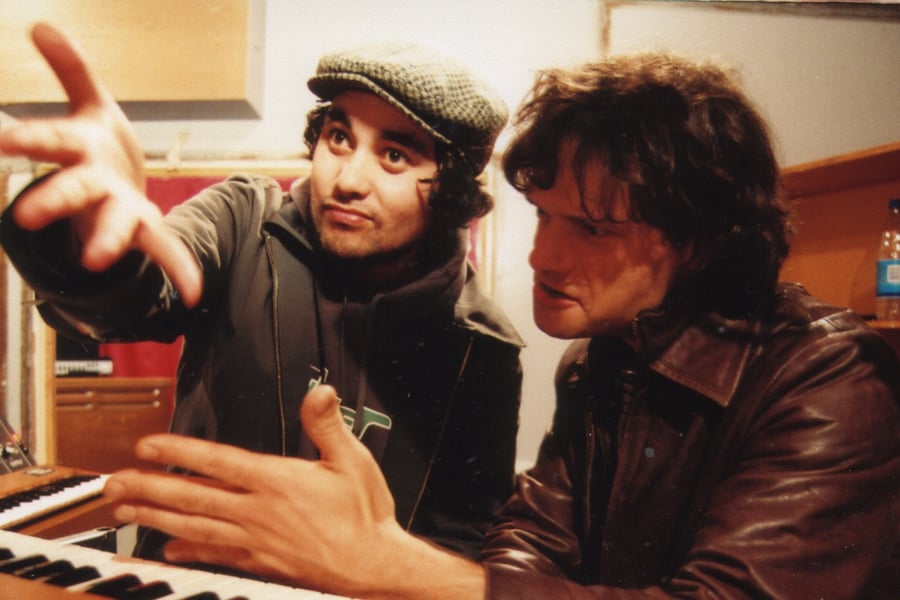
In the 1990s, the celebrated New Zealand pianist, composer, and multi-instrumentalist Jonathan Crayford immersed himself in New York’s storied jazz, funk, and Latin music scenes, performing and recording with Kurt Rosenwinkel, David Binney, Jay Rodriguez, Bill Ware, Groove Collective, and Mambo Macoco. At the end of the decade, he returned home to Te Whanganui-a-Tara Wellington with a songbook shaped by the energy of the Big Apple.
“There was a feeling I got in New York that wasn’t to do with being from one culture or another; it was about being with every culture,” he said, speaking with Rolling Stone AU/NZ on a video call from his apartment in Tāmaki Makaurau Auckland. “I’d be sitting on the subway next to an African princess in traditional dress, and a homeless man would come past asking for a dollar. Everyone’s together in New York. I got the idea that we’re all just people on a planet. We’ve got our hustles, our cultures, and our rights and wrongs. My music became a playful romp through an imaginative journey.”
Back in Wellington, Crayford continued refining his songs, performing them with different ensembles. In 2007, he entered Trident Studios with drummer, composer, and producer Riki Gooch-Pirihi, vocalists Emma Paki, Lisa Tomlins, and Hollie Smith, and a violin group led by Donald Armstrong. The result was Jonathan Crayford & Riki Gooch’s Big Foot, an expansive jazz-fusion album released as a short-run CD.
Opening with the squelchy synth-funk of its title track, Big Foot unfolds with a breezy, seaside disposition. Moving from the swinging, ecosystem-minded jazz fusion of “Can You Hear the Birds” to the smooth city-pop glide of “Jewel City” and the rubbery abstraction of “Phantom”, the songs reveals new depths and details with every playback.
Crayford and Gooch-Pirihi freely admit the album didn’t sell many copies. Regardless, it reached the right ears. Today Big Foot is considered a cult classic that documents the creativity surging through Wellington’s nocturnal jazz scene during the 2000s. In late May, it was reissued on vinyl by the newly established Auckland-based label Crayon Records.
Crayford and Gooch-Pirihi first crossed paths at the dawn of the 21st century. Back then, Gooch-Pirihi was playing in the expansive Wellington jazz-soul-reggae band TrinityRoots, among other ensembles.
Love Music?
Get your daily dose of everything happening in Australian/New Zealand music and globally.

“I remember hearing Riki drum at Quinn Shaw-Williams’ place on Taranaki Street,” Crayford said. “What struck me immediately was his sound — this warm, soft, deeply personal tone on the drums. I’d played with a lot of great drummers, including [the late actor and musician] Bruno Lawrence, who had his own unmistakable voice. Riki had that same kind of individuality. That’s what drew me in.”
Previously, Crayford had worked with a circle of longstanding New Zealand jazz musicians, including Chris O’Connor (drums), Patrick Bleakley (bass), and Neil Clayton (guitar). Through Gooch-Pirihi, he connected with a younger set of instrumentalists like Rio Hunuki-Hemopo (bass), Mike Fab aka Lord Echo (guitar), and Lucien Johnson (saxophone). Soon enough, they were playing around the city together.
“There’s this thing in life where you have great teachers come along,” said Gooch-Pirihi, after he joined us on the video call. “The biggest musical development in my life was through playing with Jonathan [Crayford]. I can speak for Rio as well when I say we learned more with him than at jazz school. It was a really magical time.”
“Wellington at that time was incredibly interconnected,” Crayford reflected, thinking back to an era before smartphones, social media, and streaming services took hold in New Zealand. “There were a lot of small venues, a lot of crossover between musicians, and a strong sense of community.” He recalled holding weekly residencies in now-closed spots like Lucky’s Juice Joint and The Matterhorn, and longstanding institutions such as Motel and Havana Bar.
When the Brazilian singer Alda Rezende turned up in Wellington, Crayford and his friends started playing with her as well. Later on he helped her make jazz, bossa nova, and samba album, Traveller (2006). There was always a studio session to sit in on, or a show.
Crayon Records founder Michael Robins was often in the audience while Crayford was playing. “In Wellington, the weekend used to start on Wednesday night,” he chuckled when I ran into him on Karangahape Road in Auckland recently, reflecting on the era’s vibrant nightlife.
During those years, Fat Freddy’s Drop, TrinityRoots, Kora, and The Black Seeds were beginning to enter the national consciousness, blending songwriting with improvisation and extended jams. “In that context, what we were doing, playing original, improvisation-driven music, felt a little outside the mainstream, but there was still space for it,” Crayford said.
In many ways, the late 1990s and early 2000s culminated in a golden moment for Wellington musicians.
Cheap rent, affordable inner-city warehouses, the influence of the local jazz school, and the PACE (Pathways to Arts and Cultural Employment) benefit scheme fostered fertile conditions for music and the rest of the arts.
Across a plethora of bars, venues, nightclubs, and DIY spaces, even left-of-centre musicians could find their footing, often performing several nights a week for receptive audiences. “There had been this jam culture in Wellington with groups like Bongmaster,” Gooch-Pirihi remembered. “It all reached a new level after Jonathan came back.”
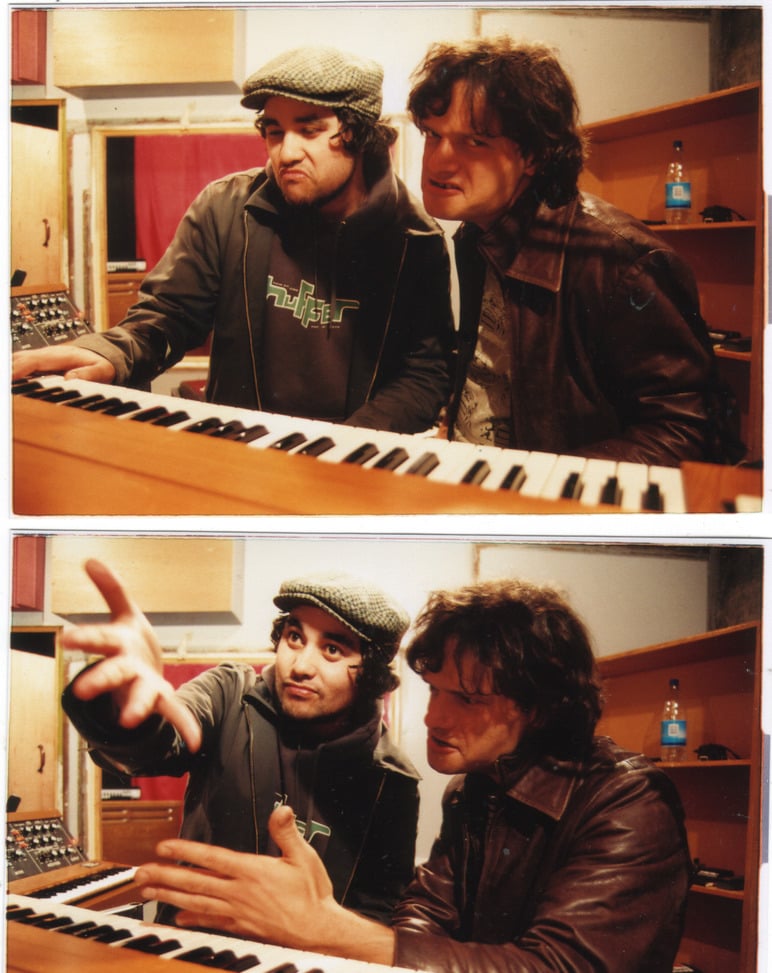
Credit: Supplied
Once he’d found his people, Crayford started thinking about ways to maintain a musical connection with New York. He eventually secured funding to bring American jazz musicians to Wellington for an artist residency programme. Crayford wanted them to be able to play gigs, host workshops, and have a reciprocal exchange with the local scene. Thanks to Creative New Zealand, the Inspiring Artists Project (IAP) was born.
One edition Crayford and Gooch-Pirihi recall fondly involved a month-long visit to the capital by the late Harlem drummer Clifford Barbaro, who played with the afrofuturist free jazz pioneer Sun Ra. IAP ran for several fruitful years. As Crayford put it, “A lot of people put a lot of effort into that and really worked for it.”
Despite operating on the fringes, Crayford also contributed to higher-profile projects, adding clavinet and marimba to TrinityRoots’ first two albums. Alongside session work and his own music, he was, and still is, active as a film and television soundtrack composer.
When Geoff Murphy, the late New Zealand new wave filmmaker who made Goodbye Pork Pie, Utu, and The Quiet Earth, returned from Hollywood to shoot the conspiracy thriller Spooked, Crayford composed two pieces for it: “Virus” (title theme) and “Boogaloo”. He recorded them with a band of local and American musicians, Gooch-Pirihi, George Coleman, Aaron Coddell, Miguel Fuentes, and Paul Norman. “George Coleman played saxophone with Miles Davis on ‘Seven Steps to Heaven’,” said Gooch-Pirihi. “It was a super active period, and it really pushed everything.”
Around the same time, the American electronica producer Matthew Chicoine, aka Recloose, relocated to Wellington. Crayford, Gooch-Pirihi, and Hunuki-Hemopo featured on his second album Hiatus on the Horizon in 2005. That summer, its jazzy deep house sound seemed inescapable at barbecues and house parties; today, it’s barely visible online, a reminder of how something once ubiquitous can become ephemeral.
Show by show, Crayford continued to slow-cook the tunes that became Big Foot, most often alongside Gooch-Pirihi and Hunuki-Hemopo. “The more I think about it, we played thousands of gigs together,” Gooch-Pirihi said.
“Riki [Gooch-Pirihi] and Rio [Hunuki-Hemopo] had a deep feel together,” Crayford remembered. “They could lay things down in a way that gave me complete freedom to move—more orchestrally, more texturally. We played those tunes constantly: as a trio, as a duo, in different venues, with and without singers. Over time, the music became more expansive and more defined.”
By 2007, Crayford was sensing change was in the air for him, the Wellington scene, and New Zealand at large. “Just as it felt like a chapter might be closing, Riki suggested we go into the studio and document the music,” he said. They spent two and a half days recording Big Foot with a mixture of drums, percussion, Hammond organ, synthesisers, guitars and woodwinds.
The basis of the album was Crayford and Gooch-Pirihi’s dialogue as a duo. From there, they worked with their friends to build the music out into something more layered and expansive. Tracks like “Moana” and “Nine” evoke neon lights and lush, coastal landscapes in equal measure. After all, to live in Wellington is to live in a city, but also live with the ocean waters.
“In the end, Big Foot became a kind of time capsule,” Crayford continued. “It captured that period — my transition back from New York, the relationships with Riki and Rio, the broader Wellington scene, and the full range of how that music was being played and understood.”
After they released Big Foot, Crayford was awarded the Edwin Carr Foundation Scholarship. He spent the next two years in Paris researching the short life of Évariste Galois, a brilliant 19th century French mathematician who died in a duel at the age of 20.
“That got me into Europe for long enough that I could reconnect with my old New York friends while they were touring,” he recalled. In Paris, Crayford worked with the American saxophonist and composer David Murray on a range of projects including ‘Questlove’s Afro Picks’, where he shared the stage with Macy Gray, Mamani Keita, the late Tony Allen and Amp Fiddler, and Questlove himself.
View this post on Instagram
While Crayford was in France, Gooch-Pirihi masterminded an extravagant psychedelic jazz funk big band called Eru Dangerspiel. He released an album titled Great News for the Modern Man in 2008 and flew Crayford back for two sprawling town hall shows in Wellington and Auckland. Later on, the Auckland show was released as a live CD/DVD.
Fifteen years and countless musical adventures later, Crayford had a conversation with Robins, who suggested reissuing Big Foot on vinyl through Crayon Records. “What I didn’t realise at the time was that ‘Big Foot’ had become meaningful, especially to younger musicians in Wellington,” Crayford said. “Over the years, people have told me how deeply they listened to it, how much they heard in it. That’s been important to me, because I tend to work with a lot of detail and subtlety without necessarily talking about it.”
In late May, Crayon Records hosted Crayford, Gooch-Pirihi, and friends for a Big Foot residency at a private venue on Karangahape Road in central Auckland. On a balmy Friday night, they played to a packed room, delivering blisteringly hot instrumental renditions of songs from the album.
Surrounded by keyboards, synthesisers, and other instruments, Crayford played in a free-flowing dialogue with Gooch-Pirihi’s rhythms and their two guests, multi-instrumentalist Joe Kaptein and master percussionist Miguel Fuentes. Lost in bliss, he looked out to the audience, cracked a cheeky grin and winked. As the music played, decades of musical history collapsed into a single golden moment.
Martyn Pepperell is an award-winning freelance music journalist, broadcaster and DJ from Te Whanganui-a-tara, Aotearoa.

