





























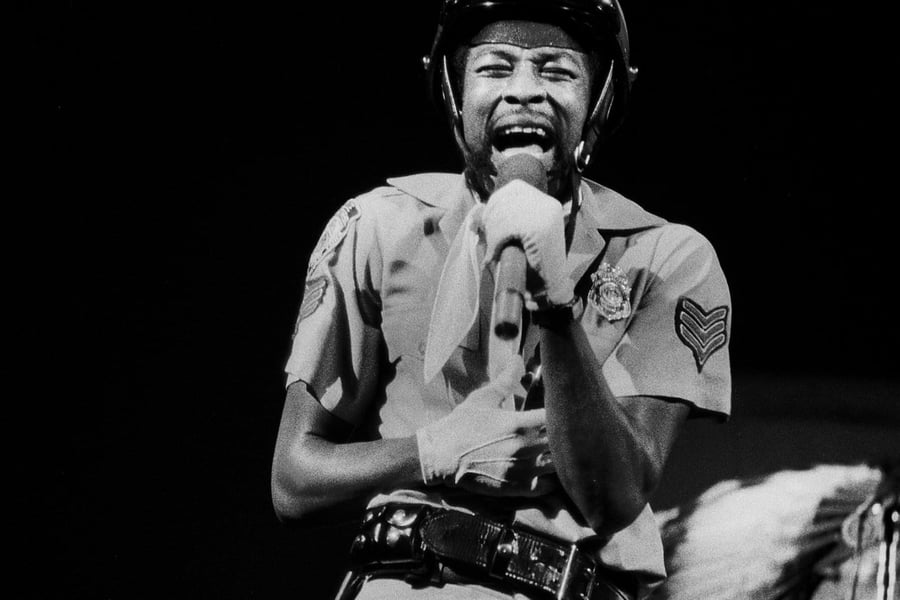
Victor Willis, frontman and “policeman” for the Village People, died Tuesday after battling “a short, but aggressive illness,” his wife and manager, Karen Huff-Willis, reported on social media a day after his death. He was 74.
As the Village People’s lead singer and cowriter of “Y.M.C.A.,” “Macho Man,” “In the Navy,” and “Go West,” among others, Willis helped establish disco as the fun-loving, gay-friendly soundtrack of the late Seventies. He preached togetherness in nearly every song, and his exuberance made him the ideal ambassador for a new era of open-mindedness and camaraderie, inviting everyone who heard him to party down. Plus, the multiethnic group’s campy, flamboyant costumes that played up to gay stereotypes (a cowboy, a sailor, a construction worker, a Native American, a … biker?) reflected how inclusive disco could be.
“Each of us represents American images that have been around for a long time,” Willis told Rolling Stone in 1979. “When I saw us on Thanksgiving Day in the parade, I realized that we really belonged there.”
“He was a great and happy guy who loved that I used his groups [sic] song, YMCA, at my Rallies,” President Trump wrote on his Truth Social network. “It became a ‘monster’ hit, again, 30 years after its original launch.”
Producer Jacques Morali acted behind the scenes as the great and powerful Oz when the Village People formed in New York in 1977, co-writing their beat-heavy first hits, “San Francisco (You’ve Got Me)” and “In Hollywood (Everybody Is a Star),” with his business partners Henri Belolo and Peter Whitehead and lyricist Paul Hutt. They hired Willis, a straight, Texas-born/San Francisco–bred singer and actor who’d appeared in theatrical productions of Hair,The River Niger, and The Wiz, to give their songs some R&B soulfulness. The vocalist, born Victor Edward Willis on July 1, 1951, grown up singing gospel in the church where his father, a Baptist minister, preached, according to The New York Times.
The cover of the self-titled first Village People album showed models in various costumes and only after it became a hit did Morali place a Village Voice ad seeking “gay singers and dancers, very good looking, with mustaches,” to support Willis.
Now a hot property, Willis was soon writing songs with Morali, the first of which, “Macho Man,” made it to Number Four on Billboard’s dance chart. The lyrics were barely coded when it came to luxuriating in homoerotic delights (they titled their third full-length, Cruisin’), but the sheer fun of it all as a supposed novelty single found an audience with straight discogoers, too.
Love Music?
Get your daily dose of everything happening in Australian/New Zealand music and globally.

“I don’t think that the straight audiences know that they are a gay group,” Morali told Rolling Stone in 1978. “Victor Willis is not gay, but all of them can work together, which is what America is trying to do. … The Village People don’t look like queens, they look like boys. And the straight guys in America want to get the macho look.”
At their peak, the Village People logged six gold and four platinum records, including the indomitable “Y.M.C.A.,” whose interactive dance helped it reach Number Two on both the dance and pop charts. They soon became ubiquitous disco ambassadors, appearing on talk shows and selling out concerts, and reports from the time claimed they’d sold over 20 million singles and 18 million albums worldwide. “‘Y.M.C.A.’ is a humanitarian song,” Willis told Rolling Stone in 1979. “It just deals with helping somebody.” (In the same interview, Willis said, “We’re not a gay group.” Years later, he would maintain that the inspiration for the song was more about cheap lodging than cheap thrills.)
In later years, Willis and his wife began threatening to sue people who called “Y.M.C.A.” a “gay anthem.” “I don’t mind if gay people want to claim it as a gay anthem for them,” he told Rolling Stone. “My thing is that when anybody wants to make a story on it, and they say ‘gay anthem’ because of the illicitness of the lyrics, that’s incorrect, because there’s nothing in my lyrics that says anything about gayness or gay acts at the Y.M.C.A.”
“Y.M.C.A.” nevertheless became one of the top 25 bestselling singles of all time in the U.K., and the Village People’s appeal would continue to grow overseas even as their U.S. popularity waned. The song became a staple of weddings and sports events. Willis split from the group in 1979 “over lifestyle differences and how the group was being perceived,” according to his archived, old website, just ahead of the group starring in the movie Can’t Stop the Music, and Ray Simpson (Valerie Simpson’s brother) took over. (They failed to replicate the same success.) Other than “Ready for the 80’s” and the minor disco hit “Can’t Stop the Music,” the hits stopped for the Village People after Willis’ departure.
Willis returned briefly to the group in 1982 but exited in 1984. From 1978 to 1982, he was married to actress Phylica Ayers-Allen, later Phylicia Rashad. He struggled with a failing solo career (his only released was a 1983 robotic-soul cover of “Physical,” made famous by Olivia Newton-John) and battled drug addiction until he completed court-ordered drug treatment in 2007. He refused to sing “Y.M.C.A.” or the group’s other hits in his years outside of the band. His 1979 solo album, Solo Man, wasn’t released until 2015.
To get by in that difficult time, he sold the rights to his songs to Morali’s company. Later, his wife and manager, Karen, who was also an attorney, sued to reclaim control of the songs under a law allowing creators to reclaim ownership of copyrights within a certain timeframe.
In the meantime, the group’s popularity as a nostalgia act exploded. U2 parodied them in a 1997 music video, and similar references proliferated in Wayne’s World 2, City Slickers, Married … With Children, and 3rd Rock From the Sun. The Library of Congress announced in 2020 that it would preserve “Y.M.C.A.” in its National Recording Registry.
Willis later fronted the group, after years of litigation, from 2017 to 2023. “It was my group, and I wanted to be able to perform my music,” he told Rolling Stone. Donald Trump, who frequented Studio 54 in the late Seventies, embraced the group’s music quixotically — was the man hellbent on rolling back LGBTQ+ rights completely oblivious to the songs’ overt gayness? — in his presidential campaigns. Willis initially objected to the use, though, over the way Trump had addressed the deaths of George Floyd and Breonna Taylor, writing in an open note to Trump his request that Trump stop using “Y.M.C.A.” and “Macho Man.” Karen also sent a cease-and-desist to Trump when performers dressed as the Village People sang the song at Mar-a-Lago in 2023.
By 2024, though, Willis’ tune changed. “I noticed that Trump genuinely liked the song, and that each time he used it, it was bringing so much joy to the American people,” he told Rolling Stone. He instructed BMI, which enforces song licenses, not to prohibit Trump from using the song. When Trump won the presidency a second time, Willis, a Democrat, supported him since he felt he should support whoever won the election. He led the Village People at a performance at Trump’s inauguration.
“We have no regrets for performing for the inauguration,” Willis said. “That was the biggest thing that Village People has ever done, and it’s an honour to be invited to the White House by whoever the president is.”
Reflecting on the legacy of “Y.M.C.A.” for the Library of Congress, Willis said, ” had no idea when we wrote ‘Y.M.C.A.’ that it would become one of the most iconic songs in the world and a fixture at almost every wedding, birthday party, bar mitzvah and sporting event.”
From Rolling Stone US

