





























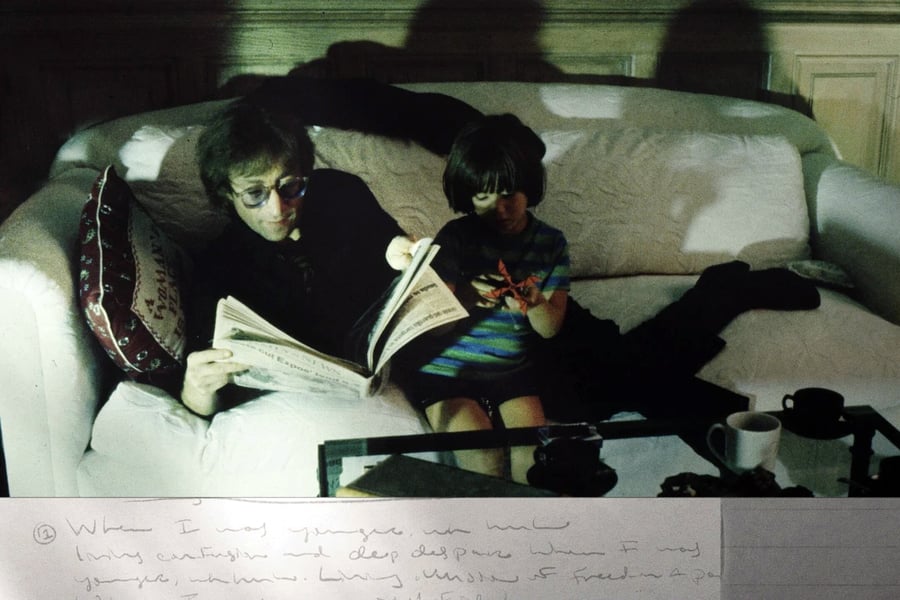
In late 1980, Dave Sholin was summoned to David Geffen’s office and played a song. The music director of Bay Area radio station KFRC didn’t recognise the man singing it, but he dug the sound — a sort of 1950s rock and roll ballad given a 1980s production sheen. Geffen eventually told Sholin that was this “(Just Like) Starting Over,” the upcoming single off of John Lennon‘s first new record in five years. The whole album, a joint project with Yoko Ono titled Double Fantasy, would be out in November. Lennon only wanted to do a little bit of press to promote it, but he wanted to do one radio interview. Would Sholin and his crew be interested in talking to the former Beatle and his wife at their home in New York City about the record?
The answer, unsurprisingly, was an emphatic “yes!” So, on December 8th, Sholin, producer Ron Hummel and on-air host Laurie Kaye walked into the Dakota and set up their microphones in the apartment where John and Yoko lived. Upstairs, the couple were being photographed by Annie Leibowitz for a Rolling Stone cover story. Ono eventually came down and greeted the trio (along with record executive Bert Keane, who was also present), and talked to them while Lennon posed for solo shots. He eventually joined his wife and talked to the KFRC team for close to three hours. The couple then left to work on what they hoped would be a follow-up to Double Fantasy, catching a ride to the studio in the back of the team’s car. Sholin immediately went to the airport to catch a flight back to San Francisco. He arrived home that night to the news that Lennon had been fatally shot outside the Dakota.
The three people who conducted what would turn out to be the musician’s final conversation recount this story in John Lennon: The Last Interview, Steven Soderbergh‘s documentary about this long, surprisingly candid chat. And though it’s been some four-plus decades since they listened to John and Yoko hold forth on everything from parenting to music to their rocky past, you can still feel their emotional rush in looking back at that encounter. Like Kevin Macdonald’s One to One: John & Yoko, which revolved around Lennon’s benefit Madison Square concerts in 1972 while covering the couple’s early years in New York City, Soderbergh’s doc uses the recording as a foundation for exploring the final five years of the musician’s life, and how that family and domesticity was the ballast that allowed Lennon to start writing songs again. (“You could not ask for a better double feature,” Soderbergh says.)
The radio interview, which ran on the station a few days after Lennon’s death, has been floating around in various incarnations and popped up on YouTube over the years. But this is the first time that the bulk of it has been officially put out in public, and Soderbergh’s film places this last interview in the context of both John and Yoko’s creative legacy and their personal relationship. You hear them talk about the obstacles they faced, the joy they found in collaborating, and the balance they struck that allowed their son Sean to lead as close to a normal, stable life as possible. You hear Yoko open up about kicking John out of their house in the early 1970s and Lennon kicking off his infamous “lost weekend” — but you also hear him express accountability and regret over his actions. You hear why Lennon returned to making music again after an extended hiatus, and how he hoped Double Fantasy was the beginning of a creative second wind. And you hear the way in which the notoriously mercurial, unsettled artist had reached a much-earned peace of mind.
The morning after the film’s premiere at Cannes, Soderbergh sat down over coffee at the Majestic Hotel on the Croisette and opened up about the challenges of “turning a piece of audio into cinema,” the use of AI imagery to accompany John and Yoko’s comments (a decision that’s already generated a good deal of controversy around the project), and why Lennon’s words endure as much as his music. This conversation has been edited for length and clarity.
Had you known about this “last interview” prior to this project?
I’d never heard about it. I should have, because I was living in San Francisco with my sister, watching that Monday night football game when Howard Cosell announced it. That’s how I heard about his killing. But I wasn’t aware of its existence until I got a call from [producer] Michael Sugar telling me about it. This would have been the fall of 2023, so we’ve been working on this a long time. Hearing the interview was a sort of moment of revelation. There was there was no way to be asked “would you want to make a documentary around this?” and not say “yes” — it was a bit of a “shoot first, ask questions” later situation, because the reality of turning a piece of audio into cinema was something I hadn’t thought deeply about when I responded emotionally into the interview.
“I’d love to do this. How the hell do I do this?“
And: “How do we get this to a manageable length?” The interview is two hours and 40 minutes, I think, and the whole thing is fascinating. We were trying to really focus, however, on things that were perennial ideas and subjects, and — except when he was talking about music — limit the amount of time on things that was kind of date specific to when this interview took place.
Love Music?
Get your daily dose of everything happening in Australian/New Zealand music and globally.

It’s funny, because it’s easy to go: Why make a documentary about this instead of just putting the audio out? It’s significant enough on its own. Then you see those music sections where John is talking about how 1980s music is just a revamp of 1950s rock & roll, and you’re cutting between the two — and stuff like that justifies having made a film about it.
There are a couple of favourite sections for me of their conversation, but one of them is John sort of making all these different connections and talking about disco in ways that kind of are disarming, you know what I mean? The fact that it’s clear he’s a fan of music, period. He’s not a snob, and understands that it’s all a mosaic that that you should respect and appreciate. It upends your expectations.
And I think you’re right in terms of it being significant on its own; they must have sensed the opportunity that was in front of them to have more control over the narrative of their relationship and of the album. But to me, they seem so eager to talk. What’s so striking about it, as somebody who’s been interviewed a lot, is the enthusiasm and the freshness of their responses, and their willingness to talk about anything. Hearing them be really candid about everything is exciting. I found myself sort of enveloped in their conversation. And the degree to which Yoko gets to speak for herself and about herself, and about them as a couple….
She really gets a voice here.
My other favourite section is them talking about the period when they were separated. It’s an incredibly raw kind of moment, but I think hugely important for people to understand that as they’re trying to explain everybody has these problems. Just because you’re a rock star and a famous conceptual artist doesn’t mean you’re immune from these kinds of personal problems that can wreck your life.
It counters the mythology around that infamous “lost weekend.”
I mean, he was off the rails for over a year. But you’re getting her side of things as well. I love when she talks about how, you know, “I couldn’t think straight. I’m dealing with a guy who hasn’t completely shed some of this sort of aggro behaviour, and everybody’s on his side, everybody hates me. I can’t think straight. You need to leave.” And he’s very emotional when he talks about it.
But it kicks off his destruction of that entire rock god myth, which was a slow rolling process. I mean, he’d talked about how, “I wrote ‘Help’ because that’s exactly what I was feeling at the time.” [Laughs] And to see him get to a place of killing that sort of myth off gives you hope, because it’s not that he’s just killing the rock star myth. What he’s saying is that we all find ourselves in situations where we’re pushed into being a certain version of ourselves because of circumstances or inherent tendencies, and we all go through this feeling of not being in control of who we are and what’s happening to us. His way of eventually addressing that, and figuring out how to change that, is applicable to any of us. I mean, it’s really just about: Are you willing to do the work on yourself to push through this idea of yourself that is kind of stalled and has become stale and kind of self-destructive? He was. And he handed that idea down to Sean as well.
How were the early discussions between you and the estate regarding this project? In the statement from Sean Lennon that was read before the premiere, it sounded like he was initially reluctant to be involved at first…
When we first talked to Sean and Jonas [Herbsman, the estate’s lawyer], it was a huge leap of faith they were taking on by saying yes. I was able to kind of describe what we had in mind, but it was still a process of discovery once we were able to really get into it. We were very upfront with them about these sequences that were going to be in the film that we weren’t sure how we were going to execute, but could involve some techno-generative video technology.
So you were already thinking about using AI early on in the project?
Yeah, and their attitude was, “Hey, whatever works, call us when you’ve got something to show.” Sean said, “Look, we’re now two generations on from his death. I really want to keep his name alive for young people to let them know what he was about. Not just like all the songs he wrote, but like what he was about. What they were both about.”
A lot of what Lennon said was timeless: “All you need is love, give peace a chance.” The music endures, naturally. But you do wonder what the concept of someone like John Lennon means in 2026 to someone under the age of 30.
My experience of right now is a real concern on the part of young people regarding authenticity. This guy walked the walk, so I would think for people being exposed to him for the first time, there would be a real sense of, “That guy is not fucking around.” He’s not afraid to say what he thinks. More importantly, John was outspoken from a place of love, not of hate or divisiveness. Both he and Yoko were speaking out in a way that’s constructive and not destructive. That’s the other thing that really comes across in the interview, how much the both of them were driven by feelings of love initially for their art, and then for each other. There’s a palpable sense that man, if they hadn’t met, I don’t know what would have happened to either of them. They needed to find each other.
John gets a rap as being cynical. He’s not cynical. He’s just a realist. The sincerity of it, and the way he just sort of radiates a kind of integrity — I’m not a musician, but that’s something that I certainly wanted to emulate, you know.
How do you listen to this interview without thinking of what comes right after it? Is the fact that death kind of hangs over everything he’s saying simply inevitable?
I mean… it is inevitable. We start with that idea right up front, when he says something that sort of makes you gasp in a way, because he conjures his own end.
John’s comment about “when I’m dead and buried… which I hope is a long time from now,” right?
Right. That was very purposeful. But I found the first time I was able to watch the whole thing end to end, and was starting to get the sense of it as a movie, an interesting thing happened. About an hour into it, I forgot the ending. Because you’re so just interested in what they have to say, and when it comes, you really feel it — the tragedy of it lands because you’;re listening to him open up, you feel really good inside, and you kind of forget for a second. Then you somebody come in and say, “It’s time to go… .” And you just go, “Oh. Oh, no.”
People were already been talking about some of the creative choices you made in terms of using AI in places where, say, animation or recreations of events might traditionally be used, before the premiere. And to be fair, there is a sense that “what do you think about AI?” is the new “what do you think about Marvel movies?” in terms of filmmaker questions — it’s a bit of a minefield. But given that it’s a prominent aspect of the film, I’m curious about the thinking behind using this as part of your creative process.
In this context, it was an enormous help, and really the only way for us to get what I felt the movie had to have in a way that wasn’t prohibitive in terms of time and money. Look, it’s one of the most contentious subjects that that I’ve seen since I got into this business a long time ago — as it should be, because it’s a big deal. We don’t know yet where this is really going to land, and to what extent it’s really going to be present. I think there will be an allergic reaction to something that’s been done this way, in terms of: It can be done this way, as opposed to it should be done this way. I was saying the other day, I think it needs to meet a couple of different criteria.
Such as?
One is: Is this really necessary to do it this way? And second, and most important: Does it make it better? Because you’re going to see a lot of stuff that’s done this way, and think, “Well, I just don’t understand why that’s considered ‘better?’” You’re going to see a sort of a pendulum swing, the way you always do when a new piece of tech shows up. Remember drum machines? Drummers were having the night sweats when drum machines showed up. Turned out you still need drummers. [Laughs]
You need the human element.
You need the human element. The easier it is for more people to make something that has a kind of technical perfection, the more important it is that things that have imperfections become. It’s complicated by the fact that there are real-world legitimate concerns around this technology that that sort of bleed into the creative conversation. What are these data centres doing to the environment? What are we doing about companies that weaponise it in order to manipulate people to increase their profits? What do we do about just the creeping sense that we all have of it being an existential threat? Why does our amygdala light up when we say those two letters together?
The only way I think to work through it is, in my case, to be transparent about it. “Well, this is what I’m doing with it.” I feel that this is actually the good version of a filmmaker using this technology, because it enabled me to do something that I literally would not have been able to do or afford to do.
So it comes down to time and money, more or less?
And a big diminishment in philosophical scale, because it’s just really important for the film, I think. We had stills, and archival footage, and a access to a good deal of material. All of that is in the film as well. But when they start going on these abstract riffs, I wanted the film to be able to follow them, you know, into the sky — like if the movie can’t do that, you just feel tethered to the earth in a way that I just think would have been unsatisfying. I was really happy when I saw what we were going to be able to do in terms of matching John and Yoko when they start to get go to high level conceptual ideas.
Can you give me an example of some of the prompts you were using to create those AI sequences?
First off, you literally need a PhD in literature to get this thing to do exactly what you’re trying to get it to do. Sometimes it’s wrong in a way that’s really fascinating, and you end up kind of chasing the wrong thing in a way that leads you to something interesting and unexpected. There’s a section of the doc that I call “the bed section.” John and Yoko are talking about how to connect with people and present ideas that are the opposite of divisive, and they’re talking about the famous bed-in in 1969. I’m like, “Let’s start by trying to kind of recreate the bed, but not in a literal space, you know. Let’s have it like in a cloud bank, and then that goes away, you pull back, and they’re people standing there.” I saw a sort of early iteration of that, and the team wasn’t happy with the rendering. They wanted it to look more representative, more real: “This is a bad prompt, we can rewrite this and get a better result,” and I went, “No, let’s go the other way.” Like, how do you transition to a place where we can go, like, full Peter Max, you know, and have it evolve in that? Forget about AI making something “real.” I want to see something that’s impossible. That was an example of the evolution of something that started as a theoretical technical problem that really wasn’t. It was actually the solution to what it wanted to be.
I think a lot of people — myself included —were worried there would be these AI recreations of John Lennon’s image and voice, which would start blurring some serious ethical lines.
I’d worry about that too going into this, to be honest. Again, it comes down to this issue of transparency. I would never tell somebody you can’t do X or Y. I just want to know that you did it. Then I can decide how I feel about it, and also I want to see the result. I’m just not big on preemptively telling artists what they can and cannot do. I retain the right to say what I want about what they did, but I would never tell an artist, “You’re not allowed to do that.” And I don’t think John and Yoko would either.
I mean, it’s hard to tell to what extent certain notions and approaches to this tech will sustain themselves, or if this will all be just be like a phase. There were purists in the documentary world who, when they saw The Thin Blue Line, felt that Errol Morris was not being respectful of the form by shooting these reenactments that looked like movies. For a while it was, “You’re not allowed to do that. This is a documentary.” And he was like, I can do whatever I want. He literally created a grammar that is part of the nonfiction filmmaking lexicon now. And ended up getting a guy out of jail.
I mean, I had the interview subjects who I shot, the mortar between these bricks, and that that’s a good palate cleanser. But I didn’t want this to become visually repetitive. The bigger thing that I didn’t want to happen — which has already happened a little bit, but I’m hoping will change once more people see the film — is that it distracts from the content of the piece. I wanted to enhance what they were saying, but I also wanted to be very careful that I didn’t pull you out of what they were saying by me being insecure. The text is strong. You don’t have to worry about people being interested once they start talking.
Surprisingly, people want to hear what John and Yoko had to say!
Conversations with smart people — it turns out that’s a really good way to solve a problem. You can’t go wrong with that. It’s worked out well for me.
From Rolling Stone US

