





























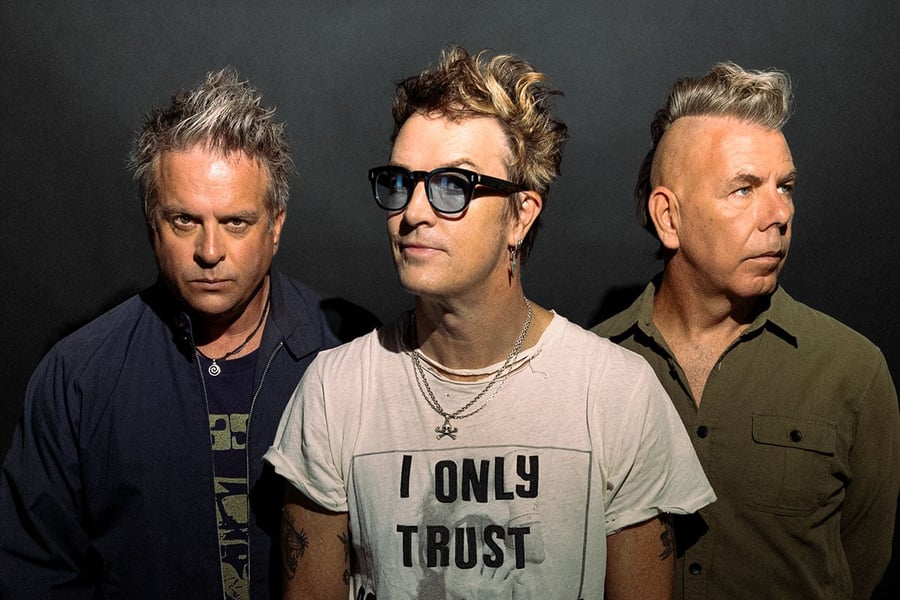
Chris Cheney has just been for a run when he answers the phone, which feels oddly fitting.
The Living End frontman is still catching his breath, but there’s a spark in his voice that cuts straight through the line. He sounds energised. Restless, even. Not in the burned-out, “still doing this after three decades” kind of way, but in the slightly dangerous, still-chasing-something way that has always powered The Living End at their best.
“Life is good,” he says. “I’m feeling fit, feeling healthy, feeling energised.”
It’s a good place to find him. The Living End are about to hit Tamworth as part of Great Southern Nights’ Live Fest, sharing a massive Australian bill with Lime Cordiale, Jet, Thelma Plum, and Kita Alexander on Saturday, May 9th. It’s the kind of lineup that stretches across generations and radio formats: rock, indie-pop, festival singalongs, old-school sweat, new-school polish.
For Cheney, that’s exactly the point.
“Number one, it’s exposing yourself to a different audience,” he says of mixed-bill regional festivals. “That was our main goal since our first gig when we were in high school.”
Love Music?
Get your daily dose of everything happening in Australian/New Zealand music and globally.
View this post on Instagram

The Living End may now be firmly written into Australian culture, but Cheney still talks about the band like three kids trying to smuggle a strange idea into the mainstream. Punk. Rockabilly. Big hooks. Political bite. Pub-rock muscle. A double bass where a bass guitar should be. It shouldn’t have worked as well as it did, and maybe that’s why it worked so well.
“We came from that very small punk, rockabilly kind of subculture scene in Melbourne,” he says. “But we didn’t want to play to 200 people at the Tote for the rest of our career. We wanted to branch out.”
That instinct, to push beyond the boundaries of a scene without sanding off the things that made them interesting, is a huge part of why The Living End have lasted. They were stylised without being novelty. Technically sharp without being cold. Loud enough for the pit, catchy enough for radio, and smart enough to sneak substance into songs that could still tear a festival field apart.
Australia, Cheney says, gave them space to do that.
“The population’s not big enough here to support every scene,” he says. “Therefore, things do come together and there’s all different people in the audiences, all from different walks of life and into different genres of music. We always wanted to appeal to them all.”
That makes Live Fest feel less like an odd pairing and more like a natural extension of what The Living End have always done. Lime Cordiale and Thelma Plum will bring their own crowds. Jet, old friends of the band, bring another lineage of Australian rock history. Kita Alexander rounds out a bill built for people who don’t necessarily live in one lane.
“I think there’s probably going to be a lot of people that haven’t seen The Living End before,” Cheney says. “It’s probably going to be a younger crowd. And that’s what happened on Good Things a couple of years ago. We’ve noticed there’s a lot of young people at our shows. That’s the coolest thing ever, to not just be playing to the same people that were there in ’98.”
Of course, 1998 still looms large. The Living End’s self-titled debut was one of those records that didn’t just do well, it seemed to arrive kitted in a leather jacket, kicking open doors and yelling at an entire generation to get up. “Prisoner of Society” became the kind of anthem bands don’t get to manufacture. They can only write it, release it, and watch it become bigger than them.
Cheney remembers the Big Day Out as a turning point.
“We played on the main stage, which for us was incredible,” he says. “I think every single person at the Big Day Out was in the arena to see us at that point. When we played ‘Prisoner of Society’, because that was the gigantic hit at that point, the entire place kind of erupted. I was like, ‘Oh… okay. I don’t think we’re going to be going back to the Corner Hotel next week.’”
He laughs now at the memory, but he also knows what that moment meant.
“It captured an entire generation,” he says. “I remember writing that and trying it out in our rehearsal room and not thinking, ‘This will be an anthem. This will be something people will be screaming back to us in masses.’ It was just another song.”
Now, with the benefit of hindsight, he can see why it connected.
“It’s so stupid and dumb and simple and anthemic,” he says. “It has all the things that a great big loud rock and roll song should have.”
That plain-speaking honesty is very Cheney. He’ll happily call one of his band’s biggest songs “stupid and dumb”, but only because he understands the intelligence in simplicity. The Living End were never trying to be clever for clever’s sake. They were trying to write songs that moved, kicked, stuck, and mattered.
They also wanted to be more than a look.
“We didn’t want to be just hung up on the style,” he says. “We wanted there to be substance. A lot of our influences were visually impressive bands, The Clash and the Stray Cats and all those bands we’ve always spoken about, but they had songs too.”
That balance has now carried The Living End all the way to the ARIA Hall of Fame, with the band recently announced among the 2026 inductees. For Cheney, it’s still a strange thing to process.
“It’s unreal,” he says. “It’s hard to put into words. You start out as kids with a dream and our dream was pretty left field, combining the musical influences that we did, trying to create this band that didn’t necessarily exist. To get a career out of it, to get records and airplay and an audience, and then to win an ARIA and then to get the Hall of Fame, it’s just great that other people bought our idea.”
The word “validation” comes up, but not in a needy way. More in the sense of looking back at a ridiculous gamble and realising it actually landed.
Still, Cheney is quick to swat away any suggestion that the Hall of Fame is some kind of full stop.
“The ARIA Hall of Fame to me always felt like, isn’t that for people who are ready to hang up their boots?” he says. “But I feel personally, we’re a long way from that.”
If anything, he says the band’s latest album, I Only Trust Rock ’n’ Roll, has lit another fire under them. Released in 2025, the record found The Living End stripping things back to the essentials after years of pushing into bigger arrangements, heavier production, strings, pianos and songwriting experiments that, as Cheney puts it, “hasn’t always worked.”
“This last record that we put out, it was a rebirth,” he says. “After the 25th anniversary of our first album, we did some big shows. With this Hall of Fame thing coming up, it just felt like it was the right time for that batch of songs to come along to remind everyone, ‘Oh yeah, that’s what they do.’”
What they do, at their core, is still beautifully simple.
“Just a straight-up rock and roll band,” he says. “I feel like we’ve rediscovered those guys again. We just plugged in and re-energised ourselves.”
That renewed energy also matters because touring Australia in 2026 is not for the faint-hearted. The romance of jumping in a van and playing seven nights a week might still exist in the imagination, but the reality is harsher: distance, freight, costs, logistics, and audiences with less disposable income and more competing demands.
“That’s half the reason that we’re not playing seven nights a week,” Cheney says. “It’s tough here. It’s a big country still. There’s a lot of distance to cover and freight costs and everything have never been higher. It’s become harder and harder to tour.”
That’s why regional events like Live Fest matter. Not just because they bring major artists to places outside the capital-city loop, but because they remind people that live music is an ecosystem. Bands can only show up if audiences do too.
“We really appreciate when people bother to come to the show,” Cheney says. “People say, ‘Thanks for coming and playing.’ It’s like, well, we couldn’t come and play if you didn’t buy a ticket.”
Regional audiences, he adds, have always given The Living End something special back.
“There was a different level of enthusiasm,” he says. “They seemed more grateful that you were there because they didn’t have an interstate band playing there every weekend like there is in Sydney, Melbourne and the capitals. There was an extra level of excitement and craziness in the audience, which just works for us.”
That is where The Living End still make the most sense: in front of people, volume up, bodies moving, everyone feeding off the same charge.
“We’ve never been the kind of band where we want the audience to sit there and tap their foot and listen to the music,” Cheney says. “It all becomes one thing.”
After all the records, awards, kilometres, chaos, and now Hall of Fame recognition, that hunger hasn’t left him. If anything, it sounds sharper.
“I’ve always got something to prove,” he says. “I probably don’t have anything to prove, but I have this inbuilt thing of always needing to do more. I always feel like there’s a better song to write. There’s a better gig to play.”
That might be the real legacy of The Living End. Not just the hits, or the double bass, or the era they helped define — but the refusal to coast on any of it.
“I never come off and think we’ve nailed it,” Cheney says. “I guess it’s that insatiable hunger.”
Tickets to The Living End’s Great Southern Nights show are available here.

