





























“I had no idea if it was going to work or not. I was really open to it failing,” legendary Australian musician and writer Robert Forster seems unsure how his debut novel is going to be received when he sits down with Rolling Stone AU/NZ.
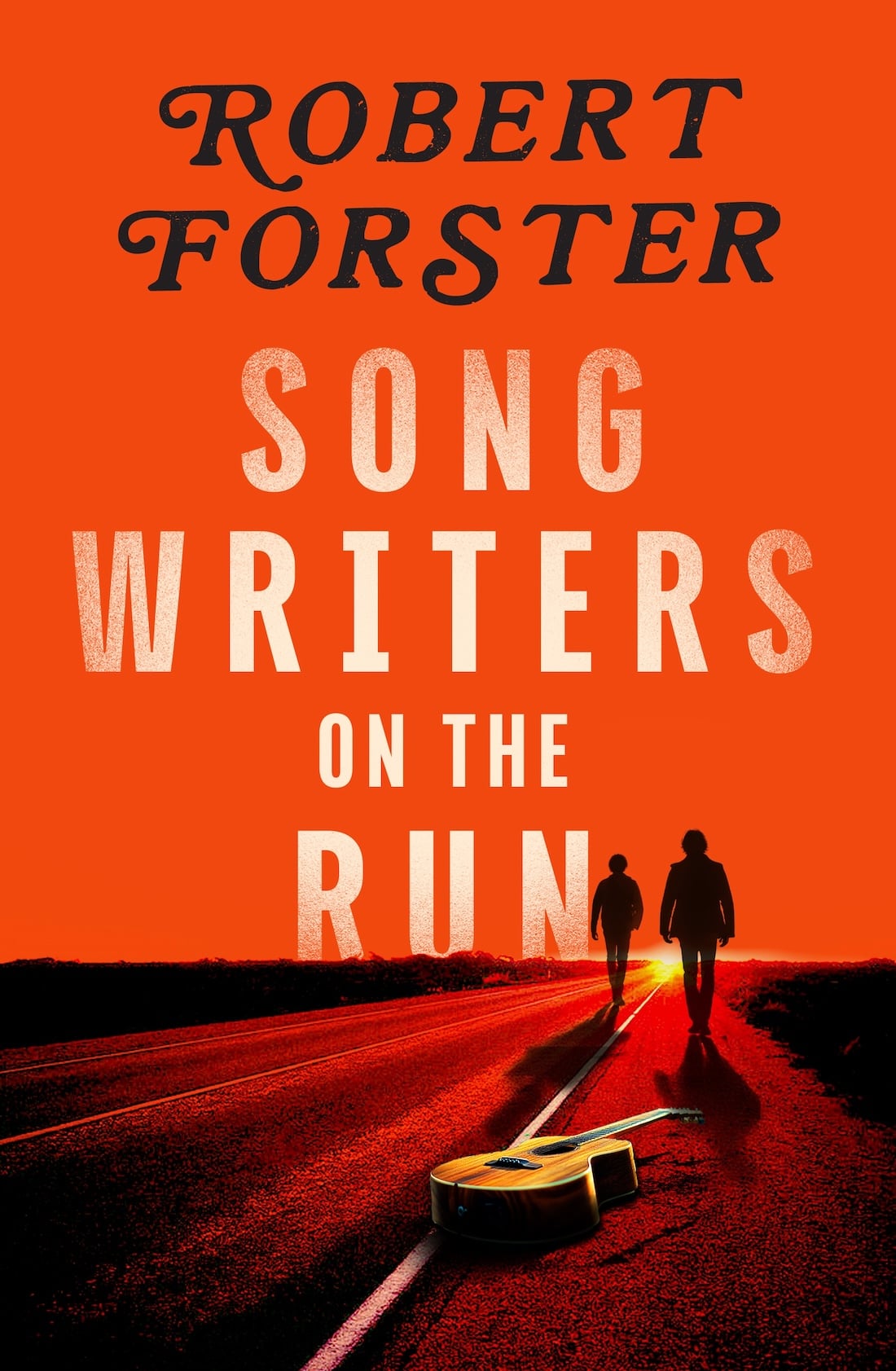
Ten years in the making, Forster’s book, Songwriters On The Run, germinated as an idea when the former member of The Go-Betweens recorded a song of the same name for his 2015 solo album, Songs To Play. It’s a gentle tune, sung with his wife Karin Baeumler, that tells the simple story of two musicians who break out of jail and, well, go on the run.
In the novel, Forster fleshes out the story, now set in the heady days of 1991, a time of disruption in the Australian music industry. Sales of CDs had overtaken vinyl, triple j was on its way to being a gatekeeper of non-mainstream success and guitar music’s dominance was being challenged by the rise and rise of hip hop and house music.
It’s amidst this period of upheaval that Forster drops his on-the-run songwriting protagonists. A backstage drug bust in Central Queensland sends two touring musos – Mick Woods and Drew Lovelock – to jail awaiting a court hearing. They make an unexpected breakout and, as promised on the book cover, they go on the run. While the action is split between a rural road trip and hiding out in Melbourne, Forster recreates an all-too-real look at life in the ‘90s for struggling independent artists.
There’s the forever-threat of being just one gig away from unrecoupable debt, community radio interviews, ego-boosting chats with obsessed fans, the judgemental flicking through vinyl collections, non-communicating managers, talk of start-up festival Big Day Out (“What’s that – a picnic?” asks one character), the loyalty of road crew, the namecheck of iconic ‘80s venues such as Seaview Ballroom, the discussion of Blue Velvet – every hipster’s favourite film back in the day – and even a cameo by the real-life Australian music legend, Spencer Jones.
And the artists talked about by the fictional music fans passing through the pages include a who’s who of the era – from household names to much-revered underground locals: Paul Kelly, The Cruel Sea, Hoodoo Gurus, Cosmic Psychos, Clouds, The Wreckery, Things Of Stone & Wood, Models, Dead Can Dance, Do-Re-Mi and so many more. An accompanying playlist is essential.
Forster need not worry, he is far from failing with his debut novel. With Songwriters On The Run he has created both outback thriller and astute urban saga. It moves at a cracking pace and sparks with realistic and witty dialogue. Having developed a writing career parallel to his musical output, Forster spun an award-winning music critic gig with The Monthly into two successful non-fiction books: The 10 Rules Of Rock And Roll – a collection of his critiques and essays – and the memoir Grant And I.
Love Music?
Get your daily dose of everything happening in Australian/New Zealand music and globally.

However, he nearly didn’t go the rock’n’roll route for his novel-writing debut. Forster explains, “I had a couple of ideas, and they all puffed out after about 1,500 words. I got about three or four other ideas, and then I’d almost forgotten about ‘Songwriters On The Run.’”
But the song had stayed in the back of his mind, and Forster realised he’d been “plotting [the story] in my head for years.”
Image by Stephen Booth
He recalls, “As soon as I started writing, it was like I was away, and I didn’t know how good it was, but I knew that I had a story to tell, and the other [ideas] weren’t stories. The others were just ideas. With this, I could go deep.”
Although only appearing in its recorded form ten years ago, Forster says the “Songwriters On The Run” track goes back further: “I wrote the song in 2009, and basically it intrigued me like no other song I’d ever really written. I started to just wonder through the years why they were in jail, how they got out, where were they going to. And it was like a puzzle in my mind that just came from the song.
“You know, like I wrote the lyrics of three fairly bare verses, but they tell a story, and I just started to tease it out in my mind, really. And then in 2017, I’d finished Grant And I, I’d stopped writing for The Monthly, and I wanted to write some fiction.”
As the book’s narrative unfolds, the actual Forster song ‘Songwriters On The Run’ gets penned by the protagonists. It’s a meta moment as we experience the song structure formulating throughout the musicians’ journey – a line jotted down one day, a chorus half-completed some time later, a jam session along the way to flesh out the work-in-progress.
Forster admits it is a peek behind the curtain as to how he creates songs, “It happens a little bit quicker in the book, but that’s the way it works. I didn’t want to jam too many themes into the book, but I wanted it to be – and it had to be – about songwriting. I wanted that to be a part of it. I wanted that sort of love of songs, how do songs get created, how do songs travel, where’s the inspiration? I wanted all of that in there, and it came really naturally because I’m a singer-songwriter, and also I’m writing a book called Songwriters On The Run, so it all just sort of meshed together quite easily, but that was something, and that is pretty much how it works, yes.”
In the book, Woods espouses a theory that “rock and roll is essentially a songwriting contest, and whoever has the best songs wins”. For example, he cites that The Beatles won the sixties. And, that the bands with the best songs win access to the bigger venues and radio airplay (it’s 1991, remember, that still counted then).
Forster believes there is some truth in the music-as-a-competitive-pursuit theory. “It was something I came up with for the book. And it’s something that I believe, you know, like, I think there’s a lot of validity in what Mick is saying there. I think there’s good things in his theory. And yeah… he’s got valid points there.”
The book also walks us through the gigging-musician experiences, such as taking part in an open mic night and the little acknowledged issue of being distracted mid-song on stage. As the audience, we are lost in the moment of witnessing our favourite artists performing in front of us – but up on stage, it seems they sometimes might be clocking us.
“I think that musicians are looking at faces in the crowd,” Forster begins, explaining why he has Lovelock distracted by a potential future love interest while on stage. “You can be playing to 50 people or 5,000 people, and you’re picking out faces… you’re not just sort of blind, I mean you can be, but you are really playing to a crowd when you’re on stage. People can be talking, there can be some aggro guy down the front elbowing people, and it’s a distraction. It can be like a woman’s face, or like a very interesting group of friends together, and it’s something that you are very aware of on stage and, of course, occasionally I imagine songwriters do sing to attractive people that they see in the audience. That’s been going on for about 2,000 years.”
Songwriters On The Run also highlights the sometimes-strained relationship between artist and manager. In the book, Lovelock and Woods spend as much time searching for their gone-to-ground manager as they spend on the run. He who is meant to bail them out in a time of crisis is not returning calls. But he’s not quite the villain of the piece.
Image by Stephen Booth
In fact, Forster insists he has empathy with hard-put-upon managers, “I must admit, in earlier drafts – and this is what I learned through the book – it was very black and white. The manager was a bad guy, and the songwriters were the good guys, the brave guys. But then the more I wrote the book, I realised it must be difficult to manage these songwriters, these, sort of, obsessed songwriters. You’re trying to set up gigs, and they’re reluctant to do interviews, and it’s not easy.
“And the more I wrote, the more sympathy I had for Bingo, the manager. He cares for the band, and he cares for them. And I wanted more of the backstory, which came in towards the end, of the betrayal that Drew and Mick feel with the financial shenanigans that go on, because when they started the band, they all thought they were in there together, and they still are.”
Forster’s characters also talk a lot about music. The author has scattered almost 100 musical references in his story – there’s even a cat named after boho-rocker and former Velvet Underground singer Nico. Even the most ardent music fans will be furiously crate-digging for lesser-known names like Greg Quill and Hans Poulsen, who are praised by Lovelock, Woods and their on-the-run acquaintances.
“Oh, look,” says Forster, “if I’ve led one person towards Greg Quill & Country Radio, I’m very, very happy. But, just going on this bit… There was another little thing that was in me… Something I wanted to do in the book, but it came really naturally at the same time, is that, I wanted the musicians and people in general to be talking about music. This is what musicians and fans do. I’ve read books about music, and I’ve seen films [about music], and musicians and fans seem to talk about everything else but music.
“But, being around musicians, being around fans, it’s obsessive, and people talk about this and go off into, you know, stratospheres, talking about bands and things they love and like and hate. And I wanted to get that in the book. I wanted people to be talking about music. And that was really important to me right from the start.”
Forster’s writing offers a meticulous account of Melbourne in 1991. The Go-Betweens settled in the city for six months in the early ‘80s; at that time, the live music scene was centred on inner-city suburbs Carlton, Fitzroy and St Kilda. At one stage, Lovelock and Woods make a very detailed dash across Melbourne, weaving from one side of town to the other.
Forster has fond memories of his band’s time in Melbourne and is happy to learn his knowledge of its geography passes muster. “That’s really good to hear,” he laughs. “It’s really early in [The Go-Betweens] history. It’s from November 1981 to May 1982… and we moved around a bit, like it was a three-piece band then… and we played a lot around town. We’d come down from Brisbane, where you could play one gig every month or six weeks; we were suddenly playing twice a week, and so we were going all around the town, meeting a lot of people. It was a really special, very high-charged time. So a lot of it comes from that time, but also a lot of visits through the years as well to just reconnect. So I don’t know Melbourne super well, but I felt that I could set the book, the latter part of the book, there.”
Forster previously detailed those young Go-Betweens days in his thoughtful and sometimes raw 2016 memoir Grant & I – a study of his friendship with bandmate, the late Grant McLennan. But Forster’s life has also been the topic of other writers, most notably in David Nichols’ The Go-Betweens biography from 2011 (“there’s some truth in there, but some things that I would quibble with”) and Tracey Thorn’s My Rock ’N’ Roll Friend about Forster’s ex-partner and former drummer of The Go-Betweens, Lindy Morrison.
“I haven’t read that one,” says Forster when asked about the latter book penned by the Everything But The Girl’s Thorn, “I read her first one [Bedsit Disco Queen], which I really, really liked. With her suburban life. With her family and the start of the Marine Girls and all of that. That’s one of the best musical biographies.”
He denies that there is anything biographical about the duo at the heart of his new book. They are not based on any Australian artists in particular, despite the similarity of their names to ‘80s musical icons Damien Lovelock (Celibate Rifles) and Mick Blood (Lime Spiders). “I came up with the names really quickly,” Forster says, “And then my editor went ‘Damien Lovelock’ and I hadn’t really thought of it. You know, like I knew Celibate Rifles, and it could have been subconsciously, but it didn’t really clock with me. I just sort of felt comfortable with [the names] right from the get-go. You know, with Mick Woods, I just wanted something quite punchy and rock’n’roll where Drew was a little bit more, you know, the romantic.”
Although his character names came quickly, completing the book was a slower task. “Songwriters was very interrupted,” Forster explains, “You know, like I’d make an album. Then I’d tour it, and then I’d come back to the book six months later. But I sort of can’t come back to the book for a day or two days. I almost have to read my way back into it. All right. So, I need at least a week. Two weeks is great. Longer is great.
“And, I sort of plot and plan it a bit. But it naturally falls in between times where if something comes up where I’ve got to go on tour or suddenly I’ve got to write something else, I can always set it aside. And then I’ll go back to it. So, it’s actually quite a good system. I just pick it up when I’m not doing other things. And there’s a fair amount of time of that where I’m not doing other things. And I really do want to, the book’s not something where I just have a back burner and I go, ‘Oh, right, I should go back to my book.’ I’m not like that. It’s a lot more in my mind. But I just sort of put it together with music making and songwriting and touring and recording. And it works out well.”
Given that he initially had a few ideas for novels when he first contemplated his shift into writing fiction, it’s not surprising to learn work has commenced on a second novel. According to Forster, “I started just working a little on a new idea. And I’ve got about 10,000 words for something new. And unlike Songwriters On The Run where I knew the plot, you know, like where I was, this is a little bit more I’m learning. I had an idea of the start… and it’s not as plot-driven perhaps or fast. But I’m liking what I’m writing. And because I just don’t know where it’s going as surely as I did with Songwriters, I’m just sort of feeling my way a little bit. But I’m really enjoying it. And it might come to something. It might fall down. I really don’t know. But I’m enjoying writing.”
Having released Strawberries, his most recent solo album, a year ago, Forster also admits that new music might be some time away, “Two years maybe… I’m writing songs at the moment.”
However, he will be taking his guitar with him on his upcoming book tour. Forster promises: “I am going to be on stage for about an hour and a half. I feel as if the book has got a story and that I can tell it. I want to expand on the book. [For] people that are interested, I want to sort of fill in, you know, like just explain in deeper, in much more detail, how the book came to be and what I’m doing in the book. I also want to play songs from the book. Yeah. So, I’ll have a guitar on stage. So, performing as well. I’m going to play ‘Songwriters On The Run’. But I will be playing other songs as well.”
Songwriters on the Run is out now.