

























Home Music Music Lists

The 100 Greatest Guitar Solos of All Time

Blues pioneers, hippie jammers, punk rockers, metal warriors, funkateers, and more
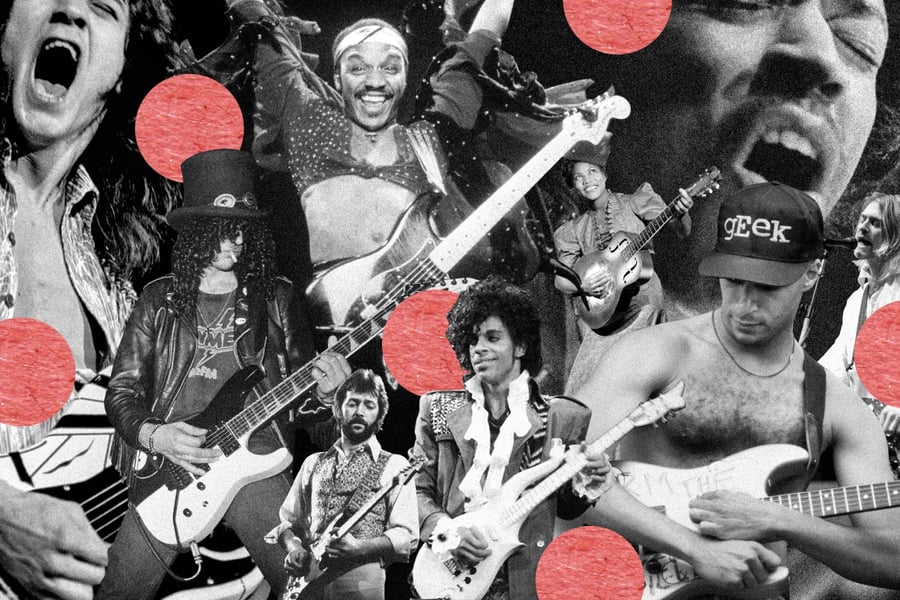
Greatest guitar solos photo illustration

All hail the guitar solo — one of the most indestructibly great art forms in all of modern music. There’s nothing quite like the thrill of a glorious six-string explosion — a long, twisted, never-ending saga that stretches from “Free Bird” to “Purple Rain,” from “Johnny B. Goode” to “Eruption.” Some classic solos come from virtuoso shredders; others are just a blast of awesomely sleazy licks. But they’ve all burned their way into our brains.

Rolling Stone’s list of the 100 greatest guitar solos of all time is a full-blast mix of different genres, generations, grooves. We travel all over history, with blues pioneers, hippie jammers, punk rockers, metal warriors, funkateers. We’ve got surfers, stoners, starship troopers, and steely knives. We’ve got legends like Jimmy Page, Jerry Garcia, and Jimi Hendrix, alongside seasoned slingers St. Vincent and John Mayer, and young rebels like Geese and MJ Lenderman. Some are solos that always make you hum in the car, or play air guitar using the nearest vacuum cleaner. A few you could even sing in the shower. (Hey, we don’t judge. Guitar worship is a sacred thing.) We didn’t include any jazz (Les Paul and Mary Ford’s “How High the Moon” is a pop tune by a guy with a jazz background), and a few entries are instrumentals.

The criterion isn’t sales or airplay — just the six-string brilliance on display. We also took into account that the solo makes the song, and that it doesn’t just repeat the melody line. (A bonus: if you can sing it note-for-note.)

As you can imagine, the arguments we had assembling this list got louder than the final minute of “Voodoo Chile.” Note: This is about solos, not riffs, which is why our Deep Purple classic is “Highway Star” instead of “Smoke on the Water.” Some of these stretch out for double-digit minutes, exploring the cosmos. Others just need a few seconds to make their impact. But a guitar trip can be a cry from the heart, full of rage, joy, hunger, pain, or maybe all at once.

Some of these 100 solos are influential cult classics; others are so universally beloved they’re banned at your local guitar shop. Every fan would compile a different list, and that’s the point. But it’s a salute to the guitar-solo tradition and all the rituals that go with it. So crank up the volume, and read this list loud.

Photographs in Illustration By:

Gus Stewart/Redferns/Getty Images; Echoes/Redferns/Getty Images; Evening Standard/Hulton Archive/Getty Images; Larry Marano/Getty Images; James Kriegsmann/Michael Ochs Archives/Getty Images;  John Atashian/Getty Images; Chris Walter/WireImage/Getty Images; Richard E. Aaron/Redferns; Gie Knaeps/Getty Images

Love Music?

Get your daily dose of everything happening in Australian/New Zealand music and globally.

Contributors:

, , , , , , , , , , , , , , ,

From Rolling Stone US

25

Guns N’ Roses, ‘Sweet Child O’ Mine’

The riff that introduces GNR’s breakthrough single may be iconic, but it’s Slash’s solo that gives “Sweet Child O’ Mine” its heart and soul. As lyrical as Axl Rose’s cooing vocals in the verses, it’s a crisp and clean Les Paul tone that slowly builds to an explosive blast of bluesy distortion. It’s also the only part of the Appetite for Destruction track that Slash likes — he often criticizes “Sweet Child” as being too much of a ballad. “It really rubbed me the wrong way,” he once told Guitar Center. “I came in with the chord changes for the solo part, which for me was the only redeeming part of the song.” —J.H.

24

Television, ‘Marquee Moon’

Television were the ultimate New York guitar band, exploring a new kind of punk psychedelia in the urban grime. With Tom Verlaine on Fender Jazzmaster and Richard Lloyd on Strat, these boys jammed onstage like CBGB’s answer to the Dead. “Marquee Moon” is their grand 10-minute epic — Verlaine soars over a staccato groove full of spooky after-hours dread, hypnotized by the city lights, with his eerie upper-register twang. Patti Smith described his sound as “like a thousand bluebirds screaming.” They took “Marquee Moon” somewhere new every night — especially the 17-minute version from Portland, Oregon, in 1978. “It was just being onstage and wanting to create something,” Verlaine said. “So I would play until something happened. That much more comes from jazz or the Doors or the Five Live Yardbirds album — that kind of rave-up dynamics.” It’s a guitar adventure open to any band crazy enough to try it, whether that’s Pavement,  Wilco, or Geese. —R.S. 

23

Derek and the Dominos, ‘Layla’

In August 1970, Duane Allman heard that Eric Clapton was down in Miami, recording with his new band. So he casually dropped by the sessions — and made history. “There had to be some kind of telepathy going on,” producer Tom Dowd said, “because I’ve never seen spontaneous inspiration happen at that rate and level.” Skydog and Slowhand had never met, but they had instant musical chemistry, turning the whole Layla album into a guitar duel — especially the title song, a desperate plea to George Harrison’s wife, Pattie Boyd. According to Clapton, Allman came up with the 12-note riff, but then topped it with that high-pitched screaming slide solo, which sounds like a theremin chased by a Delta hellhound. You can hear someone in the studio gasp “woooo!” For the coup de grace, Allman adds the final bird chirps, after the piano interlude. —R.S.

22

Neil Young and Crazy Horse, “Powderfinger”

Neil Young’s saga is full of so many ragged guitar glories, from the one-note solo in “Cinnamon Girl” to the reveries of “Like a Hurricane” or “Cortez the Killer” or “Danger Bird.” But “Powderfinger,” the monster centerpiece of his 1979 classic Rust Never Sleeps, is Shakey at his fiercest, rising to the challenge of punk rock. His solo is full of brutal violence, yet so vulnerable and elegiac, a pained lament for a lost kid trapped in a war he can’t understand. Backed by the mighty stomp of Crazy Horse, he sails away on Old Black, the 1953 Les Paul Goldtop he’s been beating up onstage since the late Sixties. It’s still the highlight of his live show, with Young blazing for verse after verse. “You can’t practice and be great,” he says in the bio Shakey. “You gotta be in tune with yourself — then you can play an out-of-tune guitar and it’s great.” —R.S.

21

Stevie Ray Vaughan, ‘Texas Flood’

The solo in Stevie Ray Vaughan’s recording of “Texas Flood” sounds as vital today as when the blues revivalist first recorded it during the 1982 sessions for his debut album. That too was titled Texas Flood, and it helped spur new interest in the genre. To guitar-blues neophytes, Vaughan’s soloing is startling: The nearly two-minute spotlight exorcises all manner of demons, with the late guitarist consistently pushing his Fender Strat further and further. According to bassist Carmine Rojas, who recorded with Vaughan during David Bowie’s Let’s Dance sessions, SRV let the muse guide him. “Most guys are very good, technically, but they’ve got no spirit. You need to have the two,” he told Classic Rock magazine in 2020. “Texas Flood” is an emotional song. You put it on, and it sounds like he’s coming through the speakers. He wasn’t bullshitting around.” —J.H.

20

Jeff Beck, ‘Freeway Jam’

Considering how innovative Jeff Beck was, this list could’ve easily been 100 Jeff Beck solos. The lead break on the Yardbirds’ “Shapes of Things” sounds like a tremulous rock raga; “Beck’s Bolero” combined a laser-beam lead whine with sighing blues guitar; the weepy, brittle break on “People Get Ready” effects more soul than Rod Stewart’s rasp; and “Nadia” is a fluttering whammy-bar meditation that trembles in and out of trip-hop beats. But his legacy blooms in Blow by Blow’s instrumental “Freeway Jam,” four-and-a-half minutes of jazz-fusion expressionism on which Beck bends floating harmonics, shimmies on the high notes, and lets notes warble as he plays with the frets. It’s a master class in musicianship but the tip of the iceberg. —K.G.

19

Lynyrd Skynyrd, ‘Free Bird’

What song is it you wanna hear? There is only one answer: “Free Birrrrrrd!” Ever since Lynyrd Skynyrd released their lighters-up Southern guitar epic in 1973, it’s been a title that fans love to scream, even at other artists’ shows. (Even at the Band’s farewell Last Waltz concert in 1976, Rolling Stone’s Greil Marcus reported, “Damned if somebody didn’t yell for ‘Free Bird.’”) Skynyrd began stretching it out in their early Florida bar-band days, to let singer Ronnie Van Zant catch his breath. “Y’all play a little longer,” he told the boys. “My throat’s hurting, and I need a break.” Allen Collins played the four-minute solo on his Gibson Explorer, with Gary Rossington adding slide fills on his SG. “The whole long jam was Allen Collins himself,” Rossington said. “He was bad. He was super bad! He was bad-to-the-bone bad.” The solo has been making bikers cry into their beers ever since.

18

The Jimi Hendrix Experience, ‘Little Wing’

“Little Wing” might be one of Jimi Hendrix’s shortest songs, but it’s also his most stunning. The Axis: Bold as Love highlight is the true definition of “less is more,” a beautiful burst of euphoria that drifts away before you even realize it was there. Hendrix wrote it after performing at the Monterey Pop Festival, a legendary experience he captures perfectly on the solo. On it, he delivers dreamy, slow-tempo notes through a Leslie speaker cabinet, a wooden device originally designed for organs. “‘Little Wing’ is painfully short and painfully beautiful,” John Mayer told Rolling Stone in 2010. “It’s like your grandfather coming back from the dead and hanging out with you for a minute and a half and then going away. It’s perfect, then it’s gone.” —A.M.

17

Ozzy Osbourne, ‘Crazy Train’

In the mid-Seventies, Randy Rhoads’ band Quiet Riot ran in the same circles as Van Halen, where he was considered just as innovative and imposing as Eddie Van Halen. But where Van Halen became instant superstars with their 1978 self-titled debut, Quiet Riot initially failed to break through. Enter Ozzy Osbourne. Fresh out of Black Sabbath, the Prince of Darkness now needed to keep up with Van Halen, and luckily Rhoads had the necessary spitfire ambition and unique verve to stand out from Eddie’s would-be clones. Rhoads’ solo on “Crazy Train” blends the minor-key drama of Beethoven with fingertapping and blues whines, and there’s a quality to his tone that feels like it’s cutting a hole in your speakers. Steve Vai once called it the first solo he ever heard that made him feel scared. —K.G.

16

Grateful Dead, ‘Morning Dew’ (Live at Cornell University, May 8, 1977)

Jerry Garcia loved to play “Morning Dew” his entire life. Folk singer Bonnie Dobson wrote it in 1961, but in Garcia’s hands, it became an epic psychedelic lament. This glorious 14-minute “Morning Dew” has gone down in history — the legendary climax of the most legendary show the Dead ever played, at Cornell University on May 8, 1977.  It’s Garcia at his most transcendent. They dropped this “Dew” on a crowd already dazed by a 27-minute “Scarlet > Fire,” coming right out of “St. Stephen” and “Not Fade Away.” Garcia soars on his Travis Bean TP500 guitar, especially in the final six minutes, where he builds from a hushed whisper to a full-on electric-funeral howl. Like “Dark Star,” “Morning Dew” was a story the Dead kept telling over the decades, with so many crucial versions. But ever since the Cornell show hit the 1970s tape-trader circuit, this “Dew” has been showing Deadheads the light. —R.S.

15

Prince, ‘While My Guitar Gently Weeps’ (Rock & Roll Hall of Fame Ceremony)

Prince’s now legendary, mega-viral guitar solo from the 2004 Rock & Roll Hall of Fame induction ceremony was allegedly a response to being snubbed on this publication’s 2003 “100 Greatest Guitarists of All Time” list. (On the updated 2023 version, he’s at 14.) Midway through a star-studded closing performance of the Beatles’ “While My Guitar Gently Weeps,” His Purpleness suddenly emerges unannounced from the shadows and effortlessly throws down three minutes of sublime guitar badassery that leaves Tom Petty and Jeff Lynne grinning as they eat his paisley dust. The largely improvised and unrehearsed solo is emotionally charged from the first note, erupting into a blaze of acrobatic shredding, rapid-fire legato runs, and electric showmanship. But even at his flashiest, Prince keeps his phrasing rooted in the melody of Harrison’s White Album classic — a show of respect from one all-timer to another. —J.R.

14

Queen, ‘Bohemian Rhapsody’

“Bohemian Rhapsody” is filled with to-the-max flourishes, chief among them Brian May’s charging nine-measure guitar solo, which links the song’s balladic opening and its increasingly frantic operatic breakdown. In an interview with Guitar Player, May said that he wanted to match the song’s vocal showmanship with his own instrument: “[Queen lead singer Freddie Mercury] said he wanted a solo in there, and I said I would like to, effectively, sing a verse on the guitar,” May recalled. “I would like to take it somewhere else. I would inject a different melody.” May’s solo stands alone melodically (“That melody isn’t anywhere else in the song, but it’s on a familiar chord sequence, so it dovetails in quite nicely,” he said), and it is a master class in maximizing a short amount of time in the spotlight. —M.J.

13

Allman Brothers Band, ‘Statesboro Blues’

For his 22nd birthday, Duane Allman was sick in bed. So his brother, Gregg, came by with a present: a bottle of pills. But a couple of hours after leaving, Gregg got a call saying, “Baby brother, get over here now!” Duane had emptied out the bottle and started using it as a slide, playing the old Blind Willie McTell tune “Statesboro Blues.” “I just sat around for three weeks and practiced,” Duane told Rolling Stone in 1971. “It still sounded terrible.” Yet he used that bottle slide — and that song — for the rest of his all-too-brief life, as the Allmans hotwired “Statesboro Blues” to kick off their live classic At Fillmore East. Duane crammed a lifetime of legendary guitar into his 24 years: the epic jam of “You Don’t Love Me,” the down-home serenity of “Blue Sky,” the lovelorn screech of “Layla.” But his whole story is in “Statesboro Blues.” His surviving bandmates played it at his funeral. —R.S. 

12

Michael Jackson, ‘Beat It’

Even Eddie Van Halen’s own brother and bandmate, Alex, never could understand it. Why did Eddie unleash his entire bag of tricks, the greatest arsenal of stunts any guitar player has ever amassed, in a single 20-second guest solo on a Michael Jackson song, without credit or even payment? It’s all there, from the two-handed tapping to the magical harmonic squeals to the furious tremolo-picking to the whammy-bar abuse — an entire decade-shaping vocabulary, all from one pair of hands. It’s quite possibly the most generous guest appearance in the history of recorded music, and nothing like it has graced any pop song before or since. Well before Run-D.M.C. met Aerosmith, it tore down walls between genres, and helped Jackson push past MTV’s reluctance to play Black artists. —B.H.

11

Jimi Hendrix, ‘All Along the Watchtower’

“All Along the Watchtower” was already a classic before Jimi Hendrix grabbed hold of it. It’s one of Bob Dylan’s scariest songs, a stripped-down acoustic Biblical parable from his 1967 album, John Wesley Harding. But Hendrix, a longtime Dylan fanatic, took it to a whole new level, drastically reworking it into a howling-wind guitar storm. He recorded “Watchtower” just a few weeks after the original came out, for Electric Ladyland. His five-part solo brings the stark atmosphere to life, especially that ghostly slide groan at the two-minute mark. “It overwhelmed me, really,” Dylan said in 1995 of Hendrix’s version. “He had such talent — he could find things inside a song and vigorously develop them. He found things that other people wouldn’t think of finding in there. He probably improved upon it by the spaces he was using.” —R.S.

10

The Beatles, ‘While My Guitar Gently Weeps’

“While My Guitar Gently Weeps,” the White Album classic, is the most legendary of Beatles solos — yet it was played by George Harrison’s best friend, Eric Clapton. It was a spur-of-the-moment whim: George invited his mate to come play just before the session, while the two were driving into London. Clapton was horrified, saying, “No one plays on Beatles sessions!” George just replied, “So what? It’s my song!” But he had an ulterior motive — he was sick of the open warfare at Abbey Road, and he knew the Fabs would mind their manners around an honored guest. As he quipped, “They were all on their best behavior.” Clapton played a very Harrison-like solo on a cherry-red 1957 Les Paul he’d just given George as a gift, nicknamed “Lucy.” George used it on the White Album and Abbey Road, including “Something.” (Yes, that’s right: He played his most romantic love song to Pattie Boyd on the guitar Clapton gave him.) —R.S.

9

Funkadelic, ‘Maggot Brain’

According to legend, P-Funk mastermind George Clinton told guitarist Eddie Hazel to play the opening track of Funkadelic’s 1971 album as if he’d just been told his mother died. The result is the sort of heartbreaking, mind-bending instrumental that feels like a transmission of pure, uncut grief. A self-taught guitarist who worshipped Jimi Hendrix, Hazel contributed a lot to the P-Funk canon. But the nearly 10-minute guitar solo that kicks off their dark, troubling, yet still groovy-as-fuck 1971 LP is still the cornerstone of his legacy. Notes are not played so much as wept and wrenched out of his instrument; Hazel eventually conjures a sense of perseverance, rising phoenix-like from the ashes of his echo pedals in the final minutes. “It’s a piece of music to evoke the ghosts of the past,” Living Colour’s Vernon Reid said. “It evokes the suffering. It evokes the joy. It’s a masterwork.” —D.F.

8

Steely Dan, ‘Kid Charlemagne’

In classic Steely Dan fashion, Larry Carlton spent at least 90 minutes — possibly more — in the studio with Donald Fagen and Walter Becker, working on the guitar solo for “Kid Charlemagne.” The jazz-trained guitarist, so renowned for his use of the Gibson ES-335 he earned the nickname “Mr. 335,” even had to do several takes, at Becker’s behest, with a Fender Stratocaster before being allowed to return to his primary guitar. “It was not long after that, that we were into it,” Carlton recalled in one interview, exuding a nonchalance befitting his work on “Kid Charlemagne.” His mid-point and outro solos (the latter done in one take) masterfully balance complexity and ease, solid gold pop-rock melodies unafraid of cosmic jazz twists. And his phrasing never falters, an effortless glide even at the speediest or prickliest parts, each note melting like ink off a blotter. —J. Blistein

7

Led Zeppelin, ‘Stairway to Heaven’

“I thought ‘Stairway’ crystallized the essence of the band,” guitarist Jimmy Page told Rolling Stone in 1975. He’s not wrong. The eight-minute odyssey from Led Zeppelin IV showcases what each member did best: Robert Plant’s Celtic-inspired, pastoral lyrics, delivered through his iconic banshee wail; bassist John Paul Jones, as versatile as ever, contributing mystical recorder and electric piano; John Bonham bringing both heaven and hell with his thunderous drums. Then there’s Page, who used a 1959 Fender Telecaster gifted to him by Jeff Beck for the dazzling finale. Page’s solo was totally improvised, a “first-thought-best-thought” master class in melody and power — just enough to bring it on home, but not so much where it overshadows everything else. “Every musician wants to do something of lasting quality, something which will hold up for a long time,” Page said. “And I guess we did it with ‘Stairway.’” —A.M.

6

Chuck Berry, ‘Johnny B. Goode’

Chuck Berry perfected the rock & roll guitar solo as we know it in “Johnny B. Goode,” the definitive guitar-hero anthem. His opening 18-second barrage was the shot heard around the world, a Tunguska-level blast of electric bravado that inspired half the players on this list to pick up their first guitar. As Keith Richards said, “Chuck is the granddaddy of us all.” It’s the tale of the Louisiana country boy who strums while his mama urges, “Go, Johnny, go!” But it was inspired by playing his first gig in New Orleans, haunted by the city’s history. As he wrote in his memoir, “The thrill of seeing my Black name posted all over town in one of the cities they brought the slaves through turned into ‘Johnny B. Goode.’” Every tradition of American music is somewhere in Chuck Berry’s guitar — never louder or more defiant than right here. —R.S.

5

Van Halen, ‘Eruption’

Nearly a half century after Van Halen released their self-titled debut, it’s almost impossible to conceive of the impact that the album’s second track, a minute and 42 second guitar solo aptly named “Eruption,” had on the course of guitar history. Eddie Van Halen’s succinct statement of purpose, with its revolutionary use of two-handed tapping, total mastery of the whammy bar, blinding speed, and rich, overdriven tone — he referred to it as the “brown sound” — establishing the lexicon for a new generation of guitarists. As Van Halen — who often complained that “Eruption” has a mistake in it that he couldn’t subsequently reproduce — told it, the solo’s inclusion on the album was almost an afterthought. “We were in the studio practicing for a show we had that night at the Whisky, and I was warming up with my solo,” Van Halen said to journalist Jas Obrecht. “Our producer, Ted Templeman, walked by and said, ‘What’s that?’ I said, ‘Oh, it’s just it’s a little thing I do live.’ And he said, ‘Hey that’s great; let’s put it on the record!’” —T.B.

4

Pink Floyd, ‘Comfortably Numb’

David Gilmour’s transcendent “Comfortably Numb” solo isn’t merely one lead but the best parts of five or six takes, not that anyone would know it. “I just followed my usual procedure, which is to listen back to each solo and mark out bar lines, saying which bits are good,” Gilmour once said. He simply raised and lowered the faders whenever a phrase perked up his ears, creating a mosaic that became the most affecting solo of his career. His playing is weepy, soulful, and beautiful, giving the dreariness of The Wall human warmth. Luckily for Pink Floyd fans, he kept it in the band’s sets after Roger Waters left, expanding it brilliantly on live albums like Pink Floyd’s Pulse and his own recent solo live album, The Luck and Strange Concerts. According to Gilmour, every time he played the solo, it turned into something new onstage. —K.G.

3

The Eagles, ‘Hotel California’

There’s simply no denying the peerless Seventies rock-radio greatness that is the dueling guitar solos in “Hotel California.” Preserved for all time by producer Bill Szymczyk in the marathon title track to the band’s 1976 album, the solos are a high-noon showdown between guitar slingers Joe Walsh and Don Felder. They’re also eminently singable — admit it, you’ve shouted “da, da, da, da …” in the car during the song’s climax. “There was always a little competition between Felder and I. We always tried to kind of one up each other … ‘Oh yeah? Listen to this!’” Walsh says in the 2013 documentary History of the Eagles. Whether on the original recording or onstage, the guitar solos never fail to summon that cool breeze and warm smell of colitas. Says Szymczyk, who oversaw albums by B.B. King and Bob Seger, “The ending of ‘Hotel California’ is one of the high points of my recording career.” —J.H.

2

Jimi Hendrix, ‘Machine Gun’

Nobody ever did more with the guitar than Jimi Hendrix, but “Machine Gun” is Hendrix at his most Hendrix — the most ambitious, raw, soulful, go-for-broke expression of his musical genius. It comes from Band of Gypsys, recorded live on New Year’s Day 1970 at the Fillmore East, a 12-minute firestorm of electric anguish and political rage, inspired by the violence in Vietnam and America. So many guitar legends have called this the greatest solo ever, from Slash (“that’s the Holy Grail”) to Kirk Hammett. “Not only is this my favorite guitar solo of all time,” Phish’s Trey Anastasio said, “but it includes the single greatest note ever played on electric guitar: the high screaming note Jimi plays right at the beginning of his solo.” (Check it out right at the four-minute point.) Hendrix had bigger hits, but this is the furthest he ever traveled. Over 50 years later, “Machine Gun” remains the outer limits of how high a guitar — and a guitarist — can reach. —R.S.

1

Prince, ‘Purple Rain’

The origins of “Purple Rain” are filled with legends: Prince thought it could’ve become a country song; he offered it to Stevie Nicks, who felt it was too cinematic for her to record; and a homeless woman was the first to hear it when Prince invited her into the Revolution’s rehearsal space. But none of that matters, since for everybody else, the band birthed “Purple Rain” at Minneapolis’ First Avenue on Aug. 3, 1983, when Prince wrung a solo from his guitar that felt more like a moving cry of the soul than a musical spotlight. It’s the first time they played it live, and it’s the version on Purple Rain. Prince’s guitar prowess was well documented by that point, but the fluidity of his phrasing on the song and the way he pinched his strings for notes that ascended heavenward spoke more about what “Purple Rain” meant than his obtuse lyrics. —K.G.
