




























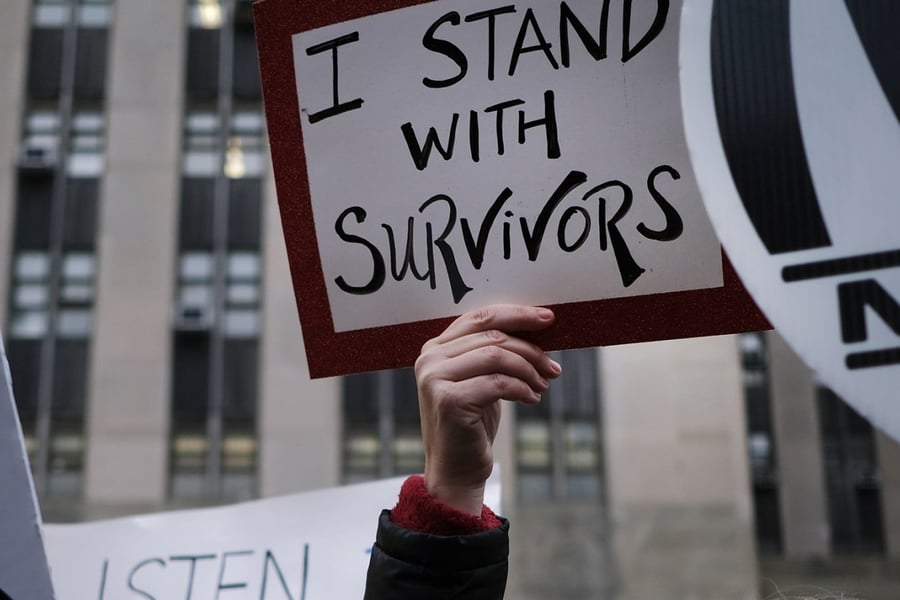
April is Sexual Assault Awareness Month, and I’m writing this open letter not to call anyone out, but to invite you in.
The music industry has had several opportunities for a reckoning in recent years. But so far, it’s a reckoning the industry has managed to avoid. What we’ve seen instead are individual moments, isolated legal outcomes, and public spectacles that generate headlines but haven’t produced the systemic change this industry needs. The scrutiny that swept through Hollywood at the height of the #MeToo movement largely passed over the music industry. And while the last few years have heightened that scrutiny, the industry’s response has been mostly silence.
Historically, the legal window for survivors of sexual assault to seek justice was shockingly narrow. On the criminal side, prosecutors in New York had as few as five years to bring charges for most felony sexual assault cases. On the civil side, survivors had just three years to file a lawsuit. In California, the time limit to criminally prosecute cases of rape was within 10 years, and three years to pursue civil action.
For anyone who understands how trauma actually works, how long it can take a survivor to process what happened, to find the language for it, to feel safe enough to come forward, those timelines were never realistic. In 2019, New York extended the criminal statute of limitations to as long as 20 years for certain sex crimes and extended the civil window to 20 years as well. California removed the statute of limitations for prosecuting rape cases entirely in 2016, and gave sexual abuse survivors 10 years to pursue litigation civilly. But none of those changes were retroactive, meaning that anyone whose window had already closed was still locked out of the legal system.
In 2022, the Adult Survivors Act (ASA) in New York state was passed to address that gap. It opened a one-year lookback window, allowing survivors to file civil suits that the previous statute of limitations had barred, regardless of when the abuse occurred. New York City’s Victims of Gender-Motivated Violence Act provided an additional pathway for survivors to file claims. More than 3,500 complaints were filed before the ASA window closed in November 2023, and the music industry was at the centre of some of the most high-profile cases. The lawsuits filed under these lookback windows didn’t just expose individual behaviour. They exposed systems, institutional silence, and a culture that too often prioritised reputation and revenue over the safety of the people whose lives and labour make the industry thrive.
California followed with the Sexual Abuse and Cover-up Accountability Act, its own lookback window that revived civil claims for sexual assaults with some strings attached. A one-year window for claims prior to 2009 required evidence of an institutional cover-up. A related two-year window for incidents after Jan.1, 2009 was more expansive but was due to close at the end of this year. After the vague wording of the initial law caused mixed results in the courts, California legislators passed a second law, the Justice for Survivors of Sexual Assault Act, which went into effect Jan. 1, 2026.
The new law opened an additional two-year filing window that is fully retroactive, expanding survivors’ ability to hold individual abusers accountable for sexual assault claims, no matter how old, without requiring them to also name a company or allege a cover-up. That window closes on Dec. 31, 2027. These laws aren’t just about courtrooms. They’re about culture. This wave of legislative shifts signals that the legal landscape is looking to provide more realistic pathways to keep up with society’s evolving understanding of the dynamics that enable sexual violence.
Love Music?
Get your daily dose of everything happening in Australian/New Zealand music and globally.

And yet, even with all of these new laws and legal claims, the industry has not had its reckoning. Fame, wealth, and power continue to distort and deny justice. What fandom and pop culture continue to prove is that if someone is talented enough, famous enough, and rich enough, there will always be people willing to ignore that person’s crimes, especially when those crimes are sexual in nature. Nostalgia and stardom have a way of putting people under a spell. I’ve seen it up close. Fame is a special kind of power that gets people to ignore things they would never tolerate from “normal people.” When the person accused is someone whose music is the soundtrack to their lives, the public reaction isn’t outrage. It’s a negotiation. It’s “But I love that song.” Celebrity turns the pursuit of justice into “content.” It turns survivors into characters in someone else’s story. And it gives the industry permission to do what it has always done: wait for the news cycle to pass and move on.
That same power dynamic in the industry operates behind closed doors and away from cameras every day, making the most vulnerable susceptible to manipulation or worse. The gatekeepers who control whether your song gets picked, whether your deal gets signed, or whether you get invited back into potentially life-changing rooms hold a level of influence that extends well beyond the professional reach. And in an industry where so much happens informally — in studios late at night, at private events where the lines between business and social disappear — the opportunities for abuse of power are everywhere.
The music industry runs on collaboration. It runs on trust. A songwriter walks into a session with a producer they may have never met. An artist meets with an executive in a closed-door meeting to discuss a deal that could change their life. A young executive shows up on day one wanting nothing more than to prove they belong. Every one of these moments requires an environment where people feel safe enough to create, negotiate, learn, and say no without consequence. We all know that the environment doesn’t always exist. And too many of us have looked the other way.
A 2024 global study by MIDiA Research, TuneCore, and Believe surveyed more than 4,100 music creators and professionals across 133 countries and found that three in five women in the music industry have experienced sexual harassment, and one in five have experienced sexual assault. More than 70 percent of those women did not report it, citing fear of retaliation and a belief that nothing would change. And for the women who did come forward, the outcomes weren’t much better. Fifty-six percent said their claims were ignored or dismissed, and nearly one-third were told to keep quiet.
So why hasn’t anything changed? Part of the answer is structural.
One of the biggest differences between the film industry and the music industry is organisation. Hollywood has unions, guilds, and collective bodies that represent workers across the business. When the #MeToo movement began, those structures didn’t lead the charge, but they gave the movement somewhere to land and became vehicles for new codes of conduct, reporting systems, and protections. The music industry doesn’t have those same structures, but that doesn’t mean we’re powerless. It means we have to build differently. You don’t need a union to be unified. You don’t need to collectively bargain to have a collective consciousness. Keeping people safe in the rooms where music gets made is a human rights issue, and it should be something every company in this business can come to the table about.
View this post on Instagram
The last few years have made this impossible to ignore. We have watched the federal prosecution and conviction of one of the most powerful figures in music history on charges tied to the exploitation of people inside his own organisation. We have watched survivors come forward publicly, at tremendous personal cost, to tell stories that too many people in this business already knew.
And still, the question remains: what are the companies doing about it? Not the individuals. The companies. The record labels, music publishers, management firms, studios, and agencies. The institutions that fund the careers, expand the platforms, and decide what behaviour gets addressed and what gets ignored.
As founder of The 100 Percenters, a nonprofit that aims to transform the standards of the music industry so that every working music creator can build a safe and sustainable career, I’ve watched this industry avoid its reckoning long enough. In response to that reality, The 100 Percenters created the Safe Music Business Pledge. A public commitment from companies across the music business to four straightforward principles: keep your people safe in the workplace and in studio sessions; report harassment and abuse when it happens and take action; refuse to tolerate inappropriate or abusive behaviour; and create a safe space for those who don’t feel protected.
That’s it. Four commitments. None of them are controversial.
Organisations like the Recording Academy, BMI, SONA, LVRN, and others have already taken the pledge, and we welcome more support of this very important work. We are seeking record labels, publishers, and management firms with artists, songwriters, producers, and employees on their rosters. Companies that have the resources and the influence to set the standard for the entire industry.
Not having signed the pledge doesn’t mean a company is unsafe, and signing it doesn’t automatically make a company safe. But taking the pledge signals something that matters. It tells your artists, your songwriters, your producers, and your staff that you see the problem and you’re willing to do something about it.
The laws are evolving, the culture is shifting, survivors are speaking, and the public is watching. The reckoning this industry has managed to avoid is coming. The question is whether you will be on the right side of it.
If your company hasn’t taken the Safe Music Business Pledge, please visit the100percenters.com and sign it this month. If you’re an artist, songwriter, or producer reading this, I’m asking you to share the pledge with the companies you work with and tell them why it matters to you. We’ve even prepared an outreach template on our site to make that as easy as possible.
The Safe Music Business Pledge is a concrete step toward making sure the people who create the music that drives this entire ecosystem can do so without fear. The industry is built on songs. Let’s make sure the people who write, produce, and perform them can walk into every room knowing they’re protected.
From Rolling Stone US

