




























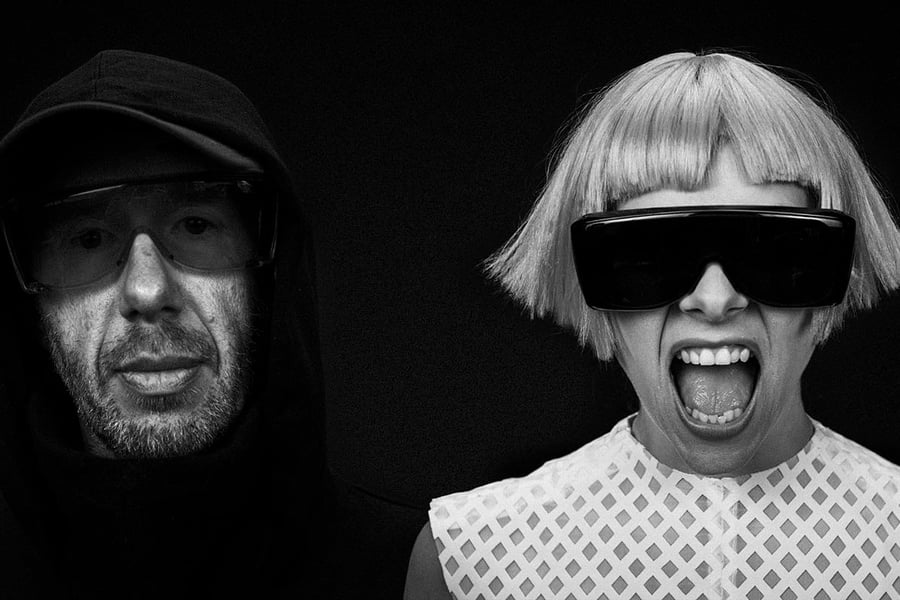
There’s a point, early in the conversation, where Tom Rowlands starts talking about what it felt like to make music with AURORA without any expectation attached to it. No plan. No outcome. No sense of where it needed to go.
He circles the idea for a moment, then lands on it plainly.
“It reminded me of making music when there was no expectation on what you were making and no pressure and nothing to live up to,” he says. “There was no past to it and no future to it, only a present.”
That’s the core of TOMORA — the new project the Chemical Brothers producer and Norwegian singer-songwriter have quietly built over the better part of a decade — and it explains why COME CLOSER, their debut album, doesn’t feel like a side project, or a crossover, or even a collaboration in the traditional sense, but more like a reset.
The origin story is deceptively simple. Rowlands first saw AURORA performing at Glastonbury in 2016 and was immediately struck by her. The power of her voice, yes, but also something harder to define. A uniqueness. A looseness.
Years later, after working together in fragments — features, production and creative overlaps — he asked her a question that would quietly change everything.
“Do you want to just write for fun with no direction?” AURORA recalls. “And I was like, ‘Yes, of course. That’s really fun.’”
Love Music?
Get your daily dose of everything happening in Australian/New Zealand music and globally.

There was no grand plan. No discussion of albums or identities or timelines. Just two artists together — in the UK, in Norway — and making things because they could.
“I think ‘Somewhere Else’ was the first thing we kind of did,” AURORA says. “And then eventually came ‘Ring the Alarm’ too and then ‘Come Closer’. It was just very like… okay, this feels like very specific, weird personalities. And we have more of them within us. And then we were like, ‘This has to have its own name.’”
That name became TOMORA — and amalgamation of both of their names — not just a project, but, increasingly, a space they could step into together.
“There was no expectation that we were making an album or forming a band,” Rowlands says. “It really was just for the… I think both of us really enjoy making music. It’s like, oh yeah, that’s why I’m a musician.”
Perhaps that’s what makes COME CLOSER feel the way it does. It isn’t chasing anything. It isn’t responding to anything. It simply… is. For two artists with such defined creative identities, the most surprising thing about TOMORA is how little friction there seems to be between them.
“There wasn’t a single compromise,” AURORA says, before pausing. “Except for one synthesiser doubling the vocals… four bars of music.”
Rowlands laughs. It’s the kind of detail that says everything.
“It’s very ego-free, which is rare, I think,” she continues. “Or that’s very, very nice.”
That lack of ego isn’t accidental; it’s something they’ve actively leaned into. Not by diminishing their own instincts, but by choosing to set them aside.
View this post on Instagram
“Tom is absolutely brilliant and he knows what he’s doing and I know what I’m doing,” AURORA says. “And then we can kind of keep that in mind in our subconscious, but also let that go a bit and act like we don’t know what we’re doing… just really let go in the moment and let the music truly take us somewhere.”
Rowlands puts it more bluntly.
“Individually we both really know what we’re doing,” he says. “But when we come together, neither of us know what we’re doing.”
It’s not chaos so much as a kind of deliberate unlearning. A refusal to fall back on muscle memory.
“You form habits making music,” Rowlands says. “But with Aurora… we both enjoy almost leaving our past thing behind us and being like, okay, this is a new beginning.”
AURORA describes it less as a reset and more as a hunt.
“We don’t know what it sounds like or what it looks like,” she says. “But we know exactly when we found it, when we found it. And it’s just hunting and searching, being curious.”
That instinct — recognising something before you can name it — is what gives TOMORA its shape. Long before the first track officially dropped, TOMORA already existed in fragments online — anagrams, riddles, scattered clues. Fans on Reddit tried to decode who was behind it, what it was, whether it was even real.
“It was really fun,” AURORA says.
Not in a marketing sense — more in the way of creating a feeling.
“It’s nice when we have to figure something out on our own sometimes,” she says. “It does something good to the brain of a human to be pondering and wondering about something.”
For Rowlands, the appeal was tied back to that same idea of starting again.
“The idea of starting something from total unknownness… it was like, oh, this is something we should relish,” he says.
And there’s something quietly poetic about that. This is a project born out of freedom, choosing to introduce itself quietly, letting people find their way to it rather than announcing itself outright.
“It feels very special,” AURORA says. “Everyone who has found their way to our project… it’s just very cute.”
If TOMORA in the studio is about letting go, TOMORA on stage is about surrender.
The project made its Coachella debut last weekend. Asked whether the show is something to observe or something to disappear into, they answer in unison: “Both.”
“It has to be,” AURORA adds.
For her, it’s a shift away from the traditional idea of performance. Less about presenting, and more about dissolving.
“I’ve never been on the stage making music where people just get really… where almost I can get invisible on stage,” she says. “And that’s always been a dream of mine, because then you’re truly at one with the crowd.”
It’s a striking concept — invisibility not as absence, but as connection.
Rowlands views it in motion.
“I always think the music is leading all of us,” he says. “It’s almost like we’re all hanging on to the music train that we’re making… we’re just holding onto this thing that’s careering out of control.”
There are moments in the show, he says, where it genuinely feels like that: not performance, not control, just movement.
A shared current.
Trying to pin down COME CLOSER in genre terms feels beside the point.
For AURORA, the more interesting idea is that difference doesn’t necessarily mean separation.
“The two songs that in my brain feels the most TOMORA is ‘Come Closer’ and ‘Ring the Alarm,’” she says. “Because they really show that they belong together so much, but they also show how even songs that you think are different genres are the same if they have the same name, birthing them.”
It’s a typically abstract way of describing something quite precise; cohesion through origin, rather than similarity.
Rowlands leans into the same idea from another angle.
“I love that those two pieces of music can exist very close to each other on an album,” he says. “They’re very connected, but very different… and it feels very natural, and not a force.”
That’s what TOMORA manages to hold across the record: contradiction without tension. Songs that shouldn’t play nice with each other but do, because they share the same origin story.
In reality, TOMORA didn’t appear overnight. It’s the result of years of orbit: creative overlap, shared instincts, a long-building trust. But it only became itself when they stopped trying to define it.
“There was no expectation that we were making an album,” Rowlands says again.
And maybe that’s just the point. Not just of the project, but of the way it feels.
In an industry built on forward momentum — plans, rollouts, outcomes — TOMORA exists almost entirely in the present tense. A quiet space where two artists can meet, forget what they know, and follow something they can’t quite name.
As the conversation winds down, the question turns, inevitably, to what happens next. Touring. Expansion. Whether TOMORA might make its way to Australia.
They hesitate.
“Maybe,” Rowlands says.
“We’re doing everything we can,” AURORA adds.
It’s not a non-answer. It’s just an honest one.
Because if there’s one thing TOMORA has made clear, it’s that this project doesn’t move according to expectation. It doesn’t rush toward outcomes. It doesn’t announce itself before it’s ready.
It appears when it appears.
And when it does, you’ll know.
Or, as AURORA might put it — you don’t know what it looks like, or what it sounds like.
But you know exactly when you’ve found it.
COME CLOSER by TOMORA is streaming now on all platforms.

