




























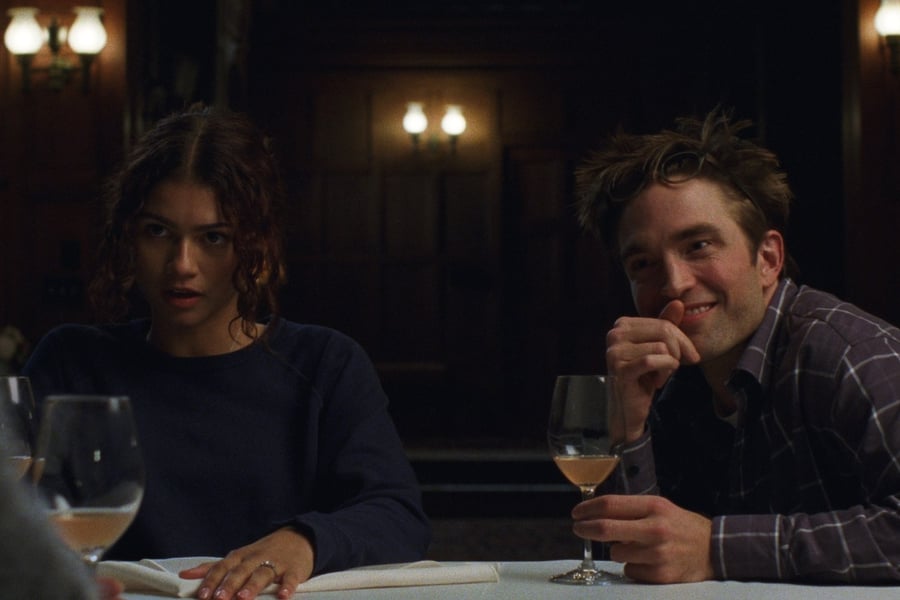
Maybe you’ve heard that people are already going a little cuckoo over The Drama, the upcoming film starring Zendaya and Robert Pattinson (in theatres April 2 in Australia). Some of it has to do with breathless expectations around seeing the Euphoria megastar and the former Twilight poster boy turned perfect silver-screen weirdo in what, on page, might read like an old-fashioned romantic comedy: Boy meets girl. Boy proposes. Girl says yes. Things get crazy before the wedding. This is a technically accurate description of the premise, albeit one that misses the vibe by a million light-years. We can only assume moviegoers expecting warm-and-fuzzies had missed the film’s early teaser, which suggested this couple’s ship is sailing on ill winds from the get-go. Perhaps those same moviegoers also forgot that both the studio, A24, and the film’s producer, Ari Aster, were responsible for that lighthearted rom-com Midsommar.
A lot of the hysteria also has to do with a bombshell that gets dropped, a “twist” that sends The Drama off into a different direction than the one in which many thought it might be heading. When we meet Charlie (Pattinson) and Emma (Zendaya), he’s embarrassing himself by trying to chat her up at a cafe. Spying a novel she’s reading, he googles the plot and pretends it’s his favourite book. She’s deaf in one ear and, because she has an earbud in the other, can’t hear his pitiful attempts at literary sophistication. This is their version of a meet-cute, the kind of flop-sweat anecdote that makes for a sweet relationship footnote when recounted during a wedding. Both of them negotiate over who gets to use it in their speeches. You, the viewer, are already wincing at the sheer stalker-y awkwardness of it all.
Later, while testing out food and wine choices for the reception, the couple and their married friends, Mike (Mamoudou Athie) and Rachel (Alana Haim), decide to play a game. It hinges on a question: What’s the worst thing you’ve ever done? Mike’s story involves an ex-girlfriend, a dog, and a bad night. Rachel’s answer revolves around an act of cruelty in her youth. Charlie mumbles something about cyberbullying; it’s about as believable as his declaration of love for the book he hadn’t read. Then, perhaps because she doesn’t want to seem mealy-mouthed like her fiancé or maybe because the vino has been flowing freely all night, Emma tells them about her worst thing. Let’s just say in terms of “worst,” it wins the game.
This unfortunate moment of TMI honesty changes how everyone in the room sees her, and how everyone in the theatre sees the movie — it’s the point of no return for the characters and, for a lot of folks who’ve seen The Drama early on, the moment it loses them. We’re on a new playing field now, and the remainder of this “comedy” jettisons romance in favour of cringe. The friendship between the two couples becomes strained, to put it lightly. Charlie starts looking at Emma differently; the film keeps flashing to the thoughts inside his head, as he pictures not the person she is today but the person he now thinks she was. Emma becomes withdrawn and retreats to bad habits. Charlie’s co-worker, Misha (Hailey Gates), gets roped into the mess as well. You wonder if any of this is in good taste, whatever that phrase means in 2026, or if the sudden introduction of an issue much, much bigger than the film itself isn’t simply a shock value masquerading as shock therapy.
How you fall on that last bit is key to whether you end up viewing The Drama as daring or a heap of dung dropped into a Lismore Diamond punch bowl. Norwegian director Kristoffer Borgli has ventured into such danger zones before. He’s best known for Dream Scenario (2023), which acted as a pressure valve for Nicolas Cage regarding meme-era celebrity, but his feature debut, Sick of Myself (2022), walked a similar thin line between thought-provoking and trolling with its dark digs at attention seekers in the attention-economy age. (That it used the very same social issue deployed in The Drama as part of a punchline in a subplot makes it feel like we should have seen this coming.) There’s a sense of sniggering that lurks behind all of the provocation, which thankfully never crosses the line into full 4chan territory. But the fact that so much hinges on the poking of a wound doesn’t automatically make it audacious in a way that’s taboo-breaking. It’s the sort of too-edgy-for-the-mainstream movie that’s not nearly as edgy as it thinks it is.
None of that matters in terms of how Pattinson and Zendaya skip merrily through the movie’s minefields, with each leaning into the unpleasant, clammy-palmed aspects of the story with gusto. We’ve become so used to seeing Pattinson swerve left where most matinee-idol types would veer right that even his so-called “normal” characters now feel off in fundamental ways. It doesn’t seem like it would take much to make his blandly oddball Charlie unravel, which makes his reactions to the seismic narrative pivot feel weirdly on-point as well as on-brand. It’s a portrait of someone already uncomfortable in their own skin trying not to crumble entirely. And while it’s tough to say if this is the best work Zendaya has ever done in a filmography that includes Challengers, it’s easy to note that with the possible exception of Euphoria‘s Rue, this is the role that gives her the most space to roam. Forced to cover ground that detours through neediness, regret, rejection, anger, hurt, righteousness, and forgiveness — both for others and herself — she pirouettes past each checkpoint like a pro.
We do eventually arrive at the Big Day, and it isn’t exactly a dream scenario. (Both Pattinson and Haim have now permanently taken themselves out of the running to be asked for any future IRL wedding speeches.) But the nuptials are an afterthought, just icing on a ruined three-tier cake. That’s not what The Drama is about at its core. What it’s really about is not the revelation itself, but how anyone deals with such information. And the way that certain subjects are not only impossible to grasp, but equally impossible to discuss in a manner that takes in the vast complexity of the human experience. And how teen alienation is still misunderstood, how so many tragedies never get past the point of being sensational-headline fodder, and how we never truly know our partners, much less ourselves.
Love Music?
Get your daily dose of everything happening in Australian/New Zealand music and globally.

At least, those are the things the movie would like us to think it’s about. Whether the end result gets there or is merely content to stop at the social issue-exploitation gate is a tough call. Early on, the couple spy their wedding DJ on the street, smoking what appears to be heroin. Should they fire her? It’s just drugs, one says, shrugging it off. It’s not “just drugs,” the other replies, it’s heroin. How far does one have to go to hit the “too far” mark? The Drama wants to be that question. It tries to go “too far” to make audiences question their own estimation of such parameters. The real drama isn’t engineered to happen onscreen. Which, given the pre-release uproar, means it may be a success no matter how many people end up paying for a ticket.
From Rolling Stone US

