





























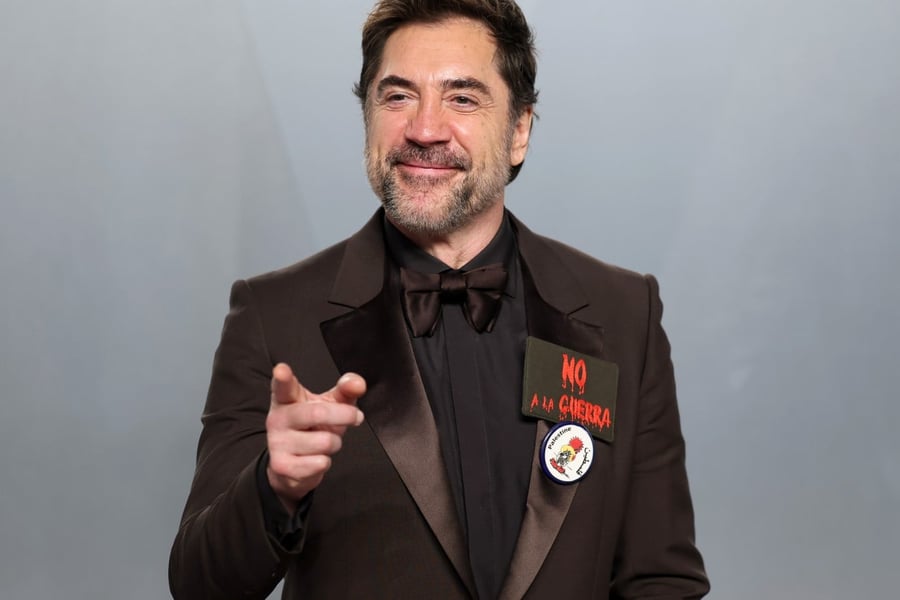
The Oscars largely avoided politics this year besides a few quips in host Conan O’Brien’s opening monologue. Javier Bardem, however, used his platform as a presenter to take a stance on the war in Iran and the ongoing conflict between Israel and Palestine.
While presenting the Oscar for Best International Film, Bardem declared, “No to war and free Palestine.” The actor was notably wearing a “No a la Guerra” patch on his lapel. At the Vanity Fair party later in the evening, Bardem explained that it’s the same patch he wore to the Goya Awards in Spain in 2003.
“I’m wearing a pin that I used in 2003 with the Iraq war, which was an illegal war,” Bardem told reporters on the red carpet at the party. “And we are here, 23 years after, with another illegal war, created by Trump and Netanyahu with another lie.”
Speaking to Variety, Barden said it was important for him to speak up during the Oscars ceremony. “I think it’s important to understand, to bring awareness, that you can do both,” he said. “You can be part of the movie-making community, which is an important community, and also be a citizen that uses this huge [platform] to denounce what one thinks is injustice. In this case it’s the genocide in Palestine that is still going on.”
He noted that 600 people have been killed in Palestine since the ceasefire and called out the “abuse” in the West Bank. “The ethnic cleansing that’s happening in the West Bank is horrible and we’re not talking about it enough,” Bardem said.
Javier Bardem on his “Free Palestine” remark at the #Oscars: “It’s important to understand that you can be part of the movie-making community and also be a citizen who uses this huge speaker to denounce injustice.” pic.twitter.com/TxgtuwomBx
— Variety (@Variety) March 16, 2026
Love Music?
Get your daily dose of everything happening in Australian/New Zealand music and globally.

The Oscar winners mostly steered clear of politics in their acceptance speeches. David Borenstein, who directed winning documentary Mr. Nobody Against Putin, made the most politically-inclined speech of the evening.
He explained his film “is about how you lose your country.” “What we saw when working with this footage is that you lose it through countless small, little acts of complicity: when we act complicit when a government murders people on the streets of our major cities, when we don’t say anything when oligarchs take over the media and control how we can produce it and consume it, we all face a moral choice,” Borenstein said. “But luckily, even a nobody is more powerful than you think.”
From Rolling Stone US

