





























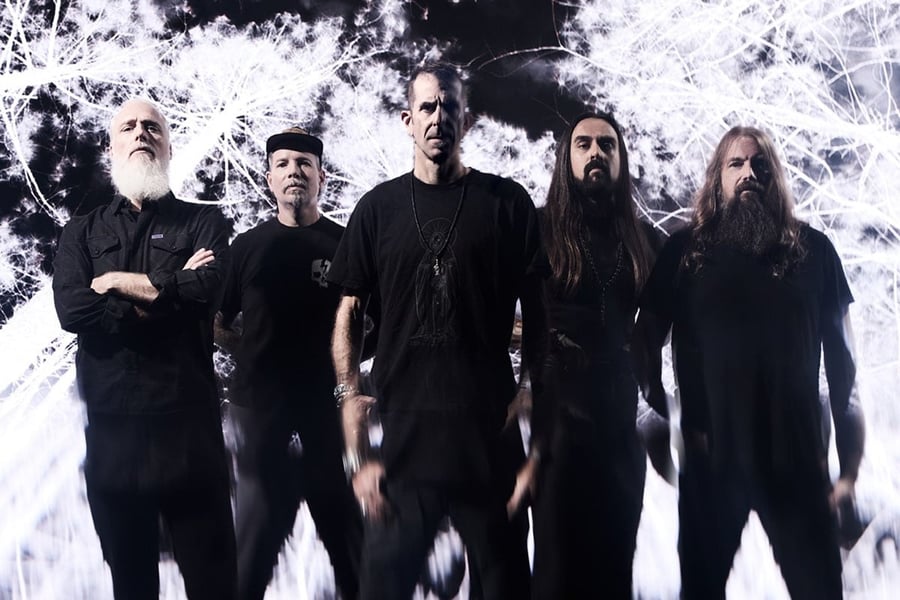
When Randy Blythe talks about the world in 2026, he doesn’t reach for metaphors.
“It’s scary,” the Lamb of God frontman says plainly. “Right now it is raining oil in Iran… there are conflicts across the globe and they’re spinning and spinning. All of these different conflicts have a very real danger of congregating and turning into one big thing.”
For Blythe, these aren’t distant headlines. They’re the atmosphere surrounding Into Oblivion, Lamb of God’s tenth studio album, released today. The title alone suggests a sense of impending collapse. Blythe doesn’t dispute the implication.
“Because that’s where we’re heading,” he says bluntly.
Across more than two decades, Lamb of God have built a reputation as one of the defining bands of modern heavy metal. Emerging from Richmond, Virginia’s underground scene in the late ’90s as Burn the Priest, the band evolved into a global force with albums like Ashes of the Wake and Sacrament, combining groove-heavy precision with lyrics that rarely shy away from the darker realities of politics and power.
But Into Oblivion feels less like commentary from a distance and more like a dispatch from the middle of the storm.
“In general, the album is about the ongoing and rapid breakdown of the social contract,” Blythe says.
Love Music?
Get your daily dose of everything happening in Australian/New Zealand music and globally.

That breakdown, he argues, has been unfolding slowly for years.
“Well, I mean, it’s been a progression over the last 10 or 15 years,” he says. “Things are becoming more and more polarised politically… people are retreating more and more into these balkanised positions. It’s yes or no, right or wrong.”
The change isn’t just visible in political debates.
“You used to be able to discuss politics without it turning into some sort of horrific argument,” Blythe says. “Now you see families broken apart. People who don’t talk to their parents anymore. I have friends who don’t speak to their families. That’s awful.”
And while political rhetoric may be the surface-level symptom, Blythe believes the deeper shift lies in how people now interact with each other.
Much of that, he says, traces back to the internet.
One of the album’s most pointed tracks, “Parasocial Christ”, takes aim at the strange emotional attachments people now form with celebrities, influencers and online personalities.
For Blythe, the seed for the song came from watching the reaction when TikTok briefly shut down in the United States.
“I saw people completely lose their minds,” he says. “Completely lose their minds as if the apocalypse had descended.”
For many users, the panic wasn’t just about losing entertainment.
“It was like, ‘This is how I communicate. This is my business. This is my method of artistic expression,’” Blythe says.
That dependence struck him as fragile.
“If that can cripple you — dependence on an app you don’t own, you have no agency over — and it can be taken away that easily, you’re kind of fucked.”
Blythe has largely stepped away from social media himself. What once felt like a useful space to share photography and discuss art now feels unrecognisable.
“With AI and bots and all that crap, you don’t even know if anybody’s real anymore,” he says.
But the phenomenon that fascinates him most is the intensity with which people now follow the lives of strangers.
“You look at comment sections under people with massive followings, like the Kardashians,” he says, “and people are arguing about their hair, or their relationships, or what car they bought.”
He pauses.
“You really have time to care this much about someone else’s life?” he laughs. “Someone you will never meet who doesn’t know you exist?”
Blythe is hardly anti-fandom. As a self-confessed punk rock history obsessive, he’s spent decades reading about the artists who shaped him.
But he sees a difference between admiration and obsession.
“I love Iggy Pop,” he says. “I’ve hung out with the man. He’s a super nice guy. But I’m not going to sit around at night on Iggy Pop’s Instagram page arguing about his life choices.”
To Blythe, parasocial culture represents something deeper than celebrity gossip. It’s a diversion from the only thing people can actually control.
“When you’re devoting all this attention to this representation of a person,” he says, “you’re not doing the one thing you actually have control over — living your own life.”
Despite the album’s sweeping themes, Into Oblivion was shaped by something far more tangible: the physical spaces where it was made.
The record was produced by longtime collaborator Josh Wilbur and recorded across several studios, with Blythe tracking vocals at the legendary Total Access Recording in Redondo Beach, California.
The room carries a certain mythology. Black Flag recorded My War there. So did Descendents, Hüsker Dü and Saint Vitus.
For Blythe, walking into the studio felt immediately familiar.
“I felt very comfortable there,” he says. “Very comfortable to do me.”
Part of that comfort came from the studio’s deep punk lineage.
“Being in a place where great art has been created before — whether it’s writing or painting or music — is always inspiring,” he says. “There’s a vibe in those places. Without sounding too woo-woo, you can feel it. And I like to soak it up.”
Total Access, with its decades of underground history embedded in the walls, provided exactly that atmosphere.
“I walked in there and I felt that punk rock history immediately,” he says. “That’s the world I come from.”
There’s another reason Blythe prefers to record away from home. Self-preservation — for everyone around him.
“When I record a record, I become completely immersed in it,” he says. “I have a girlfriend. I have family members. And when I’m recording, I’m not a nice guy. I’ve got a headache, I’m grumpy — I’m just a jerk a lot of the time.”
The solution is simple: “I basically spare my friends and family from dealing with me,” he says with a laugh.
Recording in isolation allows him to focus entirely on the emotional intensity required for the performance. Which, given Lamb of God’s music, is considerable.
Another theme running through Into Oblivion is the quiet disappearance of regional identity in music. Before the internet flattened the musical landscape, scenes developed in isolation. “You could hear a band and immediately know where they were from,” Blythe says.
Richmond had its own character. So did New Orleans, Seattle or New York. Bands were shaped by the musicians around them — by local venues, record stores and the communities they emerged from. Now, Blythe says, those boundaries have largely dissolved. “When everybody is influenced by everything all the time, bands don’t stew in their own local creative juices anymore,” Blythe says.
He’s quick to acknowledge the upside: technology has made it easier than ever for artists in remote places to access music and tools. Still, he’s grateful he experienced the earlier era. “I’m glad I got to enjoy that world while it was there.”
Despite the album’s bleak outlook, Blythe insists the themes explored on Into Oblivion are hardly new for him. They’ve been present since the beginning.
The first song he ever wrote for the band dealt with the hypnotic effect of mass media — television, at the time. Today, he says, you could simply substitute the endless scroll of social media.
“You don’t have agency when you’re just sitting there scrolling,” he says. “You don’t have control over what’s entering your brain.”
Even the earliest Lamb of God lyrics about global power structures feel eerily relevant today. One of the band’s first released tracks dealt with leaders controlling nuclear weapons. “What does that sound like now?” Blythe says wryly.
History, he notes, may not repeat itself exactly. But it definitely rhymes.
For Blythe, music remains a way to process the chaos of the present. Writing lyrics, taking photographs or producing prose are all ways of understanding where he stands within the moment. “It’s a way of understanding my place in the world when I’m creating,” he says.
He often returns to something Nina Simone once said: that it is the duty of the artist to reflect the times. Simone spoke those words during the civil rights movement and the Vietnam War — another moment when the world seemed to be sliding toward disaster.
Blythe doesn’t presume to tell other artists what their duty should be. But for him, the sentiment resonates.
And listening to Into Oblivion, it’s clear he’s taken it to heart.
The album doesn’t attempt to offer solutions. Instead, it documents the moment — a world that feels increasingly unstable, polarised and uncertain.
“It’s not a warning,” Blythe says. “It’s a statement on where we are right now.”
Lamb of God’s Into Oblivion is out now.

