




























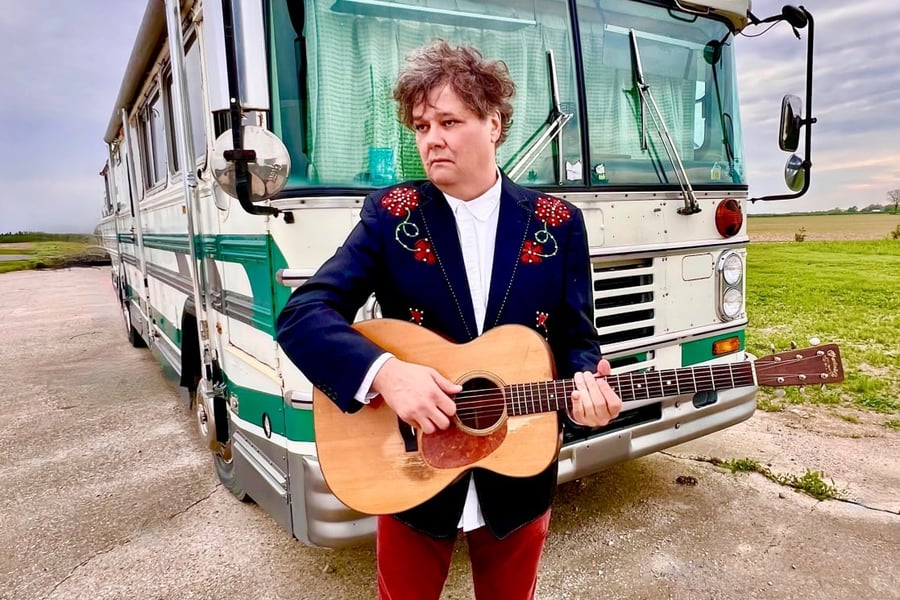
For more than three decades, Ron Sexsmith has occupied a curious place in popular music. His songs are revered by fellow writers and quietly passed around between some of the most respected figures in the business — artists like Paul McCartney, Elton John, Leonard Cohen, and Elvis Costello are fans of his work — yet Sexsmith himself has never quite become a household name.
Instead, he has built a career that feels almost old-fashioned: album by album, song by song, slowly accumulating one of the most quietly admired catalogues in contemporary songwriting.
The path that led him there still feels surreal to him.
“I have a very Forrest Gump existence,” he says with a laugh. “The people I’ve crossed paths with — meeting Paul McCartney, singing with Ray Davies, getting emails from Elton John… I was in his fan club when I was nine years old.”
Next month that unlikely journey brings Sexsmith back to Australia for the first time in more than a decade, touring in support of his new album, Hangover Terrace. For an artist whose work has often thrived on word-of-mouth devotion rather than blockbuster success, the return feels both familiar and quietly significant.
“I always look forward to getting back there,” he says. “But it’s not an easy place to get to. It’s expensive, too, the flights and all that? There were rumblings of it last year and I didn’t really believe it was going to happen. So I was very pleasantly surprised when I saw it on the calendar.”
Love Music?
Get your daily dose of everything happening in Australian/New Zealand music and globally.

Now in his sixties, he’s also aware that opportunities to make the long trip may not come forever.
“The band and I were super stoked about it,” he says. “I mean, I’m 62. I don’t know how many more times I’m going to be able to get down there.”
The tour arrives in support of Hangover Terrace, released in 2025, which Sexsmith regards as one of the strongest records he’s made.
“I think it’s my best album,” he says without hesitation. “It’s nice to be coming back with a record that’s really fun to perform live. It’s been received well in general, I think.”
The record carries a noticeably different emotional tone from some of his recent work. Where previous albums often leaned toward warmth and romantic optimism, Hangover Terrace feels more bruised, the result of a period when the wider world — and parts of Sexsmith’s own life — felt increasingly unsettled.
“A lot of things happened,” he says. “The pandemic, the Trump presidency… the world just seemed to go off the rails. I had some falling outs with different people. It was just weird. A lot of the songs were coming from that place — like, who are we now? Who are my friends?”
Those questions arrived quickly and instinctively during the writing process.
“I was scribbling down lyrics because I was feeling upset or brokenhearted about this person or that person,” he says. “The songs came pretty fast and furious.”
For Sexsmith, songwriting has always functioned as a way to process those feelings before they calcify into something heavier.
“If you’re feeling bad about someone or something, you can put it down in a song and then move on from that,” he says. “You’re not stuck there. I don’t know what people who don’t write songs do for that.”
Even when the material grows darker, though, Sexsmith resists the idea that his work is defined purely by melancholy.
“I’m not a cynical person,” he says. “I can be grumpy sometimes, but I try to be hopeful. I think it’s just a better place to be in your head; not naïvely hopeful, but hopeful that things generally work out.”
That mixture of melancholy and quiet optimism has long been central to his songwriting. Critics have often noted the sense of emotional restraint in his work: songs that rarely explode into anger or grand drama, instead offering reflection, humour, and small moments of redemption.
It’s also a sensibility that has remained remarkably consistent across nearly 20 albums. In an industry that often rewards reinvention and spectacle, Sexsmith has taken the opposite approach — refining the same melodic instincts year after year.
“People say sometimes it’s more entertaining to fail on a grand scale,” he says with a laugh. “Make a total bomb of a record and then redeem yourself a few albums later.”
He has never felt particularly tempted by that philosophy.
“I always wanted to have a body of work I could be proud of,” he says. “Because I’ve never had a big hit album, every album I make is another chance to make a first impression with somebody. There are still so many people who don’t know my music.”
The consistency isn’t the result of creative caution so much as instinct. For Sexsmith, melody remains the central organising principle.
“Melody is always the easy part for me,” he says. “I grew up in a very melodic period of music as a kid, so that’s always what I’m drawn to.”
What changes from album to album is where the songs begin.
“Sometimes it starts with melodies. Other times it’s lyrics first,” he says. “With this record, I had all these words I was scribbling down because of how I was feeling. When you’ve got the lyrics there, things seem to move quicker.”
Even the title Hangover Terrace emerged from the kind of casual moment that often shapes Sexsmith’s albums. He had originally planned to call the record Corduroy Phase, inspired by a blue corduroy jacket he bought while working in England. The final title came instead from a throwaway joke by drummer Don Kerr as the band drove past a building called Hanover Terrace in London.
“He just blurted out ‘Hangover Terrace,’” Sexsmith recalls. “And as soon as he said it I thought, ‘That’s actually not bad. It’s a much better title.’”
It felt, in its own slightly wry way, like a perfect description of the album’s emotional terrain — a record about taking stock after turbulent times.
Long before Hangover Terrace, though, Sexsmith’s reputation had already begun spreading through the music community. Early praise from some of his songwriting heroes proved pivotal at a crucial moment in his career.
“When Elvis Costello championed my first record, that changed everything,” he says. “The label was thinking about dropping me, and then suddenly they thought, ‘Maybe there’s something happening here.’”
For a young songwriter trying to establish himself in the mid-1990s, that kind of endorsement carried enormous weight.
“These people were my heroes,” he says. “So when they said those things, it made me think maybe I’m not crazy for pursuing it.”
Sexsmith didn’t arrive in the industry as a teenage prodigy or overnight sensation. He was 30 when he finally signed his first record deal, after years of trying to break through while raising a family.
“I was just about ready to give up,” he says. “I had kids and people were telling me I needed to get a steady job.”
Instead, the doors slowly began to open, leading to collaborations, friendships and surreal encounters with the very artists he had grown up idolising.
“I mean, I met Paul McCartney on my first trip to England,” he says, still sounding slightly astonished by the memory. “It’s crazy.”
Those connections eventually extended beyond admiration into interpretation. Over the years, artists including Rod Stewart and k.d. lang have recorded Sexsmith songs, each bringing their own perspective to his material.
Lang famously transformed one of his songs from a 3/4 waltz into a straight 4/4 rhythm. Stewart’s version of “Secret Heart” stripped the arrangement back even further than Sexsmith’s original recording.
“It’s always interesting when someone does your song,” he says. “You’re just flattered — and then you hope the song doesn’t collapse underneath them.”
View this post on Instagram
For all the accolades from fellow musicians, however, Sexsmith’s career has largely unfolded outside the machinery of mainstream pop success. That independence has allowed him to build something more personal: a long body of work shaped by his own instincts rather than the expectations of the marketplace.
“I’ve been studying this music my whole life,” he says. “So I never felt like I didn’t deserve to be here. I put the work in.”
Live performance remains where those decades of songwriting come together most visibly. With nearly twenty albums behind him, assembling a setlist has become both a pleasure and a logistical puzzle.
“People email me requests sometimes,” he says. “I got one for Brisbane the other day actually, for a song we haven’t been playing, so we’re going to see if we can work it in.”
The band keep things flexible, even if the sheer number of songs makes spontaneity more difficult than it once was.
“The more albums you make, the harder it is to go off script,” he says. “But we try to roll with it.”
Certain songs have found new life in recent years. One example is “God Loves Everyone”, which has recently returned to the setlist after a long absence.
“With all the craziness going on now, especially in America, it seems to resonate again,” he says.
Ultimately, though, Sexsmith’s ambitions for a show remain disarmingly simple.
“You just want people to feel like they’ve had a good night out,” he says. “I try to curate a good setlist and hopefully win people over.”
For those discovering his music for the first time on this tour, that introduction will arrive through songs that span more than three decades of quiet craftsmanship. For longtime listeners, it’s another chance to see one of the most enduring songwriters of his generation doing exactly what he has always done.
“I just want people to see that I’m for real,” Sexsmith says. “That I’ve put all my energy into this one thing — songwriting. That’s why I’m still here.”
Check out Ron Sexsmith’s Australian and New Zealand tour dates here.

