





























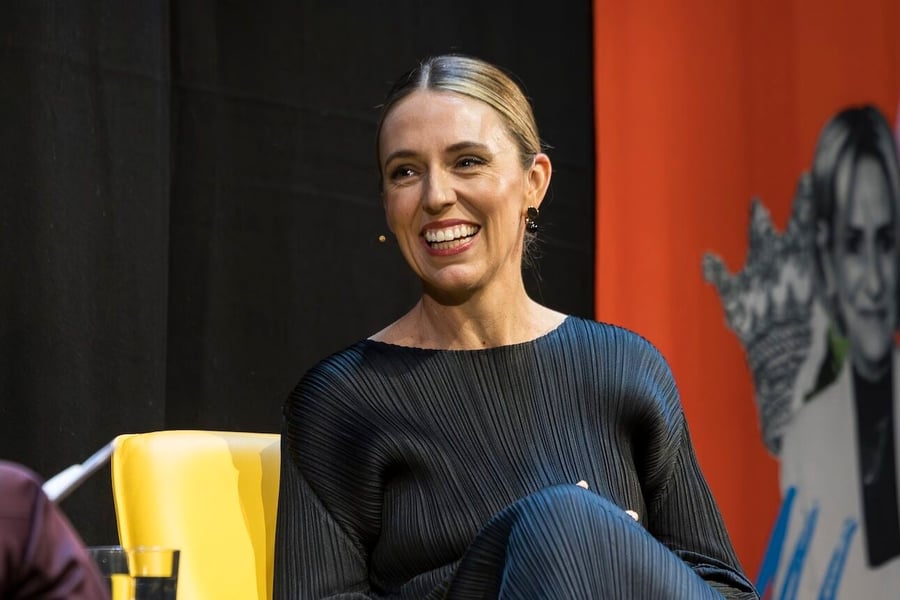
Former New Zealand prime minister Jacinda Ardern has criticised the dominance of “strongman” leadership in global politics, arguing the model has failed to deliver the stability and unity many voters once hoped it would.
Speaking at the All About Women event at the Sydney Opera House on Sunday, Ardern reflected on the leadership philosophy that defined her six years in office – and why she believes a different model is urgently needed in today’s political climate.
Ardern, who served as New Zealand’s Prime Minister from 2017 to 2023, has often been associated with an empathetic leadership style that prioritised compassion, transparency and values-driven decision-making. But during her conversation in Sydney, she pushed back on the notion that empathy should be viewed as a softer or less effective approach to power.
Instead, she suggested the global political landscape – increasingly dominated by combative rhetoric and authoritarian-leaning figures – reveals the shortcomings of “strongman” leadership.
“I’m often asked whether empathetic leadership can really work,” Ardern told the packed room. “Because the dominant form of leadership we see in the world right now is what, for lack of a better term, people call strongman leadership.”
Her response, she said, is simple. “Yes, the dominant form of leadership is strongman leadership – and look where that’s got us,” she said.
Ardern pointed to a range of global challenges that have intensified in recent years, including declining trust in democratic institutions, growing political division, and the widespread belief among younger generations that their future prospects may be worse than those of their parents.
Love Music?
Get your daily dose of everything happening in Australian/New Zealand music and globally.

“You have fewer people turning out to vote. You have more people who don’t trust political institutions anymore,” she said. “You have an increase in the number of people who carry a sense of grievance against political systems.”
Those trends signal a deeper problem with how leadership is currently defined and rewarded, she argued. “It’s very easy to use simplistic measures of success in politics,” she said. “You win an election and that’s considered success.”
But winning alone, she added, cannot be the only benchmark. “If you win, but fewer people trust the system, fewer people participate in democracy, and society becomes more divided, then you have to ask whether that is actually success at all.”
Ardern’s comments come as many democracies grapple with rising populism and polarisation, trends that have reshaped political landscapes across Europe, the US, and parts of Asia. While she acknowledged that strongman-style leaders have found electoral success in several countries, she suggested that approach often relies on exploiting division rather than resolving it.
“You see a generation now that believes they will be worse off than the one before them,” she said. “You see declining social cohesion, increasing conflict, and a planet facing enormous environmental challenges.
“Tell me if that is success,” she added. “Because in my mind it is not.”
Instead, Ardern believes politics needs to broaden its understanding of leadership, moving beyond models built on dominance and confrontation.
During her time as Prime Minister, she frequently emphasised values such as kindness, empathy, and responsibility as central to governing. Those values, she said, were intended to provide a framework for decision-making, particularly in moments of crisis.
“If people know what you stand for, then they know how you will respond when something unexpected happens,” she explained.
That philosophy became especially visible during some of the most defining moments of her leadership, including the aftermath of the 2019 Christchurch mosque attacks and the Covid pandemic.
But Ardern argued the concept of empathetic leadership is often misunderstood. Empathy, she said, is not simply about symbolic gestures or expressions of compassion. “Empathy is nothing without action,” she said. “You cannot truly say you feel someone’s pain if you are not willing to do something about it.”
In Christchurch, that meant swiftly reforming New Zealand’s gun laws following the terrorist attack. During the pandemic, it meant implementing strict public health measures designed to protect vulnerable communities.
Now, in her post-political life, Ardern continues to advocate for what she calls “empathetic leadership”, including through a fellowship she established to support leaders interested in values-driven governance.
Her broader argument is that empathy should not be dismissed as a weakness in politics – nor should it be viewed as a trait exclusive to women. She believes it should instead be recognised as a critical leadership quality at a time when many political systems are struggling to rebuild trust.
“If the current model of leadership were working,” Ardern said, “the world would look very different.”

