



























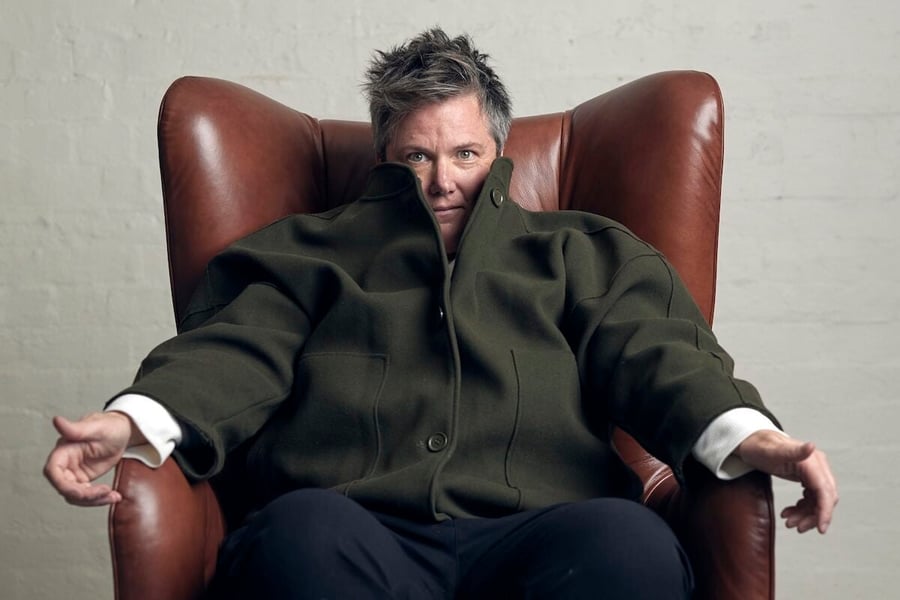
Australian comedian Hannah Gadsby joins a brand new episode of the Rolling Stone Uncut podcast!
Gadsby jumped on the show with host and Editor-in-Chief Neil Griffiths to talk about their latest special, Woof!, as well as their upcoming appearances at the Melbourne Comedy Festival.
In this episode, Gadsby also reflects on their success following their 2017 special, Nanette, which took the comic from local stages to the world, including The Tonight Show with Jimmy Fallon and the Emmys.
Watch or listen to the full episode below.
Why Gadsby’s latest special isn’t on streaming platforms
“There’s an argument to be made that I made a series of creative decisions, and I could walk you through them, and I stand by them. But also, it’s a pretty great example of pathological demand avoidance and I’ve just done it on a grand career scale where they’re like, ‘Well you’ll just do another Netflix special, won’t you?’ And I’m like, ‘You know what? No. I’ll take everything the algorithm stands for and do the exact opposite.’
Love Music?
Get your daily dose of everything happening in Australian/New Zealand music and globally.

“I think it’s partly personal and partly an artistic statement. I felt trapped, I felt unhappy.”
Finding global success with Nanette
“It was a whiplash, that’s for sure. And certainly, I’m thankful that my break in success didn’t happen too soon because I skipped many levels. But it was a significant whiplash. I really struggled with it, honestly, because what this success wasn’t backed up by, and while it was backed up by skill and hard work, it wasn’t backed up by ambition. I hadn’t gone, ‘I’m going to crack the American market.’
“I really wanted to work the most and put the most of my hard work into my actual work. And when you’re starting to just be like, ‘I’m gonna crack the American market,’ what that means is you’re gonna have to spend most of your time networking and travelling. And so I made a very conscious decision.
“But I think I might have adapted had the pandemic not happened. I think the pandemic is a rupture. It’s like a before times and after times, and I feel like I made it just at the end of the before times. I always reference this: I had a billboard in Times Square. Like you were saying, I went from an Australian favourite doing the Forum, and then I had a billboard in Times Square, and Times Square was empty.”
Did they enjoy the fame and attention?
“I’ve always processed my life a little bit in hindsight. And there was a moment, even though it was overwhelming and everything was new, I was really starting to find my feet… I think young people are much more adaptable, and I’m an old autistic person just going, ‘I don’t understand what’s happening.’ You have to play the game, you see? And I have to understand what the game is before I can play it. And then quite often I’ll just go, ‘Look, I’m not gonna play the game, but I’ll play a game.’
“And that’s where I find myself. I think there’s such flux in the industry at the moment. I think nobody knows what’s happening. It’s having an existential crisis at the same time I’m having an existential crisis…. I think I just retreated into my work, and so I just focus on doing good work whilst also the work is reflecting this larger existential crisis.
“So I find a lot of comfort and consolation in the actual work, even though in that work, I’m untangling anxiety. So it’s both good and bad.”

