




























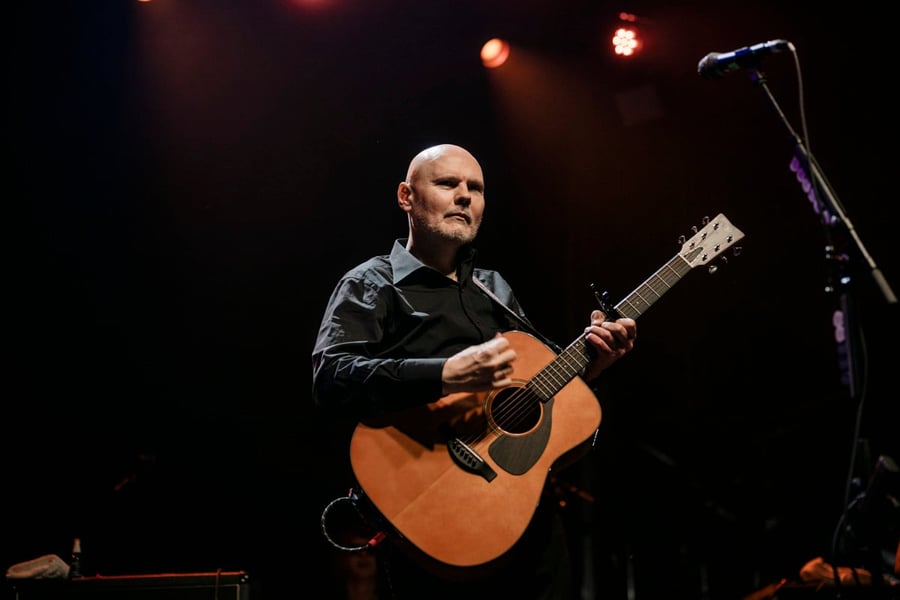
Last week, Billy Corgan made a wild assertion on his podcast, The Magnificent Others: “I think — and I will say it overtly — I think that rock has been purposely dialed down in the culture.”
He then expounded on this belief, explaining just who he believes deflated rock’s potency: “If you were at MTV or around MTV [in] 1997, ’98, suddenly they decided rock was out, when rock was still very, very high up in the thing and it was replaced by rap, right?” he said. “Their standards and practices immediately shifted. … Some people assert that the CIA was involved in all that, again, above my pay grade, but I saw it happen. I did witness it happen.”
Aside from the eyebrow-raising belief that the CIA colluded with MTV’s parent company, Viacom, to torpedo rock’s omnipresence, it seems Corgan either has his facts wrong or doesn’t remember the Nineties as well as he thinks he does.
First off, perusing a random issue of Billboard’s “Video Monitor” chart from November 1998 shows that MTV’s Top 10 that month included plenty of rock videos by Alanis Morissette, Barenaked Ladies, Korn, and Hole. Nearly a year later, in October 1999, the same chart reported on an MTV Top 10 that included Limp Bizkit, Bush, Kid Rock, and the Offspring. The Number One song of the week was Blink-182’s “All the Small Things.” Say it ain’t so, rock did not go.
Second, there are a couple of bitter pills Corgan needs to swallow. One is that MTV’s programming, like that of most TV stations, has always been more or less dictated by advertising. (Yes, apparently, that many people watch Ridiculousness.) To sell commercials, Viacom needed to broadcast music videos that attracted consumers between the ages of 12 and 24, and that meant constantly changing with the times. Music fans who were 16 when the Pumpkins helped shape the sound of alternative rock in 1993 were 23 when the band put out Machina/The Machines of God in 2000, and rapidly aging out of usefulness to MTV’s bottom line. Why wouldn’t they give more airtime to Fred Durst, who was capturing teens’ imaginations on the question of whether wearing a red baseball cap could attract more “Nookie”?
And related to that, Corgan needs to accept that the Smashing Pumpkins‘ late-Nineties albums just aren’t that good. The band’s ascendency to rock greatness earlier in the decade was perfectly timed, as MTV had just shifted its rock spotlight from sleek, overproduced groups like Cinderella and Poison to a clear alternative: the raw sounds of Nirvana, Pearl Jam, and Soundgarden, which might have seemed not-ready-for-primetime but turned out to be right on schedule.
The Pumpkins rode that wave admirably in 1993 with the faux-optimism of “Today” and “Cherub Rock” and the wounded-childhood melodrama of “Disarm.” Here came Corgan, bleating a ballad that was genuinely moving, and people wanted to hear it. Mellon Collie and the Infinite Sadness, in 1995, was more bombastic (orchestral strings!), faux-nostalgic (“1979”), and heavy (“Zero,” “Bullet With Butterfly Wings”) — and it was pretty great, too, even at two hours long.
Love Music?
Get your daily dose of everything happening in Australian/New Zealand music and globally.

But then they seemed to lose the plot over the next three years, culminating with the Pumpkins’ limp, forgettable fourth album, Adore. Corgan seems to have forgotten that he was grasping at relevance using a trip-hop beat, like many a rock band attempting to stay hip at the time, on “Perfect,” and a hip-hop groove on “Ava Adore.” But the songs weren’t hits because, frankly, the hooks that defined the Pumpkins’ big hits were missing. “The Pumpkins have given up being a Rock Band and devoted themselves to being a Pop Project,” Spin wrote in a review. Rolling Stone later called the record “a dud.” And the less said of the poorly mixed, pompous Machina, the better. “The nearly 70 minutes of Machina boil down to a handful of recurring ideas: Love is good, drugs are bad, God is everywhere and — seriously — thanks for listening,” as Rolling Stone wrote in a review. The magic just wasn’t there.
So when MTV test-drove the Backstreet Boys’ “Everybody (Backstreet’s Back)” in 1997 and Britney Spears’ “…Baby One More Time” in ’98 and seemed to get a positive response from teens interested in designer-imposter perfumes or whatever commercials MTV was showing at the time, it only made more sense the network would clear away videos by artists who made less of an impact. Much to Corgan’s chagrin, fewer rock videos meant more room for the Macarena, Aaliyah, and all the women Lou Bega had a little bit of time for.
When Corgan’s theories circulated on social media this week, MTV veteran Kurt Loder simply commented, “Sure.” Filmmaker Joseph Kahn, whose videography in 1998 included clips for Brandy and Monica but also Rob Zombie, provided his own theory. “Rock died when it separated itself from sex,” he wrote. “[I] did a video for a huge rock band and they argued over ‘the male gaze.’ … Music is ultimately driven by horny teenagers, and they fled to rap.”
It’s difficult to imagine anyone at the CIA (even this administration’s iteration of the CIA) being so concerned with the state of pop music to attempt to steer the cultural conversation in the late Nineties. The agency was likely preoccupied with things like the war in Kosovo and hunting a Saudi dissident named Osama Bin Laden toward the end of the Nineties. But at the same time, the odds that they targeted rock & roll probably aren’t zero, considering that they did once go full Wile E. Coyote and try to give Fidel Castro an exploding cigar. Either way, the CIA did not immediately respond to Rolling Stone’s request for comment on Corgan’s claims. If he ends up being right about this years from now when a Freedom of Information Act request reveals MTV and CIA collusion, Rolling Stone will gladly buy Corgan a Coke.
Others have made similar observations in a less conspiratorial tone, like Garbage’s Shirley Manson, who put it this way last year: “Radio would only really play a certain sound — a very reassuring, unthreatening, fun vibe — and these very fierce women from the Nineties just disappeared,” she claimed, pointing to the post-9/11 years. “That was when we started to see the rise of real mega-capitalist pop. We’ve been inundated with those sounds now for 20-odd years.”
Regardless, Corgan doesn’t have much to complain about these days, since the Smashing Pumpkins have been capitalising well on Nineties nostalgia. Even as their post-Nineties albums have generally returned fair-to-middling reviews, a reunion with three-quarters of their classic lineup can still headline Madison Square Garden and support fellow Nineties rockers Green Day on a stadium tour.
Not that any of that matters to Corgan, who’s still bent on convincing people that Machina/The Machines of God is worth 74 minutes of their time. Last year, he toured as a solo act called Billy Corgan and the Machines of God, playing a selection of songs from that album interspersed with Mellon Collie favourites. But no matter what size venue Corgan’s playing, it seems like he’s doomed to feel like a rat in a cage, and that’s no CIA psyop.
From Rolling Stone US

