




























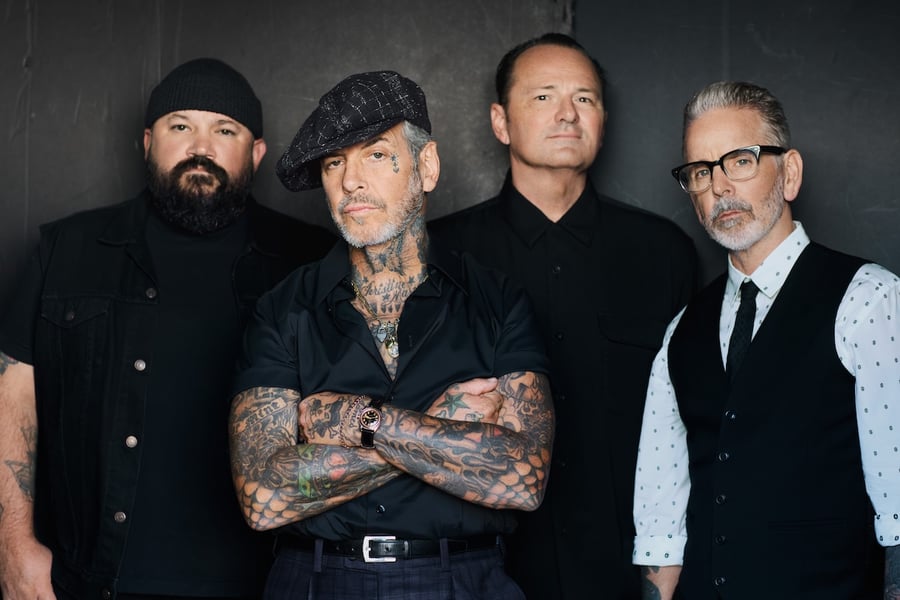
In April 2023, Mike Ness was ready for Social Distortion to finally get back in the studio. The Orange County punks were set to record their first studio album since 2011’s Hard Times and Nursery Rhymes, and Ness was armed with an arsenal of riffs, grooves, lyrics, and ideas he’d been sitting on as far back as 1996’s White Light White Heat White Trash. About halfway through the next year’s recording sessions in Los Angeles, Ness was diagnosed with Stage 1 tonsil cancer. Not only was the album indefinitely postponed, but the singer-songwriter also faced his biggest challenge in a life full of adversity. After a year on the sidelines undergoing surgery, treatment, and recovery, Ness received a clean bill of health and, along with producer Dave Sardy and his bandmates, got back to work.
“I can’t tell you just how grateful I am because some people have much different stories with cancer,” Ness tells Rolling Stone over Zoom from his OC hideout. “Even if they do survive, they’re struggling days, years, and maybe they don’t even beat it. I don’t say I beat it. I got lucky that it was curable.
“The doctors told me [that this type of cancer] had a very good success rate,” he continues. “So I get into a positive headspace and really like envisioning the future. I had a grandson on the way. I had a record to finish. I had unfinished business here. I found myself bargaining, ‘God, just let me finish the record, please.’”
Nearly two years later, Born to Kill, Social Distortion’s long-awaited eighth studio album, is set to arrive May 8, through Epitaph. Beginning with the hard-charging title track, which the band test-drove live for years before recording, the album is a look back at nearly 50 years of defiance and hell-raising that began on the streets of Fullerton, California. The nostalgic “The Way Things Were” references Ness’ teenaged years, roaming around with late Social Distortion guitarist and friend, Dennis Danell. Akin to a heavyweight boxer in the latter rounds of a title fight, Ness is bruised and battered at this point in his career, but ready to fight with a wink and a smile.
With his 64th birthday around the corner and now a grandfather, Ness is content spending time with his family and writing, rather than wreaking the havoc that marked his formative years: He’ll raise his hell onstage, when the band kicks off a North American tour in August (ahead of that, Social Distortion will play Europe and set sail on Little Steven’s Underground Garage Cruise). Here, he breaks down Born to Kill, the music he still has left to make, and why Oasis made a mark on him three decades after dismissing them as “pop stars.”
This record takes stock of everything you and Social Distortion have been through over the past five decades. Why did you decide that was the approach for this album?
I mean, some of it is conscious. I wanted to write a record that paid homage to the beginning of my career, or even pre-career, just knowing I wanted to be in a band, and just listening to records over and over again, getting inspired even though I didn’t even own a good guitar yet. I’m always searching for grooves that really move your body and then writing a song to that groove. A new album is always a chance to experiment with what you’re showing people you can do. I think those are the two main elements that went into this, but I wanted a real Seventies vibe. I feel like that’s a period of time that needs to be constantly referenced and respected.
I want these kids today to realize what it was like back then, and that we have similar things in common. Every generation had to go through something like this. The hippies were not welcome into people’s homes, right? And in the Fifties, rock & roll was the devil’s music. They wanted the kids to just keep listening to Pat Boone, right? So, every generation has a rebellious movement, and this is a period I don’t want to be forgotten.
Love Music?
Get your daily dose of everything happening in Australian/New Zealand music and globally.

What bands and artists are you specifically referencing? You’ve been unabashed about your appreciation for the Rolling Stones, David Bowie, and Creedence Clearwater Revival.
My uncles were giving me records when I was five years old. So, the Beatles and Creedence, and eventually, the glitter stuff, Bowie, Mott the Hoople, and Lou Reed, Iggy Pop, and T. Rex. It’s funny because not only did I go back to the beginning with my idols, but I also kind of wanted to recapture that spirit.
How did that inform the lyrics?
As I was writing, I noticed a recurring theme: revisiting the feeling of being suppressed. I had no voice in my family. My father was a tyrant, and I was not allowed a voice. And so when I started the band, I saw that that was a way that I could express myself. Then I had the people in my school, the people at parties, the people on the streets, telling me, “Fuck you and fuck your music. We’re gonna kill you.” I just don’t have that personality to go, “OK, I’ll try something else.” In other words, the worst thing you can do to me is tell me I can’t do something.
How far back do some of these songs go?
For “Tonight,” I wrote that riff and melody 15 years ago. And there are a couple of songs on this album that are 30-year-old songs that never got finished, really, but I thought they fit the vibe.
How many were written for Born to Kill?
We had 40, then narrowed it down to 11. I had White Light in my mind when I was writing this because, even though that album is particularly dark, the angst of that record, the attitude, the snarl, I felt like that’s still me. I wanted this to be a record that could have followed that.
I’ve got another Social D studio record ready to go. I’ve got a solo record, and I’ve always wanted to do a record of Social D songs that are completely reworked. If you could imagine “Dear Lover” with a grand piano and strings, maybe an electric guitar accompaniment, but just a stripped-down, beautiful version.
Did your cancer diagnosis inform part of the recording?
We were halfway done with the record. I was done with the writing. But, getting older and … I think it’s important to reflect, especially in these times. They’re suppressing free speech right now. It’s fucking insane. I’ve never seen this in my 60 years of being on this earth. It’s bad, and maybe it’s subconscious.
There are a few guests on here, like Lucinda Williams on “Crazy Dreamer,” and Benmont Tench of the Heartbreakers. How did that happen?
I wanted to do a duet. I wanted it to be a female, and I had some ideas, and it just made sense because we’re friends. I’m a big fan of [Williams], and our tones are so similar. It just worked perfectly. This almost seems as if it were meant for her to sing on. People don’t know this, but I’m a huge, huge Tom Petty fan. Mike Campbell is one of my favorite guitar players. Tom Petty is one of my favorite songwriters, and it only made sense that his keyboardist would be one of my favorite keyboardists.
You usually include a cover on SD albums, and on Born to Kill, it’s Chris Isaak’s “Wicked Game.” It’s been in the set for a while now, but why record it here?
It’s just such a good song! When I hear a good song, I want to try to put my own spin on it. [Isaak] started right around the same time we did. I’ve heard hundreds of versions of that song, which partly made me not want to do it. No one’s really done a just swinging rock & roll version of this, and it’s got a thick groove to it.
Seeing that you were at one of the Oasis reunion shows on Instagram was a surprise. Outside of the intrigue that the reunion was the biggest rock story of 2025, have you been a fan of theirs?
Well, in the Nineties, I was very narrow-minded, and I’m guilty of contempt prior to that investigation. [Laughs] I thought they were just an annoying pop band. My producer called me, and he had just seen them at Wembley, and he said, “Listen, when they come to L.A., you have to go. They don’t move around onstage and don’t jump in the air. They’re not doing anything except playing their instruments and singing, but to hear 100,000 people all singing this song.”
It just goes to show you what really good songwriting is and how long it can last. So, it turns out my son, Julian, is a fan. He’s really into British and European soccer, and he’s a huge Oasis fan. He and I went to a father-son night, and it was the best night. I was so impressed. It was a warm night. [Noel Gallagher’s] songwriting, I thought, was very clever, his tone, his vocal tone, the guitar playing. I was entertained from start to finish and became a huge fan.
How are you doing health-wise?
It was amazing to have gone through what I did and be working again in less than a year. I think our tour started in April, and I was at my kid’s house in November before that, and just finished treatments. I told my kids that if I’m singing by April, it’ll be a freaking miracle because I still feel like shit. I’m still in a lot of discomfort. I’m still having trouble eating and speaking, but man, when it came around, and we hit the first chord at rehearsal, I was like, “OK, I know how to do this.”
When you posted your first clip since your diagnosis, singing “Story of My Life,” it galvanized your fans.
The support and the fans during that period were mind-blowing for me. They were so positive, telling me, “We need you, we need more.” And it really helped me on days that I felt that I didn’t have what it took. I had three or four purposes in the forefront of my mind, and I just had to visualize them, including becoming a grandfather.
You have a conflicted relationship with your hometown of Fullerton. How did you feel when they gave you the key to the city in 2024?
That was such a great feeling: to have a city that would have liked to put me away, lock me up, and throw away the key, and to honor me with the key to the city. It felt good because you don’t really set out to do this. You don’t set out to be a role model. You don’t set out to change; you help people get through hard times. Those things aren’t on your mind. You just want to write, and you want to play. That town was a great town to do it in, and that was a great town to grow up in. Had I been from some other small town in the rural Southeast, I could have gotten in with a different crowd and ended up in prison. You’re just a young kid looking up to the older guys, and you want to do what they’re doing. That was me. Fortunately, none of them were bank robbers or gang bangers, or I could have been easily influenced.
Instead, it was the little-known but highly influential punk band the Mechanics who did that.
I had the Rolling Stones and the Ramones, but the Mechanics were right in my living room. Listening to them rehearse every night, and watching them, I picked up rhythm guitar more than lead from them, because the rhythm guitar player was a songwriter, and his style resonated with me.
You touched on speech suppression earlier. With all that’s going on in the country, are you optimistic about its future?
I backed off from following Instagram by 85 percent because I felt like I was doing what they wanted me to do. These people invented these phones; they knew what they were doing psychologically, and even when I say I’m not going to even look tomorrow, I find myself doing it. It’s like, “The visceral feeling that I get because of the algorithm, it’s only showing me the worst of the worst.” The freedom of speech, losing PBS and NPR, and the suppression of speaking against what they’re trying to do. But this can’t last forever. I just need to tell myself that. I also get visceral watching these ICE agents. If I went to a protest and I saw that, things would not end well for me or someone else. That’s how affected I am by it. The mentality reminds me of this conservative white nationalist, high school jock, full of fear and just white fear.
Daniel Kohn is the co-author of Tearing Down the Orange Curtain: How Punk Rock Brought Orange County to the World, for which Ness wrote the foreword.
From Rolling Stone US

