






























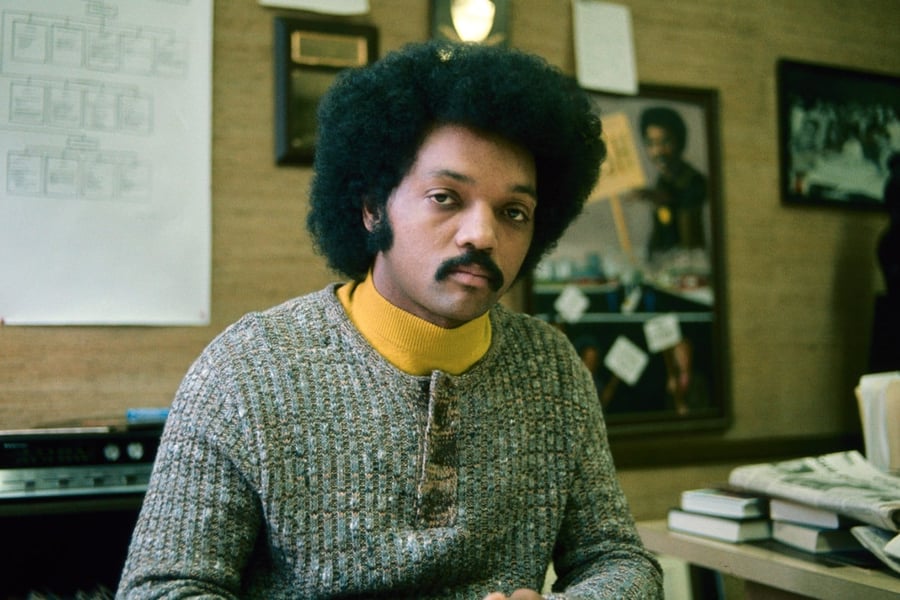
Rev. Jesse Jackson, the towering civil rights activist and religious leader who worked to improve economic conditions for Black communities and advocated for social-justice causes around the world, died on Tuesday. He was 84.
Jackson’s death was confirmed by his family, who said in a statement that he “died peacefully” while surrounded by family. “Our father was a servant leader — not only to our family, but to the oppressed, the voiceless, and the overlooked around the world,” the family’s statement continued. “We shared him with the world, and in return, the world became part of our extended family. His unwavering belief in justice, equality, and love uplifted millions, and we ask you to honour his memory by continuing the fight for the values he lived by.” A cause of death was not immediately available.
In November 2025, Jackson was hospitalised in Chicago, where he was put under observation for progressive supranuclear palsy (PSP), a neurological disorder that can affect body movements and balance. PSP is similar to Parkinson’s, which Jackson was originally diagnosed with in 2013. His PSP diagnosis was confirmed in April 2025.
For more than 50 years, Jackson was one of the most prominent activists in the United States. He got his start in the Sixties, working closely with Martin Luther King Jr., before founding two advocacy groups, Operation PUSH (People United to Serve Humanity) and the National Rainbow Coalition. (These two were later consolidated into the Rainbow PUSH Coalition.)
His opposition to Ronald Reagan led him to launch two presidential campaigns, in 1984 and 1988. Though both fell short, Jackson registered millions of new voters and significantly overperformed expectations, finishing third in 1984 (behind Gary Hart and Walter Mondale) and second in 1988 (behind Michael Dukakis). For a brief moment in 1988, he even took the delegate lead over Dukakis after a massive win in the Michigan caucus.
As the most prominent and successful Black candidate for president at that time, Jackson helped set the stage for the election of Barack Obama 20 years later. But it was also reforms he advocated for in 1988, which changed how delegates were distributed during the Democratic primary, that made Obama’s victory possible, too. And Jackson’s campaigns, with their unabashedly progressive platforms, set a mold that future longshot, outsider candidates on the left, like Bernie Sanders, would follow for decades to come.
“The issues that we raised were resonating,” Jackson recently recalled in Abby Phillip’s book A Dream Deferred: Jesse Jackson and the Fight for Black Political Power. “Our issues were on time, issues about economic justice and shared economic security, a connection between family farms and urban workers, how Blacks and whites had to relate together, and browns. So, it was in full gear. We used to call it ‘poor campaign, rich message.’ Our message was winning.”
Love Music?
Get your daily dose of everything happening in Australian/New Zealand music and globally.

Born Jesse Burns on Oct. 8, 1941, in Greenville, South Carolina, Jackson was the son of a high school student, Helen Burns, and her 33-year-old neighbor, Noah Robinson. Helen eventually married Charles Henry Jackson, who adopted Jesse and gave his stepson his last name. (Jackson learned the identity of his biological father at a young age and maintained a relationship with him throughout his life.) Of growing up in the Jim Crow South, Jackson told The New York Times in 1987, “I remember being taught my place.”
He attended segregated schools and sat at the back of the bus until the Montgomery bus boycotts of 1955 (Jackson was 14 at the time). A good student and a standout athlete, Jackson earned a scholarship to play football at the University of Illinois, but left the predominately white school after one year. He transferred to the historically Black North Carolina Agricultural & Technical College, where he continued to play football, but also became involved in the civil rights movement. He then attended the Chicago Theological Seminary, but dropped out before graduating to work for King. (He was ordained at a Chicago church in 1968 and was awarded his Master of Divinity degree in 2000.)
King appointed Jackson to run Operation Breadbasket under the banner of his Southern Christian Leadership Conference (SCLC). As head of the first Chicago chapter and then the national organisation, Jackson focused on encouraging people to patronise Black-owned businesses and organised pickets and boycotts of businesses that refused to hire Black people.
Jackson’s confident, independent streak eventually generated friction with other top lieutenants in the SCLC, as well as King himself. Jackson was present at the Lorraine Motel in Memphis when King was assassinated on April 4, 1968. He would claim that he was the last person to speak to King before he died and held him in his arms after he was shot. (The next day, he went on TV wearing the same blood-stained turtleneck.) Others in the SCLC disputed Jackson’s version of events (he was a floor below King at the motel, for instance), leading to further tensions.
In 1971, Jackson left the SCLC to found Operation PUSH (the “S” originally stood for “save” before being changed to “serve”). PUSH continued much of the economic-driven work Jackson was doing for Operation Breadbasket, including boycotts of Anheuser-Busch and Coca-Cola in the 1980s. The group’s efforts to bolster education in Black and underprivileged communities earned them federal assistance from the Jimmy Carter administration. But while Jackson’s profile grew, PUSH frequently faced criticism for poor management and follow-through. Jackson frequently responded to such criticism with the line “I’m a tree-shaker, not a jam-maker.”
When Jackson announced his first campaign for president in November 1983, he was still a polarising figure and failed to pick up endorsements from prominent Black leaders like Coretta Scott King and Atlanta Mayor Andrew Young. He also faced allegations of anti-Semitism related to his support for a Palestinian state, refusal to disavow Louis Farrakhan, and for referring to Jews as “Hymies” and New York City as “Hymietown” while speaking with a Washington Post reporter. (Jackson denied the allegation.)
Jackson’s showing in the first two 1984 primary contests, in Iowa and New Hampshire, were poor in these predominately white states. But he did exceptionally well in the next contests in the South, especially among Black voters. Jackson’s momentum grew, and he went on to win more than 3 million votes nationally in the 1984 primary. His voter-registration efforts also brought scores of new Black voters to the polls, which proved critical in the Democrats winning the Senate in 1986.
Speaking at the Democratic National Convention, Jackson spoke about the importance of building a diverse, multiethnic “rainbow coalition” (and even gave his new social-justice and political-empowerment organization the same name, the National Rainbow Coalition). “We are often reminded that we live in a great nation — and we do,” he said during his speech. “But it can be greater still. The Rainbow is mandating a new definition of greatness. We must not measure greatness from the mansion down, but the manger up.”
Four years later, Jackson significantly expanded his own coalition. He won nearly 30 percent of the popular vote during the primaries while running on a platform that included reversing Reagan-era tax cuts, increasing federal spending for social programs, and implementing single-payer universal healthcare.
Despite falling short in 1988, Jackson’s second strong showing established him as a prominent figure in Democratic politics. During the Nineties, he was elected to be the shadow senator for Washington, D.C. (a kind of lobbying/advocacy role, focused mainly on D.C. statehood), while President Bill Clinton and Secretary of State Madeline Albright appointed him Secretary of State for the Promotion of Democracy in Africa. Clinton later awarded Jackson with the Presidential Medal of Freedom.
Jackson’s stature even allowed him to serve as an ad-hoc diplomat. In the Eighties, he helped secure the release of a captured Navy lieutenant in Syria, as well as 48 Cuban and Cuban American prisoners in Cuba. He went on to bring home citizens being held as “human shields” by Saddam Hussein in Kuwait, negotiate the release of U.S. soldiers being held hostage in Kosovo, and the release of British journalists being held in Liberia.
While Jackson chose not to run for office again, his son, Jesse Jackson Jr. was elected to the U.S. House of Representatives, where he served from 1995 to 2012. The elder Jackson instead focused on his activist work, merging his two groups into the Rainbow PUSH Coalition and advocating on issues both domestic (health care, gun control, the War on Drugs) and international (ending apartheid in South Africa, pushing for democracy in Haiti, negotiating peace between Israel and Palestine, and speaking out against the Iraq War).
In 2007, Jackson became one of the earliest backers of Obama’s presidential bid, and his son served as a co-chairman on the future president’s campaign. But some friction emerged between the rising political star and his predecessor when Jackson was caught on a hot mic criticizing an Obama Father’s Day speech. (“I want to cut his nuts out,” Jackson said. “Barack, he is talking down to Black people.”) Jackson did apologize, Obama accepted, and Jackson was famously caught on camera weeping after Obama’s victory in November 2008.
Describing the emotions he felt that night, Jackson told NPR, “Well, on the one hand, I saw President Barack Obama standing there looking so majestic. And I knew that people in the villages of Kenya and Haiti, and mansions and palaces in Europe and China, were all watching this young African American male assume the leadership to take our nation out of a pit to a higher place. And then, I thought of who was not there … the martyrs and murdered whose blood made last night possible. I could not help think that this was their night.”
Jackson remained a major figurehead in the final decades of his life, while also settling into an elder-statesman role. Though not directly involved with Black Lives Matter — and sometimes seen as out of step by the movement’s young leaders — he gave his support to protesters and often stood alongside the families of Black people killed by the police. In 2021, as he was pushing 80 years old, Jackson was arrested twice within a few months during protests related to ending the Senate filibuster and challenges to the Voting Rights Act.
In 2023, Jackson announced his plans to step down as head of the Rainbow PUSH Coalition amid his advancing age and growing health concerns. Still, he continued to make public appearances, including the 2024 Democratic National Convention, and speak out on issues that mattered most to him.
Speaking to The New York Times in 1987, Jackson talked about how he wanted to be seen, especially by the Black community, saying he wanted to be “someone who can sit on television and argue their case.”
“Dr. King, he could argue their case. That was the whole thing with [trailblazing Congressman] Adam [Clayton Powell]. He could walk in the Congress or go in that White House and tell them. Or Moses. If Moses tells them let the people go, they’ll let them go. So leaders, over time, they become a force in people’s lives to which they look. It’s like you’re speaking, and people say, ‘Amen.’”
From Rolling Stone US

