




























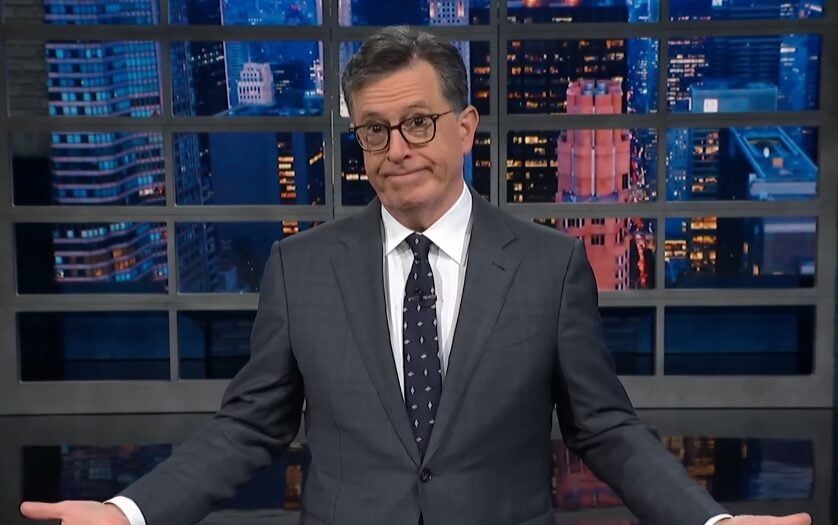
On Monday night, The Late Show host Stephen Colbert congratulated Texas House representative and U.S. Senate hopeful James Talarico on becoming the first guest in his 11-year tenure to appear only on YouTube. The strange accolade was bestowed after lawyers for CBS barred The Late Show from airing Colbert’s interview with the candidate, citing threats from the Federal Communications Commission under Donald Trump.
“He was supposed to be here, but we were told in no uncertain terms by our network’s lawyers — who called us directly — that we could not have him on the broadcast,” Colbert said in his opening monologue. “Then I was told in some uncertain terms that not only could I not have him on, I could not mention me not having him on. And because my network clearly doesn’t want us to talk about this, let’s talk about this.”
Since he couldn’t air the interview during his broadcast, Colbert announced that his conversation with Talarico would instead be distributed on the show’s YouTube channel.
Colbert opened his conversation with the progressive Senate candidate by pointing out that this was not the first time Talarico had been targeted by the FCC. Earlier this month, FCC Chair Brendan Carr opened an investigation into ABC’s The View after the long-running panel show hosted Talarico for an interview.
“I think that Donald Trump is worried that we’re about to flip Texas,” Talarico told Colbert in response to a quip about why he was causing “so much trouble” with the FCC.
While Talarico is running a long-shot bid to steal a Texas Senate seat from Republicans — a feat that hasn’t been accomplished by a Democrat in more than three decades — his prospects are relatively promising. Republicans are facing a wave of backlash from their own supporters, with the president eroding support among key demographics that swung the 2024 election in his favor. The time may be ripe for Texas Democrats to finally retake a statewide office.
“This is the party that ran against cancel culture,” Talarico told Colbert. “Now they’re trying to control what we watch, what we say, what we read. And this is the most dangerous kind of culture, the kind that comes from the top.”
Love Music?
Get your daily dose of everything happening in Australian/New Zealand music and globally.

In his opening monologue explaining why they couldn’t air the interview, Colbert reminded viewers that the FCC has begun cracking down on liberal-leaning broadcasters under the guise of enforcing the “equal time” rule. The so-called equal-time rule, found in Section 315 of the Communications Act of 1934, requires broadcast and radio stations to offer “equal opportunities” to certified candidates in an election. There are notable exceptions to the rule, including talk shows like The Late Show, as well as documentaries, on-the-spot interviews, and scheduled newscasts. Under Carr, the FCC has moved to strip those protections from liberal-leaning broadcast outlets, while exempting other broadcasts like right-wing talk radio.
FCC Commissioner Anna M. Gomez pushed back on the censorship in a statement released on social media. “This is yet another troubling example of corporate capitulation in the face of this Administration’s broader campaign to censor and control speech,” she wrote. “The FCC has no lawful authority to pressure broadcasters for political purposes or to create a climate that chills free expression. CBS is fully protected under the First Amendment to determine what interviews it airs, which makes its decision to yield to political pressure all the more disappointing.”
Gomez added that it’s “no secret that Paramount, CBS’s parent company, has regulatory matters before the government, but corporate interests cannot justify retreating from airing newsworthy content,” and urged broadcasters and their parent companies “to stand firm against these unlawful pressures and continue exercising their constitutional right to speak freely and without government interference.”
Colbert addressed the administration’s censorship efforts while speaking with Talarico. “Donald Trump’s administration wants to silence anyone who says anything bad about Trump on TV, because all Trump does is watch TV,” Colbert said. “It’s no surprise that two of the people most affected by this threat are me and my friend Jimmy Kimmel.”
Talarico agreed, noting the administration’s crackdowns on First Amendment freedoms — both within and outside of broadcast television — and adding that “across the state, there is a backlash growing to the extremism, and the corruption in our politics.”
Early voting for the Democratic primary in Texas is set to begin Feb. 17, the morning after the interview was posted to YouTube. If the Trump administration and FCC intended to draw attention away from Talarico in his battle with Rep. Jasmine Crockett (D-Texas) for the nomination, the ploy may have backfired spectacularly. According to Google Trends, searches for Talarico’s name spiked on Feb. 16, when Colbert’s monologue aired.
As of noon on Tuesday, the interview has more than a million views on YouTube, and has gone viral on various social media platforms.
As one YouTube user put it: “The FCC not wanting me to watch this made me want to watch this.”
From Rolling Stone US

