




























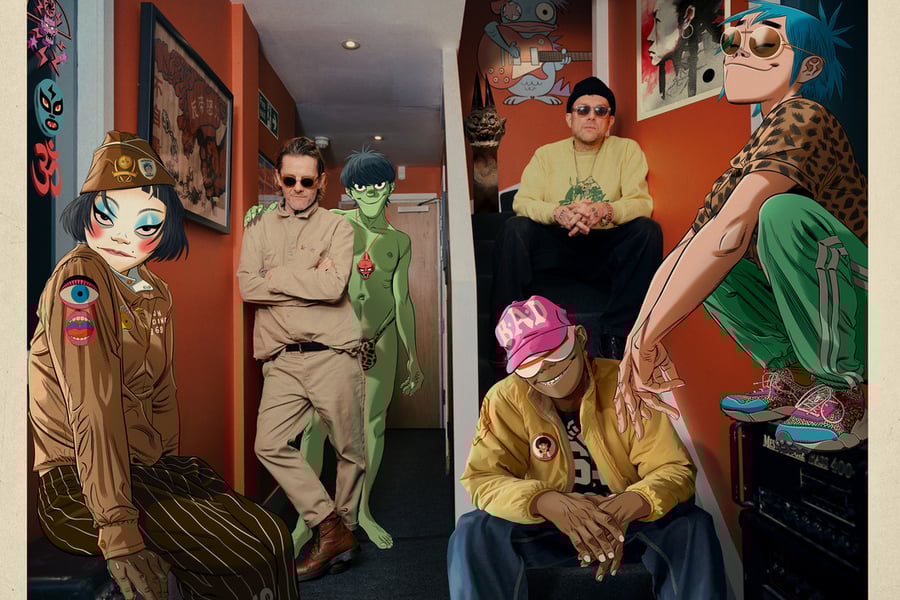
The first voice you hear on Gorillaz’s ninth studio album, The Mountain, belongs to Dennis Hopper, talking softly over a buoyant rush of Indian instrumentation. Close listeners will recognize the late actor’s vocals as an outtake from the long-running cartoon band’s 2005 masterpiece, Demon Days. “I just thought, if we’re going to talk about the subject of death, I need some people who are dead to help me talk about it,” says Damon Albarn, sitting beside visual collaborator Jamie Hewlett on a Zoom call from southwest England. “Somehow they know more about it than me.”
They made this album in the wake of some major personal losses and a pivotal trip to India that filled them with new ideas for animated characters Russel (drums), Murdoc (bass), Noodle (guitar), and 2-D (vocals). As they went through their vaults, the track list grew to include an remarkable array of posthumous contributors — Afrobeat icon Tony Allen, soul great Bobby Womack, rap trendsetter Dave Jolicoeur of De La Soul, post-punk barker Mark E. Smith of the Fall, and more — taking their place alongside living legends like 92-year-old playback singer Asha Bhosle, 23-year-old Argentinean rapper Trueno, and the Roots’ Black Thought.
In the end, The Mountain stands as the most rewarding and substantive Gorillaz album in more than a decade. “It’s kind of the next one after Plastic Beach, really,” Albarn says, referencing the acclaimed 2010 release that brought together Lou Reed, Snoop Dogg, and half of the Clash. “It’s an entire world itself.”
Later this month, on Feb. 22 and 23, they’ll bring that world to life at a pair of special shows at the Hollywood Palladium, performing The Mountain in full. Just a few days later, on Feb. 26, they’ll bring their immersive House of Kong exhibition to L.A. after a successful London run. (They hint that there may be more U.S. Gorillaz shows coming this fall.) Albarn is also composing a score and songs for Artificial, director Luca Guadagnino’s upcoming comedy-drama film about the rise of AI technology. “I get to put music under Elon Musk,” he says, before humming the Imperial March theme from Star Wars and laughing.
It’s shaping up to be a busy year for a group that recently celebrated its 25th anniversary, but Albarn and Hewlett sound energized as they stay on the line for a wide-ranging conversation about music, grief, cross-cultural collaboration, and much more.
Why do you think this album turned out so cohesively?
Albarn: It’s because we spent more time [together]. Jamie, after Plastic Beach, changed his life quite dramatically and moved to France, and that was quite a cataclysm in our relationship at the time. But we managed to completely find each other again. And I suppose going to India was the pinnacle of that: Jamie and Damon, Part Two. Reconciliation and the renewing of the vows.
Hewlett: We found ourselves on a very similar page. Damon’s father passed away, and my father passed away 10 days later. We were like, “OK, the themes of this record are starting to present themselves to us quite clearly.”
Love Music?
Get your daily dose of everything happening in Australian/New Zealand music and globally.

Damon, you’d never been to India before, right?
Albarn: No. It’s interesting, being English, going there. I mean, aside from all the colonial history, someone like me grew up in a terraced house in East London next to an Indian family. It’s very much part of being English, is Indian culture, whether it be Hindu, Muslim, or Sikh. I definitely was listening to Ravi Shankar more than the Beatles when I was a kid.
What was it like to be there while you were grieving? Did you find it inspiring?
Hewlett: Just visiting [the ancient city of] Varanasi was quite an experience, seeing the funeral pyres. Damon swam in the Ganges.
Albarn: You don’t forget that in a hurry. It’s a beautiful thing, because you’re immediately immersed in thousands of years of spiritual activity and ritual and sunrise and sunset. You just sort of allow it to wash over you, and maybe some of it infuses and then some of it haunts you.
When did you come up with the idea of including all these voices of people we’ve lost?
Albarn: In the original piece of paper, the original Gorillaz Manifesto written in 1999 by Jamie and I when we were sharing a flat, the character of Russel was able to bring forth the voices of dead musicians.
Hewlett: Great idea. It took 25 years to actually use it.
You recently performed the first three Gorillaz albums live in London. Did you enjoy looking back on those projects?
Albarn: I don’t get any pleasure out of looking back on anything.
Hewlett: We’re very much about what’s next. What’s next is exciting.
Albarn: I feel like if people start telling you how great you were, there’s something terribly missing in your life. Do you know what I mean?
Hewlett: Yeah. And if you’re living off something you did 25 years ago because you haven’t done anything new, then that’s a shame.
Did you learn anything new about those early Gorillaz projects when you performed them, though?
Albarn: They didn’t have any lyrics! The songs on the first album, the lyrics that they had were just weird. And even the weird stuff makes sense now. That shows you how mad the world is now. “Hey, we’re going to have a character who has dead people come out of his head, and the record’s not going to mean anything.”
Hewlett: That’s not even a crazy idea these days. But 25 years ago, that was pretty crazy.
Albarn: I dressed up as a priest for Demon Days. I really enjoyed that.
Hewlett: He was supposed to be Father Merrin from The Exorcist. I thought that would be a good look for Damon.
Albarn: I loved it. I would do it every night, to be honest with you.
Speaking of cartoon bands, have either of you seen KPop Demon Hunters?
Hewlett: I am going to watch it. My oldest son keeps telling me, “You’ve got to watch it, Dad.” Even if he’s 30, he likes animation.
Albarn: I thought you had to have kids to watch that. I don’t think you can watch that on your own. It’s too weird.
But it’s funny, isn’t it? You guys had this out-there idea of a cartoon band all those years ago, and now that’s the biggest thing in the world.
Albarn: [Laughs dryly.] Between that and the fucking ABBA hologram show, there’s really nothing left of our ideas. All have been taken and monetized in an extreme way.
Hewlett: I think that the fact that we are an animated band has helped just a little bit. Young people go, “What’s that? I love that animation. Let me check it out.” Then they hear the music and they go, “Oh, my God, I love it.” And then it brings a new audience.
And the characters never really age, do they? Noodle started as a kid and became an adult, but since then, they’re eternal.
Hewlett: Well, we don’t know what’s going to happen next. I’m working on something.
Albarn: They need to become cubist.
Hewlett: Oh, that would be great. Wow.
Albarn: Murdoc becomes a green rectangle [laughs].
What do you both think about the use of AI in art?
Hewlett: Well, for me personally, I wouldn’t use it in my work. But at the same time, AI, if you’re using it in the art world, is a tool. Just like when Photoshop arrived on the scene. It’s what do you do with it really that matters.
Albarn: I don’t know how to use it, so I don’t have that problem.
Hewlett: I’ve seen artists who use it really well. But there’s a lot of people who know how to tap in a command into a computer and get a picture out of it, and they consider themselves to be artists, which is a little bit far-fetched for me.… Part of the reason you fall in love with an artist’s work is because it’s their work. It’s their vision, their story, and a computer’s just harvesting the information from the entire world. So it’s not the same thing, is it? You can’t fall in love with it. It’s not like looking at a Van Gogh painting or a David Hockney and being reduced to tears.
Albarn: I think it’s too soon to say whether we can fall in love with it. It’s like Mao, when he was asked about the French Revolution, he said, “It’s too soon to tell.”
Damon, is it true that you don’t even own a phone?
Albarn: That’s right. It’s easy. You just lose it one day and don’t get another one.
What about streaming? Do you listen to music that way?
Albarn: I’ve never streamed anything in my life.
Looking at the bigger picture, you’ve both been eloquent voices for cross-cultural understanding over the years. Do you think the world is heading in the right direction these days?
Hewlett: We’ve been lucky that we’ve traveled a lot, so we’ve seen the world and we’ve had the experience of other cultures, and we’ve benefited from it hugely. You grow as a human being by accepting other people’s beliefs and cultures…. I guess the answer is we’re a bit concerned, but trying to be positive about it. Especially on this new album, the experience of working with many cultures coming together to make a beautiful record — it wouldn’t be as beautiful if it was just a couple of English guys with their mates.
That’s always been an important part of Gorillaz, bringing together different points of view, hasn’t it?
Albarn: It’s the essence of it, really. I mean, for me, when I shifted worlds from Blur to Gorillaz, which was quite a dramatic gear change … that was everything about it. It had to have that community, because we’re obscured by the cartoons. The only way there could be a real sense of a human interaction was with the people we work with.
All these years later, Blur can play huge shows in Europe, but Gorillaz is still much more known here in the U.S. How do you feel about that these days?
Albarn: We did feel at Coachella, when we came over with Blur [in 2024], that maybe it was a slight mismatch, us being at that festival. It’s kind of the embodiment of social media now, isn’t it?
Hewlett: It’s the only festival where the phones aren’t pointed at the stage, but at the person holding the phone.
Do you think Blur will ever play the U.S. again? It’s been a long time since the show you played at Madison Square Garden in 2015, which was incredible.
Albarn: Something like that’s more possible, yeah. The only problem with bloody playing Madison Square Garden, and I’ve done it a few times, is that there’s all these banners for flipping … what’s his name?
Billy Joel?
Albarn: Billy Joel. Any sense of achievement is just so deflated. I can’t bear it.
From Rolling Stone US

