



























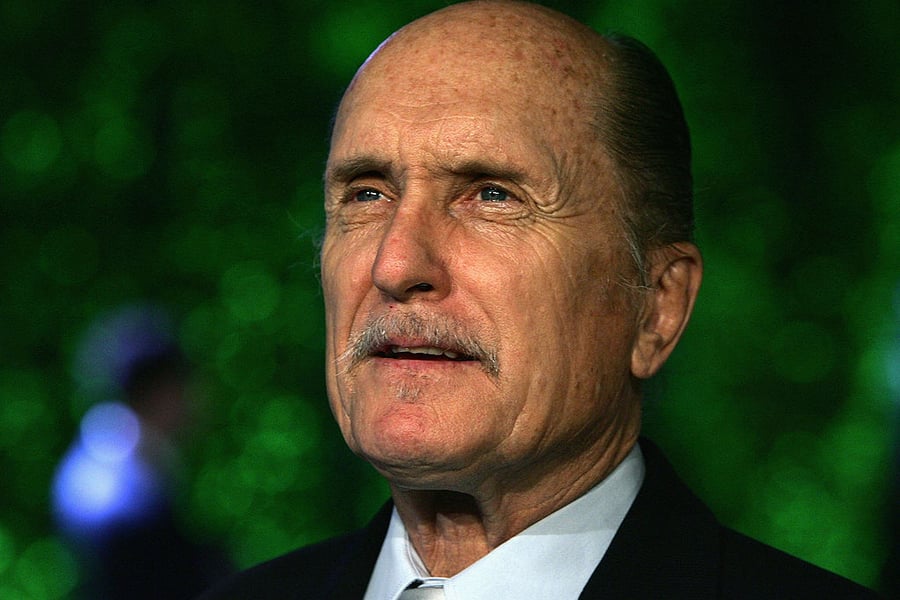
Robert Duvall, the legendary character actor who specialized in playing rugged, complicated men, died on Sunday. He was 95.
Duvall’s wife, Luciana, confirmed the actor’s death in a note shared on Duvall’s official Facebook page, writing that Duvall “passed away peacefully at home, surrounded by love and comfort.” A cause of death was not given.
“To the world, he was an Academy Award-winning actor, a director, a storyteller,” Luciana wrote. “To me, he was simply everything. His passion for his craft was matched only by his deep love for characters, a great meal, and holding court. For each of his many roles, Bob gave everything to his characters and to the truth of the human spirit they represented. In doing so, he leaves something lasting and unforgettable to us all. Thank you for the years of support you showed Bob and for giving us this time and privacy to celebrate the memories he leaves behind.”
In a film career that began in the early 1960s, Duvall was a central figure in the New Hollywood of the 1970s, adding grit and soul to legendary works from directors such as George Lucas, Robert Altman, and, most notably, Francis Ford Coppola. An Oscar winner who also proved to be a fine director in his own right — he earned an Academy Award nomination for his lead performance in his superb 1997 drama The Apostle — he lent a steadying presence to movies, proving to be a warm, paternalistic onscreen figure as he grew older. But Duvall was also no-nonsense, refusing to suffer fools and committed to his craft, even if it sometimes caused him to clash with filmmakers. “Directors say actors are difficult to work with — well, what about directors?” he once asked in an Interview profile. “It’s our face that goes up there; it’s only their name.”
Robert Selden Duvall was born Jan. 5, 1931, raised by a father in the Navy. “We moved a lot because of being in a military family,” he recalled of his childhood. “We lived in San Diego and then Annapolis, Maryland, at the Naval Academy. I remember seeing a movie when I was really young at Camp Pendleton for a dime back in the 1930s, when we lived in Mission Hills in San Diego.” After serving in the Army himself, he studied acting in New York, befriending contemporaries such as Dustin Hoffman and Gene Hackman. “The feeling was that Bobby was the new Brando,” Hoffman later told Vanity Fair. “I felt he was the one, and probably I wasn’t.”
After several years in theater, Duvall got his film break when he was cast as the kindly, misunderstood outsider Boo Radley in the Oscar-winning 1962 adaptation of To Kill a Mockingbird. (Horton Foote, who wrote the screenplay based on Harper Lee’s novel, and his wife had seen Duvall in a stage production about a year earlier; when casting for the film was underway, they suggested the relative unknown.) From there, he continued collecting supporting parts, including in 1969’s The Rain People, a film from a young director named Francis Ford Coppola.
But Duvall rose to prominence the next decade, first as the ornery Major Frank Burns in the 1970 antiwar comedy M*A*S*H, reuniting with Robert Altman, who’d previously cast him in 1967’s Countdown. A year later, he was the imperiled everyman in George Lucas’ minimalist dystopian sci-fi drama THX 1138, following it up with The Godfather, where he got to work opposite his hero, Marlon Brando. They’d previously been in the Arthur Penn drama The Chase together, but The Godfather allowed Duvall a chance to spend more time around the venerated actor. His co-star James Caan would “crack a joke and it’d take Brando three seconds to get it,” Duvall recalled in a 2021 interview on NPR. “He was like the godfather of actors. Dustin Hoffman, me, and Gene Hackman used to go to Cromwell’s Drugstore a couple of times a week in New York City. And if we mentioned Marlon once, we mentioned him 25 times.”
Love Music?
Get your daily dose of everything happening in Australian/New Zealand music and globally.

Duvall possessed a Brando-like intensity in the Seventies, whether as the coldly strategic Tom Hagen in the Godfather pictures or as Frank Hackett, the soulless, hotheaded executive in Sidney Lumet’s bruising satire Network. He could have played the lead in Jaws, but he resisted. “I wanted to play the other part, the one that the guy from England played, Robert Shaw, but I was too young,” he admitted in Interview, later adding, “But I don’t feel bad that I turned down the part or the lead, ‘cause I like more character parts.”
He received his first Oscar nomination for The Godfather, landing his second for playing Kilgore, the surfing and enthusiast and napalm-loving lieutenant colonel in Apocalypse Now. The character was meant to be a critique of America’s hawkish behavior in Vietnam, but Duvall the military veteran wanted to be sure he got it right. “The part was overwritten,” he told NPR. “It was a guy who was like a cowboy with boots. And it was a caricature. … So I got with a guy who had been in Vietnam and he told me how to shape it with the Air Cavalry, because I had been in the service in the Army and I knew what special service officers were like. We went from there and formed that.”
Not that Duvall was shy about illustrating the dark side of military service: He earned his first Best Actor Oscar nomination for his role as the abusive, tortured fighter pilot who can’t adjust to life away from active duty in The Great Santini. He’d win the Academy Award three years later as Mac Sledge, a drunken, used-up country singer looking for a second chance in Tender Mercies. It was a reunion between him and Foote, whose original screenplay also won the Oscar, and the film found Duvall essaying one of his most delicate turns, playing a difficult man getting in touch with the vulnerability underneath. But Duvall was never one to court sentimentality in his performances. In a 1991 interview, he noted, “Whenever you see documentaries, people are always trying to put a lid on their emotions, going against what’s there. That’s much more interesting. When you go against it, then the colors will come out. It’s a discipline. If you don’t cry you’ll be rewarded, something else will come out, something nice.”
Over the next few decades, he cemented his status as the consummate character actor, adding integrity and weathered grace to films like The Natural and Days of Thunder. He played father figures, curmudgeonly editors-in-chief, various law enforcement officers. No matter the role, that toughness was always there, a desire to push against the artificiality of acting to get at something true and lived-in within his characters. Duvall directed four films, the best of the group being The Apostle, a film about faith and redemption which he also wrote and financed. He cast himself as Sonny, a violent Pentecostal preacher who, after putting his wife’s lover in a coma, skips town to restart his life in a new community. It’s one of the most searing, nuanced performances he ever delivered, demonstrating the paucity of adventurous, idiosyncratic roles for serious actors in Hollywood after the heyday of the 1970s.
“An actor always looks for challenges, and this was a wonderful challenge, something I felt I could do,” Duvall said in 1997 about The Apostle. “I’m not saying other actors couldn’t, but I felt I had a bead on this guy. It was very challenging in a titillating, alive way. I wanted to see if I could recreate the rhythms, the temperament, the whole makeup and aura of the guy. … I didn’t wanna come up with an indictment or a critique of these people — I wanted something from their point of view.”
Duvall was honored with two more Oscar nominations in his career — as a lawyer representing a company polluting the environment in A Civil Action and an aging judge in The Judge — but he was just as celebrated for being a champion of younger talents, co-starring in Billy Bob Thornton’s breakthrough indie Sling Blade. A new generation of filmmakers like James Gray and Steve McQueen cast him, relishing his connection to a halcyon period in American acting. And although peers such as Hackman eventually decided to hang it up, Duvall steadily kept working. Even so, he knew the day would come when he, too, would have to leave acting behind.
“I don’t know what there is left,” he told GQ in 2014. “There’ll be a few left, I don’t know. If they keep sending me stuff that’s worthwhile. Then, eventually that’ll peter out. So retirement will be coming. A part of evolution, natural for you. It’ll peter out.”
Alongside his Oscars, he collected one Emmy, a BAFTA, and three Independent Spirit Awards. His starring role in the 1989 Western miniseries Lonesome Dove is as beloved as any of his many hallowed film roles. He never stopped being opinionated, like when he declared that Stanley Kubrick’s pictures contained “the worst performances I’ve ever seen in movies” in a 2010 Hollywood Reporter roundtable. And he famously refused to appear in The Godfather: Part III because he claimed his old buddy Coppola was lowballing him. (“There are two or three other actors in that film being paid more than I was offered,” he told the Los Angles Times at the time. “That just isn’t right. You know how cheap they are.”)
But that blunt honesty fed into the terse poetry of his acting, accentuating the sense that his characters were utterly authentic, saying what they felt and unwilling to bend in their beliefs. Duvall was never anything less than entirely genuine, never believed that he transformed himself for his roles. He was him.
“It’s like play-acting,” he once said of his profession on NPR’s Fresh Air. “Kids play house, right? … We play house as grown-ups. We get paid good money to play house. So it’s a game, really. … You become the character, but it’s really you turning yourself in a certain way, as if you’ve become the character. But you cannot lose sight of who and what you are. You have one set of emotions, one psyche, one soul, and you don’t become another thing. It’s all those things turned to what seems to be something different.”
From Rolling Stone US

