





























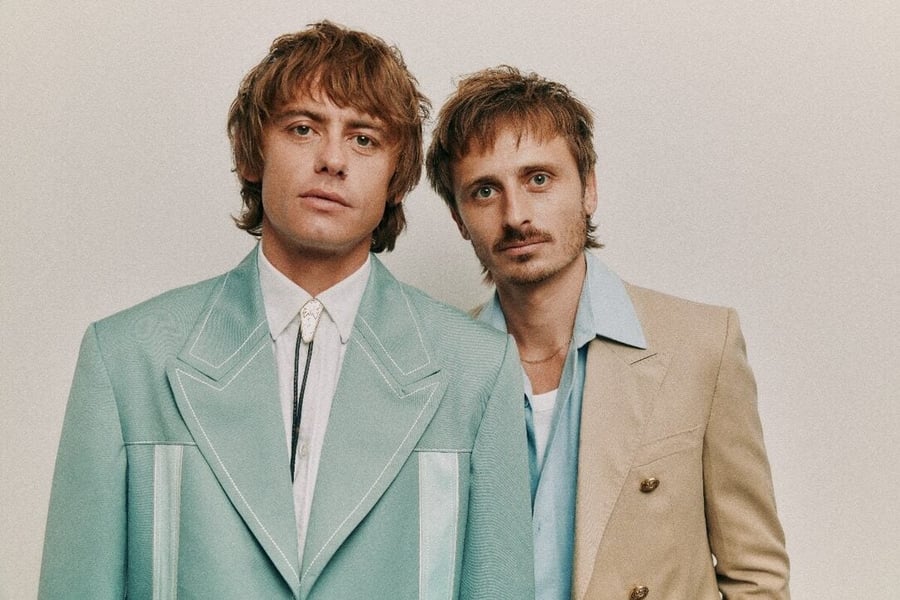
After years of touring, inevitably leaving behind a trail of flights, waste, and fumes, Lime Cordiale’s Oli Leimbach found himself asking a question that would weigh on any climate-conscious musician: “How can we keep doing this and still call ourselves environmentalists?”
The answer? Reinventing how they share their music with the world. The Aussie mainstays are attempting to rewrite the rules, in a culture where festivals often leave more trash than memories.
Their new festival, Lime Green, is going off-grid, powering itself on renewable energy, and challenging the idea that fun and sustainability can’t coexist. For Leimbach, it’s time to show that the music industry can – and must – change.
His environmentalism started quietly as a personal commitment a number of years ago. On his small farm in New South Wales, where he joins me on Zoom from, he’s been experimenting with regenerative agriculture. Having a go at a more holistic farming practice that avoids chemicals, limits diesel use, and reduces soil disruption has been healing, he tells me, but in a post-Covid era, when he and brother Louis returned to the road, all that effort seemed to unravel.
“We were making up for lost time on the road, trying to play as many shows as we could, and, oh my God, I felt like such a hypocrite,” he laughs. “I spent all this time with a more holistic farming practice, then started flying around the world and driving around on diesel buses again. We thought, if we are going to try and call ourselves environmentalists, should we not be doing this?”
View this post on InstagramLove Music?
Get your daily dose of everything happening in Australian/New Zealand music and globally.

The question haunted them for quite some time, so much so, it demanded action before Lime Cordiale shows potentially ceased to exist. So the band began documenting their tours, speaking with environmental experts, and exploring ways to reduce their footprint without abandoning live music.
From biodiesel-powered tour buses in Europe to venues running entirely on green energy, the brothers began to learn what was possible. “Even taking esky-sized batteries to power shows was a huge step,” Leimbach says. “People were nervous, like, ‘Will the gear blow up?’ But it worked perfectly. It showed us that there are alternatives. You just have to try.”
The lessons they learned have culminated in Lime Green. The festival, set for Adelaide in April, is designed to demonstrate that a large-scale, multi-artist event can operate sustainably without compromising the live music experience. From composting stations, bamboo cutlery, and reusable beer cups, to energy-conscious stage lighting, they hope it will subtly encourage festivalgoers – and festival promoters alike – to respect the environment, turning green practices into the norm, rather than an afterthought.
Adelaide became Lime Green’s natural home, Leimbach says, because of its progressive approach to renewable energy and environmental policy. “The majority of Adelaide is run on renewables,” he points out to me, as I admit I hadn’t realised how advanced the city already is. “They’ve led the way on banning single-use plastics and adopting green practices.
“Plus, in Adelaide, they’re so scarily passionate – we knew we had to do it here or they’d get angry,” he jokes.
View this post on Instagram
The event itself is, without sugarcoating it, an enormous challenge. Festivals are notoriously difficult to run, and going off-grid adds another layer of complexity. “When you’re putting one together, you can see why so many of them die. It’s so hectic putting on a festival, financially,” he says, when I ask what the biggest barriers have been.
Add budget constraints, technological hurdles, and industry skepticism, and it has certainly been a steep learning curve for the Lime Cordiale boys. The devil is in the details, Leimbach tells me, pointing out that something as seemingly insignificant as different coloured stage lights can make a difference. “Blue uses more energy than red. So, you know, don’t question it too much if everyone’s sets are super red,” he laughs. “That’s a compromise we have to, and want to, take. It’s part of the fun.”
The fun. The experimentation. That’s what it’s all about, I gather from our conversation. He confirms this, adding that they’re not trying to be perfect the first time: “The point is progress, not perfection.”
Despite the challenges, the rewards are clear – Lime Cordiale get to do what they love, and do it with a clearer conscience. They’re creating a model that Leimbach hopes other festivals will follow, and showing that sustainability can be baked into the live music experience from the ground up.
Leimbach says the experience has shifted the band’s perspective on their career, particularly as ongoing environmental concerns led them to reconsider the role touring plays in their future. He admits that sometimes, he questions why he does it when he could be in the studio writing instead. But ultimately, he comes back to the same conclusion: this, too, is something he loves.
For festival and ticket information, see here.
LIME GREEN FESTIVAL 2026
Saturday, April 18th
Adelaide Uni Cloisters, Adelaide SA
Lineup
Lime Cordiale
The Dreggs
Aleksiah
PASH
+ triple j Unearthed surprise guest

