





























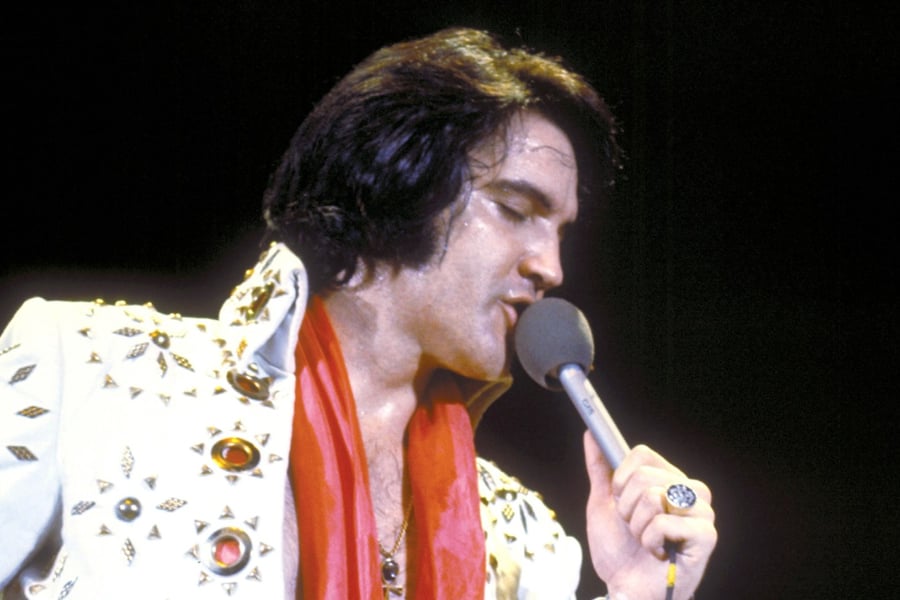
For 50 years, the Holy Grail of Elvis Presley footage — 10 professionally shot concerts from the early Seventies — sat deep in a Kansas salt mine, completely inaccessible to the public. To the hardcore Elvis-fan community, its existence was little more than myth. But when Baz Luhrmann inked a deal to direct the 2022 biopic Elvis, starring Austin Butler and Tom Hanks, he insisted that Warner Bros. excavate all 59 hours of film, which the studio owns, to see if it might spark ideas for his movie.
What Luhrmann saw left him gobsmacked. This wasn’t just Elvis at his peak as a live performer, captured from multiple angles often by expert filmmakers, but also fly-on-the-wall backstage footage and candid interviews from the notoriously press-shy music icon. “We couldn’t let this footage go back into the salt mines,” Luhrmann says by Zoom as he wanders the streets of Tokyo. “Right away, I knew we had to do something with it.”
What he didn’t want was a traditional documentary that told the story of Presley’s touring years in chronological order with title cards and talking-head interviews. He instead envisioned something more daring, which he calls a “tone poem.” As Luhrmann explains, “It’s as if Elvis comes to you in a dream and tells his story, and he sings it.”
The result, EPiC: Elvis Presley in Concert, which opens in IMAX Feb. 20 and theaters nationwide Feb. 27, is a feat of filmmaking. Despite its longtime storage in the salt mine, which helps to protect film from the damaging effects of moisture, making the footage screen-worthy presented enormous technological and financial hurdles. The journey started when Luhrmann and editor Jonathan Redmond began combing through boxes of film reels that were originally shot for the 1970 documentary Elvis: That’s the Way It Is and the 1972 concert film Elvis on Tour. “When we got it into the cutting room at Warner’s, there was this vinegar smell,” Luhrmann says. “That’s the smell of film degenerating. And it was so smelly we knew it was on the brink of crumbling.”
It looked spectacular once a very delicate digital transfer was complete, but much of the concert footage was silent. Fortunately, RCA had multitrack tapes of every show, and the filmmakers were able to painstakingly sync them up. Then, during the hunt for additional audio, they came across a previously undiscovered 45-minute interview with Presley, conducted by the Elvis on Tour directing team in 1972, with the camera off. “You can tell he’s very tired and vulnerable,” says Luhrmann. “But he’s talking, really unguarded, about his life.”
That gave them the idea to let Elvis narrate the film, using that interview along with select bits of recorded conversation from throughout his life. “It’s always been about other people telling you their story of Elvis,” says Luhrmann. “Anyone who pumped gas into Elvis’ car and looked him in the eye wrote a book about it. This is his side of the story.”
In EPiC, that story begins with a transcendent segment of the medley “An American Trilogy” from 1972. Then the film ricochets through a collage of 1950s TV performances and early concerts captured by fans in the audience. Next is a glimpse of some of the B movies the King shot in the 1960s during a period of career decline, including one in which he sings to a guy in a dog costume. “Hollywood’s image of me was wrong. I knew it, and I couldn’t say anything about it,” we hear Presley say in a moment of unexpected candor. “It was nobody’s fault except maybe my own, but I was attached to things I didn’t fully believe in.”
Love Music?
Get your daily dose of everything happening in Australian/New Zealand music and globally.

EPiC bounces between shows in 1970 and 1972, highlighting stunning performances of songs like “Bridge Over Troubled Water,” “Suspicious Minds,” “In the Ghetto,” “Burning Love,” and “How Great Thou Art.” Redmond was initially worried about “jumping through time and space and aspect ratios and formats. It’s Super 8 one shot. Then it’s 35mm anamorphic the next shot, then it’s 16mm 4:3.” But they went with their guts. “We didn’t want a linear flow,” he says.
In order to make the footage really pop, they handed it over to director Peter Jackson’s team in New Zealand, the same crew responsible for the acclaimed 2021 documentary The Beatles: Get Back. “They set the gold standard for film restoration — cleaning it up, degrading it, removing all the dust,” says Redmond. “But not losing anything as well, because you can go too far with film restoration and it starts to look plastic. These people are masters at making film look like film, but better and cleaner. What they did was the icing on the cake.”
Luhrmann and Redmond did have access to concerts shot after 1972, including Presley’s 1977 concert special. But the footage is difficult to watch due to Presley’s perilous physical state in the weeks before his death. “Elvis’ body is corrupted in 1977,” notes Luhrmann, though he adds that the King’s “spirit and voice actually soars.” The director ran a famous performance of “Unchained Melody” from this same period at the end of his 2022 biopic, and was reluctant to return to that well. “We didn’t want to repeat ourselves,” he adds, “and we didn’t want to show him at the definitive end.”
The movie concludes by noting that Elvis performed more than 1,100 concerts between 1969 and 1977, sometimes playing three a day. “He flew so close to the sun,” says Luhrmann. “And then he’s trapped, to quote the song [“Suspicious Minds”]. He’s caught in a trap, and he can’t get out. He doesn’t quite know why, but the only thing that sustains him as he keeps going round and round and round on this circuit in America is that the only love he can get is across the footlights. He became addicted to performing.”
Luhrmann is currently deep into preproduction on a Joan of Arc movie, but he’s not quite ready to let go of Elvis. A 1972 concert at the Hampton Coliseum in Hampton Roads, Virginia, was found in the vault that’s never been seen in full. He’s batting around the idea of maybe one day turning it into its own film.
What keeps him going is the knowledge that his biopic created a groundswell of interest in Elvis among young people who were only vaguely aware he existed beforehand. “Like all great icons, there comes a point when they just become wallpaper or a Halloween costume,” says Luhrmann. “But Elvis was a human being who was absolutely dirt poor. His parents could not read or write. And then overnight he becomes the most famous 20-year-old on the planet. Nothing like that had ever happened before. And so with this movie, we just wanted to get out of the way and let the audience experience him in the most intimate way possible.”
From Rolling Stone US

