






























This excerpt is part of a new Scene Report on Dunedin. Check out the series here.
The Dunedin Sound: Some Disenchanted Evening is one of the best books on the ‘Dunedin Sound’.
Ian Chapman’s book is primarily pictorial, containing photographs and memorabilia previously unseen by the public such as old gig posters and newspaper clippings.
Chapman also collated essays on 17 bands closely associated with the city’s famous sound, including The Clean, The Chills, and The Verlaines.
In the below excerpt, the latter band’s lead singer and songwriter Graeme Downes reflects on the enduring appeal of bands associated with the Dunedin Sound.
The Dunedin Sound: Some Disenchanted Evening is available to purchase via Relics.
When Ian Chapman invited me to write this foreword to his book I started reflecting on all the recent activity around the subject of Dunedin Sound and Flying Nun. In addition to the publication you are currently holding, Roger Shepherd’s book was recently published, and, meanwhile, I have been writing a book on the subject for fifteen years. I am certain that all of these projects will complement each other given their very different approaches to the topic.
Love Music?
Get your daily dose of everything happening in Australian/New Zealand music and globally.

Through photos and other images the present book might help provide some immediacy as to what it felt like to be there in those times. Roger’s is filled with priceless anecdotes, while mine aims to get to the bottom of the songs themselves, their enduring quality and indeed their greatness.
The Dunedin Sound endures, and many of the original songwriters and musicians are still very active today. For just a few examples, The Chills’ Silver Bullets album of 2015 garnered very favourable press around the world and the band has toured the US and Europe in 2016. Bob Scott and David Kilgour are always producing for themselves or collectively as the Bats or the Clean, while I am mixing a double album and hope to soon get back to orchestrating songs for the second Tally Ho concert in 2017.
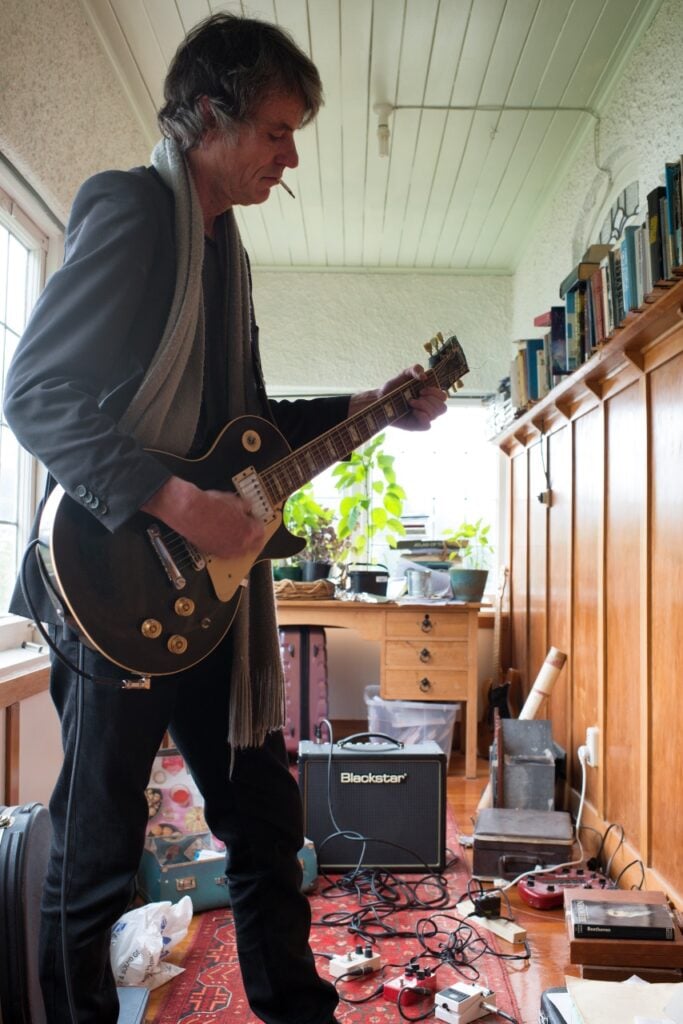
Image: Graeme Downes Credit: Alan Haig
The first Tally Ho concert in 2015 saw classic Dunedin Sound songs being performed by the Dunedin Sinfonia alongside invited guest musicians – including several of the original artists and songwriters — to a capacity audience at the Dunedin Town Hall. A huge success, this event proved that these are remarkable songs; songs that don’t require as a necessity the usual signifiers of jangly, reverbed guitars etc. to communicate, nor even – in some cases – the presence of the original performers.
Those oft-quoted signifiers of the bands’ initial live and recorded performances are the sounds of composers making do with impoverished circumstances. But what these jangly, reverberant sounds point to is usually a desire to make something sonically large, Phil Spector-ish but on the budget of three or four people. And these sounds were injected into a makeshift infrastructure.
Large bars like the Gluepot or the Gladstone were designed to accommodate the “six o’clock swill” at a time when licensing hours were restricted. Rock bands such as my own, The Verlaines, were subsequently let in to fill the void of the altered circumstances. The images in the present book are testament to a bunch of people desperate to create something in any way they could. And that something is pretty darn special.
You could pick a bunch of songs featured in the first Tally Ho concert and say some very basic things about their content and the way they comport themselves towards their audience.
Let’s take “Pink Frost”, “She Speeds”, “Getting Older”, and “Dirge”. To begin with we can group them together and say there is nothing frivolous or in the usual sense “entertaining” about them. They are all serious. “Pink Frost” is like an opera aria in that the events occur in real time within the song’s time frame. The death of the narrator’s lover, the realisation of the singer’s guilt in causing this and the futureless future, we watch/listen as all this dawns on him. One wonders how Martin [Phillipps] considered such a song could even be written let alone become popular and enduring.
The music had to be psychologically telling for it to succeed. And it is. The introduction, in its three sections, takes us from carefree daylight, through a penumbra to the heart of the darkness. This darkening is achieved by musical means alone and in that it has a symphonic dimension.
Or take “She Speeds” where the tremolando cello then the angular guitar lines over a static bass tell you everything before a word is uttered or sung — a Gordian knot of fixation, desire and frustration. Like “Pink Frost” it is dramatic, the events unfold in real time before us. Then there is the second verse, not quite the same as the first. In both you hear a freedom from the constraints of cookie cutter song form.
“Getting Older” is serious in that it confronts the thing we all do periodically — taking stock of where we are going in light of our own mortality. We circle back to a question for which there is no answer other than black humour (“why don’t you do yourself in”). The song’s urgency is its own countermovement to nihilism. Everything in it, musically, comprises circles. From the basic musical idea to the structure, everything is a palindrome.
My own “Dirge” is a song about the death vigil over my grandfather, yet is more universally about being drawn into an inevitable future of absence. The music, as it shifts from minor (the awfulness of what is being presided over) to major (and through the dissonance that ushers in the shift), represents something that has to resolve, and in that resolution lies the statement that there is no future in treading water on the surface of an abysmal ocean, and that letting go is all that there is left to do. Everyone except the very young has been through this acknowledgement process.
Ok, enough effusive, purple prose. I’ve been asked to write a foreword for a book about a slice of music history that I shared in the making of, but one that is largely pictorial. The photos and self-produced gig posters et al within these pages are, at one level, a kind of flotsam and jetsam; visual husks left behind by the music.
However, at a deeper level, such ephemera can be seen to visually represent and offer a deeper understanding into the music they accompanied. The four songs I chose to mention are serious and dark, and not all the songs written by the people you will see and read about in the pages that follow are.
Nevertheless, a unifying depth of compositional quality and artistic intent exists across the many and varied featured acts. There also exists a clearly evident pleasure and excitement in the act of artistic creation, and in these select Dunedin Sound acts this can be seen as much as it can be heard.
If the present volume achieves anything beyond its welcome and overdue documentary purpose, then it might be the insight it gives into the most baffling of all questions: “How the hell did all this happen in a city of one hundred and twenty thousand people sitting at the bottom of the world?” Look and read through the pages that follow, and scratch your head.

