





























The Necks are legends — end of.
When we released a special edition issue in 2020 ranking the 50 Greatest Australian Artists of All Time, the avant-garde jazz trio of course made the cut.
“Their influence on musicians across the musical spectrum has been profound. Their approach to composition and live performance – gently unfurling a piece of improvised music over the course of an hour through incremental changes to each member’s part – has become a template for schooled and unschooled musicians alike when approaching solo or group improvisation,” wrote Dave Williams of Augie March for our series.
“That they themselves are highly skilled musicians who continually make the trippy and complex, the esoteric and weird, accessible and somehow imbue it all with such raw emotion and pathos is further proof of their individual and collective artistry.”
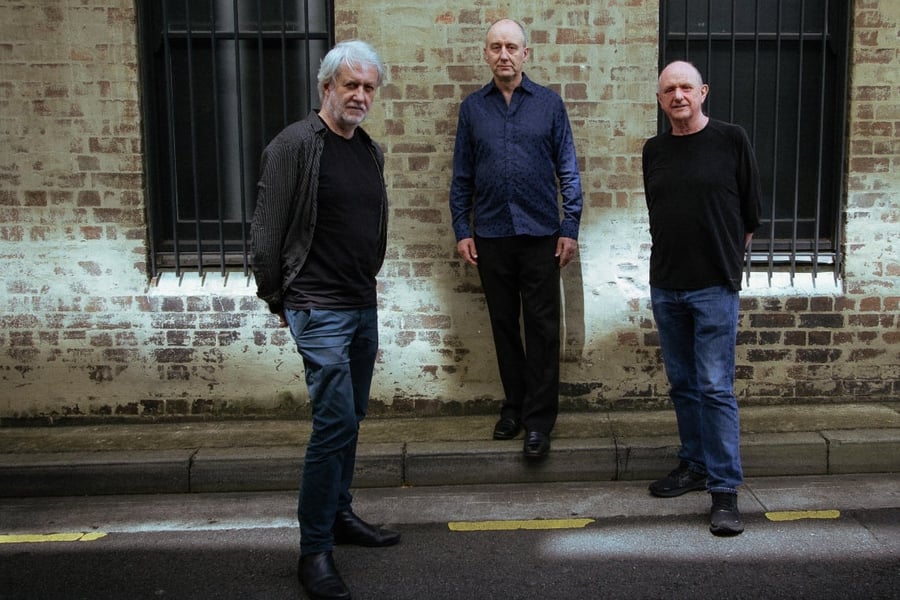
Formed in 1987, Chris Abrahams (piano), Tony Buck (drums), and Lloyd Swanton (bass) have firmly established The Necks as a seminal force in Australia’s improvisational music.
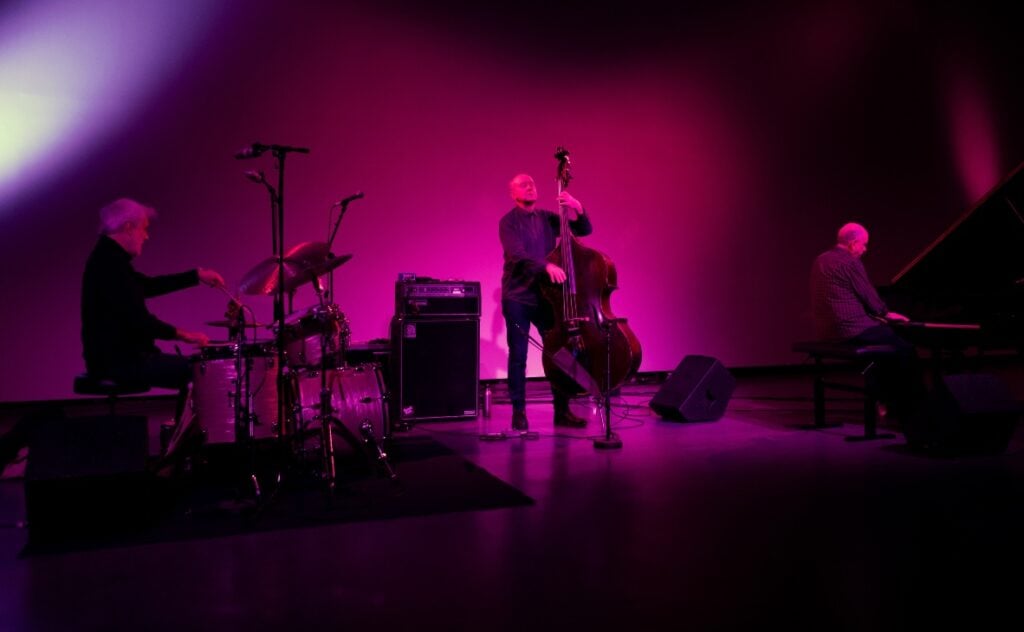
Credit: Nabeeh Samaan
Their live performances are legendary: each show consists of a single extended piece, entirely improvised, unfolding with patient intensity and microscopic focus. At times underpinned by a deep, hypnotic groove, their music evolves in real time, mesmerising, unpredictable, and profoundly transportive.
The Necks have worked with iconic names such as Brian Eno, Underworld, and Swans over the decades; they’ve composed film scores; they’ve earned rave reviews from The New York Times (“This is music that patiently watches the world”) and The Guardian (“Entirely new and entirely now… They produce a post-jazz, post-rock, post-everything sonic experience that has few parallels or rivals”); they’ve won countless awards, including the 2019 Richard Gill Award for Distinguished Services to Australian Music.
Love Music?
Get your daily dose of everything happening in Australian/New Zealand music and globally.

The Necks are still going strong all these years later, with a special show in Sydney now on the horizon.
The trio will take to the stage at City Recital Hall Thursday, February 26th, for what’s sure to be another unforgettable live performance.
Ahead of the show, we caught up with Swanton to find out more about the band and their live sets.
Ticket information for The Necks’ City Recital Hall show can be found here.
Rolling Stone AU/NZ: Improvisation is often a hit or miss creative medium, but it’s safe to say you three are all hits. Looking back to square one, can you recall how you felt as a group when you decided to improvise your music?
Lloyd Swanton: We knew from very early in the piece that we were onto something. We had just got together to try this idea we had, with no expectations of whether it would lead anywhere, and we quickly found that so long as we stayed true to this approach, we were able to generate big vistas of music quite easily.
How do you respond to the misguided conception held by some that you’re merely a jazz band?
I guess grand piano, acoustic bass, and drum kit is a pretty iconic instrumentation, so it’s understandable some people automatically conclude we play jazz. That’s not to deny the presence of jazz as an ongoing influence on our music. The jazz scene is where we first met each other, we all still love that incredible artform, and outside The Necks we all still play it professionally in varying degrees.
Can you give us a glimpse behind the curtain for your unspoken process on stage? Does one of you lead while the others follow? Is there a pre-agreed-upon tempo? Or do you really just lay the tracks in front of the train?
We really do go on stage with absolutely nothing prepared or discussed. The only “rules” are (a) that we wait on stage for one person to start – that gives us a direction. Whether it’s “good” or “bad” doesn’t matter, it’s just a starting point, which is what we need. And (b) that we will take our time, and not force the music to go anywhere that it doesn’t “want” to go.
Does your process differ when recording in the studio versus playing on the stage?
LYes, very much. We decided from the outset that there was no point attempting to replicate our live musicking in the studio. They are such vastly different environments. But in the studio, improvisation is still the foundation of our music; it’s just that instead of a single performance, it might take place over a period of days. Or even months — a big part of the composing process is the mixing and editing, where big artistic decisions are made, and that may be many months after the initial recording session.
Congratulations on the release of Disquiet. Was there anything special you wanted to achieve with it, given it was your 20th full-length project?
No, we were just in the studio having a particularly fruitful time of it, and as a consequence four distinct pieces took shape, and we decided they all complemented each other nicely and deserved to all be on the same release. So we made our first triple CD!
Who inspired you as younger musicians?
Where do you start! The Beatles, of course. John Coltrane. Alice Coltrane. Thelonious Monk. Pharoah Sanders. Miles Davis. Dub reggae. African music. James Brown. For me, as a bassist, Wilbur Ware, Charlie Haden, Steve Davis, Charles Mingus.
Are there any musicians, Australian or otherwise, that you’d love to collaborate with on a future recording or performance?
While we love collaborating and there’ve been some extraordinary experiences — Swans, Underworld, Brian Eno, Food Court, Life After Wartime Live, Radian, A Trio, Ilan Volkov with symphony orchestras, The Long Now and Timeline concerts — we’re always busy doing our own thing and we don’t actively seek them out; rather, we wait for them to come to us.
Obviously, the music will be decided upon in the moment, but what are you excited to bring to the crowd at City Recital Hall?
That Necks “thing”. That realisation that we’re all there — audience and band — in the moment together. That realisation that we may go off on a completely fresh tangent, or that even when we step onto a well-trodden path, there’ll be something unanticipated, and it will be a thing of great beauty.

