




























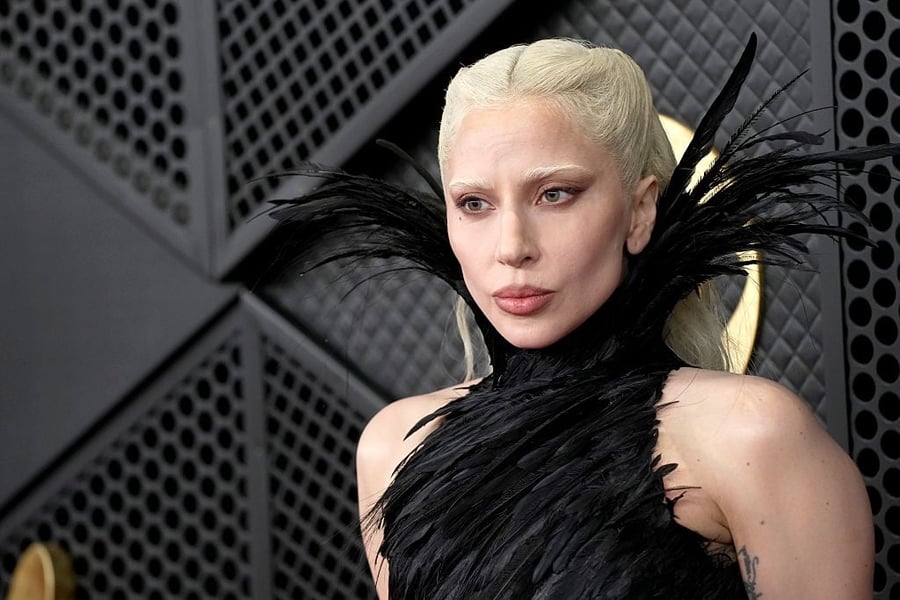
Lady Gaga had so little rehearsal time for her 2026 Grammys performance that she nearly pulled the plug on it, executive producer Ben Winston reveals in the new episode of Rolling Stone Music Now. “There was one point a few weeks before the show that we thought we might have to lose her from the show,” Winston says, “because she just was like, ‘I just don’t see how I can.’”
Gaga was in the middle of her Mayhem Ball tour, playing four shows at the Tokyo Dome — her final performance there was Jan. 30, just one day before the Grammys. She landed back in Los Angeles that morning, less than 36 hours before the live broadcast. “Unlike everybody else who had time to rehearse offsite or with their dancers or band or creative team, she couldn’t,” Winston says. “She was literally onstage.”
(To hear our entire podcast interview with Winston — with behind-the-scenes details on big moments from Justin Bieber to Cher — listen on Apple Podcasts or Spotify, or just press play above.)
Instead of the spectacle she might have mounted under normal circumstances — “a hundred dancers and this big thing,” as Winston puts it — Gaga and her team (including choreographer Parris Goebel, director Ben Dalgleish, and her fiancé Michael Polansky) came up with a minimal, band-focused approach. Mayhem executive producer Andrew Watt handled guitar, co-producer Cirkut played synth, Josh Freese drummed, and Gaga commanded two keyboards, actively tweaking sounds on a modular synthesizer. She led the band through a rock revamp of “Abracadabra,” her face obscured by a huge, freaky wicker headpiece, and the only dancer onstage was Gaga herself. “It was so different, so original, so spectacular,” says Winston.
The performance’s under-headpiece close-ups were achieved via a camera mounted on a pre-programmed robot arm, which Winston believes was a first for a live awards-show performance. It was a risky approach. “Once you press play on that robot, it’s going,” Winston says. “Human error you can fix — if a human does something wrong, you can shout in their ear. Whereas a robot, once you press play, it’s going.”
Love Music?
Get your daily dose of everything happening in Australian/New Zealand music and globally.

When the performance concluded, the production truck erupted. “We were high-fiving and celebrating,” Winston says. “What’s funny is circumstance drives you to a certain creative, but when you nail the creative, if you could go back in time and not have those restrictions, you’d still choose that creative.”
Winston visited Gaga in her dressing room after the broadcast ended. “I had been in my office just decompressing and she was still in her dressing room and we went and we hung out,” he says. “I think she was really proud of that performance, because it was so from her and her team’s genius mind. There’ll be moments in that show that will be played forever. And I think that Gaga one is really up there. It should be noted as special.”
Download and subscribe to Rolling Stone‘s weekly podcast, Rolling Stone Music Now, hosted by Brian Hiatt, on Apple Podcasts or Spotify. Check out nine years’ worth of episodes in the archive, including in-depth interviews with artists including Mariah Carey, Bruce Springsteen, Questlove, Halsey, Missy Elliott, Dua Lipa, Neil Young, Snoop Dogg, Brandi Carlile, Phoebe Bridgers, Yungblud, Rick Ross, Alicia Keys, the National, Brian May, Roger Taylor, Ice Cube, Taylor Hawkins, Willow, Keith Richards, Robert Plant, Killer Mike, Julian Casablancas, Sheryl Crow, Johnny Marr, Scott Weiland, Liam Gallagher, Alice Cooper, Fleetwood Mac, Elvis Costello, John Legend, Donald Fagen, Charlie Puth, Phil Collins, Justin Townes Earle, Stephen Malkmus, Sebastian Bach, Tom Petty, Eddie Van Halen, Kelly Clarkson, Pete Townshend, Bob Seger, the Zombies, and Gary Clark Jr. And look for dozens of episodes featuring genre-spanning discussions, debates, and explainers with Rolling Stone’s critics and reporters.
From Rolling Stone US

